
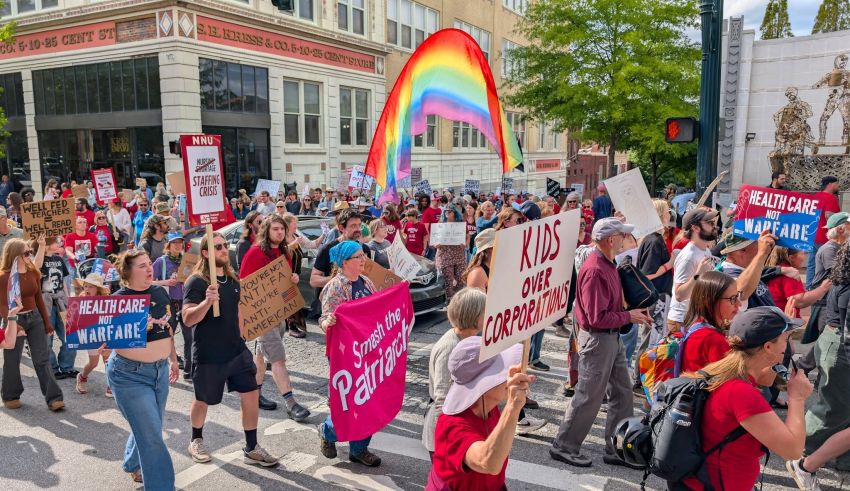
Working people across the United States marched and rallied on May 1 — International Workers’ Day — to protest Donald Trump’s authoritarian regime and its anti-worker, pro-billionaire policies.
May Day Strong, a coalition of 500 activist groups and trade unions, urged people to protest under the banner of “workers over billionaires” and called for an economic blackout through “no school, no work, no shopping”.
May Day Strong said millions of workers, students and families “made their voices heard” in thousands of events across the country, on May 1. Many workers took a “holiday”, and teachers and students left school for a day to join the protests. Thousands of teachers and students marched in Raleigh, North Carolina, to demand better pay for teachers, more school funding and higher corporate taxes.
Sunrise Movement activists blocked a freeway exit near the American Petroleum Institute in Washington DC, demanding lobbyists stop driving climate collapse. Activists also protested outside the New York Stock Exchange, where police arrested several people. Video showed some protesters trying to chain themselves to a railing.
According to the Associated Press, one of the largest protests occurred in Minneapolis, where immigration police are still terrorising the community. Chicago and Los Angeles also had big turnouts in response to Immigration and Customs Enforcement’s (ICE) ongoing raids on Latinx communities.
Prior to the event, most Americans were unaware of the significance of May Day. However, the protests and media coverage have generated renewed public awareness.
Non-unionised workers participating in the protests told journalists they came out “because it was workers’ day”.
May Day’s roots
May Day has its roots in the massive strike wave in the 1880s that erupted across the country in support of an eight-hour working day. It was a pivotal period in US labour history.
As Jonathon Singer wrote in Green Left, “The movement was strongest in Chicago, where 80,000 people took part.
“Chicago employers fought back with lockouts, police harassment and the employment of strike-breakers. On May 4, a peaceful protest meeting was called [in Haymarket]. As it came to a close, the cops ordered the meeting to disperse. A bomb was thrown at the police, probably by an agent provocateur, and police fired into the crowd, killing many.”
Several labour activists — most of them immigrants — were convicted of conspiracy and other charges; four were executed.
In 1889, the socialist movement declared May 1 an international day of action in support of labour rights, in commemoration of the Haymarket martyrs.
Decades later, the trade union officialdom, going along with US and imperialist hostility to the 1917 Russian Revolution and rise of the communist movement, set up a competing holiday in September, known as Labor Day.
Solidarity
This year’s May Day was fuelled by the mass protests against Trump’s attacks on immigrants and ICE and Border Patrol raids in communities across the country.
Trump’s federal masked police force have arrested, detained and deported migrants, permanent residents and people of colour who are US citizens. Protesters have been shot and killed.
These abuses have brought wider working-class and oppressed communities together in actions and local organising across the country.
More than eight million people marched and rallied in 3300 cities and towns across the country, in the March 28 “No Kings” protests.
According to media reports, there was a festive atmosphere at Chicago’s May 1 protest. First Nations dancers and mariachi bands performed and monarch butterfly signs — which have become a symbol of the immigrant rights movement — were a feature.
This was also true in San Francisco, San Jose and Santa Rosa in northern California.
Protesters blocked a road outside the international terminal at San Francisco’s airport, leading to its closure for about two hours, in support of the airport workers’ union picketing over wages and ICE’s presence in airports. Several state and city elected officials were arrested at the protest, according to local media.
According to media reports, New York City Mayor Zohran Mamdani, a self-described democratic socialist, addressed a large crowd at a Manhattan rally organised by unions and immigrant advocates.
He reiterated his promise to raise taxes on the wealthy and “protect our neighbours from the cruelty of ICE”.
While labour and immigrant rights are historically intertwined, May Day rallies in the US shifted their focus to immigration in 2006.
About one million people, including nearly half a million in Chicago alone, took to the streets to protest federal legislation that would have made living in the US without papers a felony.
The Chicago Teachers union declared it a “Day of Civic Action”.
This year’s events in Chicago were multiracial and all-ages protests, with members of public service unions such as the Service Employees International Union (SEIU) participating alongside teachers, nurses and airport workers.
The SEIU and teachers unions were prominent in many cities.
International
In the Philippines’ capital, Manila, where May 1 is a holiday, protesters clashed with police. In France, rallies and street protests in Paris demanded peace in Iran and higher wages, as costs rise.
The European Trade Union Confederation released a statement saying: “Working people refuse to pay the price for Donald Trump’s war in the Middle East … Today’s rallies show working people will not stand by and see their jobs and living standards destroyed.”
In Casablanca, Morocco’s largest city, taxi drivers honked their horns and bus drivers parked their vehicles to protest rising fuel costs.
“All my expenses have gone up, but my wages haven’t budged,” Akherraz Lhachimi, of the Moroccan Labor Union, told AP.
Several rallies were held in South Africa, according to AP, where Zingiswa Losi, head of the Congress of South African Trade Unions, said workers were “suffocating” under rising costs of food, electricity, transportation and healthcare.
Turkish authorities in Istanbul detained protesters for attempting to rally in Taksim Square, the epicentre of the 2013 protests, and where security forces killed 37 people at a 1977 May Day demonstration. The government has violently repressed past attempts to celebrate May Day.
In the May Day protest in Santiago, Chile, police fired water cannons and tear gas into the crowd.
Several thousand people gathered across Portugal as unions rallied together to protest proposed changes to labour laws that make it easier to sack workers and reduce bereavement leave for miscarriage of pregnancy.
Significance
This year’s May Day protests in the US were more significant than the earlier No Kings protests because they brought together more unions and linked anti-government actions with the labour movement.
The May Day protests were more about working-class and multiracial unity, than just opposition to Trump as dictator or king. There were discussions about class exploitation and the need to challenge the capitalist system.
The new unity visible on May Day is important for future united actions against Trump and the billionaire class.