
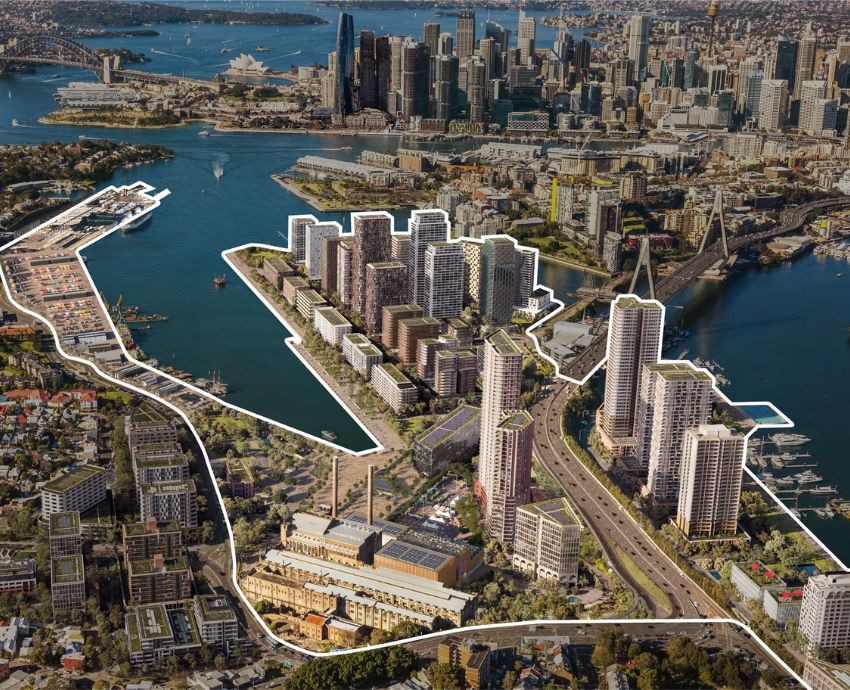
The NSW Labor government has announced plans for 7000–8500 new dwellings in the Bays West Precinct — a 77-hectare waterfront industrial site in the inner west of Gadigal Country/Sydney.
The precinct, divided into the areas of White Bay, Glebe Island and Rozelle Bay, will have various 40-storey apartment towers sitting above the new Bays West metro station, expected to open in 2032.
NSW Labor and developers are claiming that Bays West will help ease the city’s worsening affordable housing crisis. However, the proposed development includes a measly 10% “affordable and essential worker housing”, which falls short of NSW Labor’s election promise of delivering a minimum of 30% “social, affordable and universal housing” on surplus government-owned land.
Even the former Liberal government had planned for Bays West to include 30% affordable housing.
Labor’s economic modelling estimates that the site could support 30% affordable housing — at least 1700 more homes — and still deliver a profit to the government.
In most cases, “affordable housing” is a misleading term. Unlike public housing — generally capped at 25% of tenants’ income and with longer-term tenures — designated “affordable” housing is normally capped at 80% of market rent and usually only for 15 years.
With one-bedroom apartments at Bays West expected to sell for upwards of $1 million, two bedrooms for between $1.8–2.6 million and three bedrooms for $3.5–6 million, corresponding “affordable” rents would be exorbitant for working people.
Premier Chris Minns defended his decision to include only 10% affordable housing at Bays West, claiming that a greater “return” was needed to invest in “nightlife, greater foreshore protections [and] more amenity”.
In reality, the better “return” is for developers and his government.
Labor’s financial modelling that said high-density residential development would deliver the “greatest net economic benefit to the state” — the NSW government and developers — allowed for a generous 20% profit margin for developers.
The NSW government is also set to pocket $2.4 billion in windfall profits from the rise in land value, from leasing or selling the land to developers. In the middle of one of the worst housing crises, Labor is more interested in guaranteeing profits for itself and developers than providing affordable housing for working people.
Market fail
Letting the market decide has clearly failed to provide genuinely affordable housing, despite developers being essentially gifted public land and relaxed planning laws.
Anglicare’s Rental Affordability Snapshot 2025: NSW Essential Workers Report paints a dire picture of housing affordability for childcare workers, cleaners, nurses, school teachers and hospitality workers. It found that just 1–3% of private rental listings were affordable for essential workers in the Greater Sydney region.
Despite this, Labor is fixated on private, rather than public housing as the “solution” to the crisis.
Under its Transport Oriented Development (TOD) scheme, the government is encouraging a developer free-for-all, by relaxing planning restrictions, speeding up approval processes and reducing public scrutiny for developments along transport corridors.
As with most new developments under the TOD scheme, critical new infrastructure, such as public parks, schools and sporting facilities are not guaranteed in the Bays West project.
Meanwhile, developers are salivating over its profit-making potential.
Lendlease’s “unsolicited proposal” to build up to 3000 dwellings in the Rozelle Bay portion of the precinct was progressed to stage two of the assessment process by the government late last month. Unsolicited proposals is a secretive process that allows private corporations to seek a deal with the government to build major projects without a public tender process.
Lendlease was the lead developer of Barangaroo South, a corporate enclave built on public land, that architect Philip Thalis has referred to as “Lendlease-town”. “On what was once public land, we’ve ended up with ... an exclusive outdoor shopping mall, an enclave of privilege and high prices.”
Lendlease was responsible for massively scaling up the size of the original developments, reducing the public and green space and covering up serious safety issues during construction.
Lendlease was only required to deliver a paltry 50 designated affordable apartments — out of about 800 apartments in the One Sydney Harbour towers. There were reports of affordable housing tenants being denied access to gym and pool facilities, and forced to use separate entrances. In Britain, these are known as “poor doors”.
Housing for investors
Many new housing developments are geared for investors — shoddy, quickly built to be bought, sold and negatively-geared, rather than lived in. As a result, building defects, including waterproofing failures, non-compliance with safety standards and structural issues, are rampant.
This doesn’t matter to property investors who don’t live there. Property investors represented 40% of Australia’s housing finance commitments by December last year — up from 24% just five years ago. In other words, investors make up an ever-increasing share of the housing market.
Despite the renewed push to scapegoat migrants for the housing crisis, property investors who take advantage of generous tax concessions are the prime culprits for driving up house prices.
Successive Labor and Liberal state governments have no qualms about selling or leasing public land to private interests.
This was epitomised by the NSW government allowing Crown to build an exclusive members-only casino — another example of an “unsolicited proposal” — five-star hotel and luxury apartments in the middle of what was originally planned to be public green space.
At the Bays West site, a minimum of 30% public housing, appropriate mixed-density development and ample public foreshore space is feasible.
However, if developers have their way, Bays West will likely end up as a “Barangaroo 2.0” — a privatised waterfront enclave for wealthy residents and investors.
[Ben Radford is a town planner. He is standing with Socialist Alliance in the March 2027 NSW election.]