
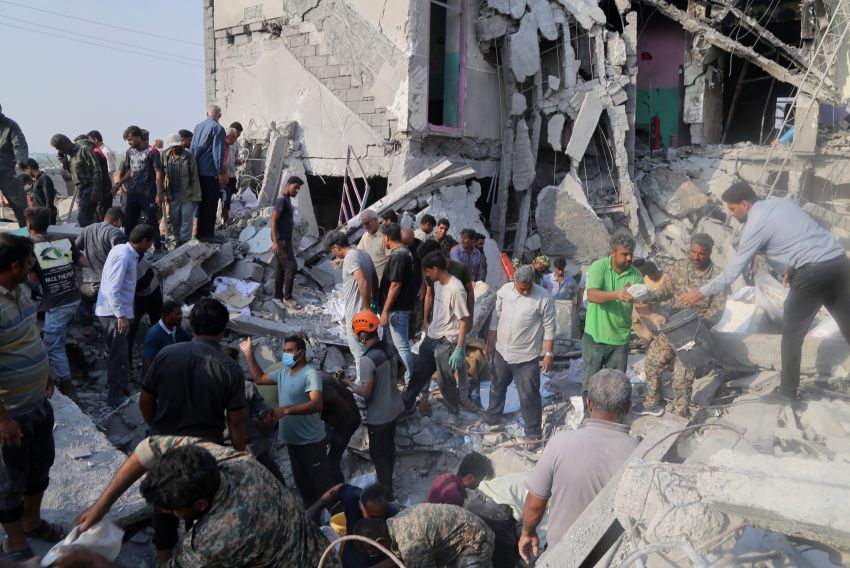
The Australian government has turned the United States and Israel’ war against Iran into a class war against the people.
Wars are never confined to battlefields. In the age of global capitalism, war itself becomes global. Thousands of kilometres from the frontlines where missiles are launched and bombs detonated, other bombs are exploding across the cities of the world — in the form of electricity bills, mortgage repayments, rent and petrol prices. That is precisely what is happening in Australia right now.
From the torrent of recent media reporting across Australia on the economic situation, energy and fuel crisis, federal budget, inflation, interest rates, housing crisis and the war against Iran, one bare truth emerges: Labor has taken the US and Israel’s war against Iran and transformed it not only into a geopolitical crisis, but into an instrument for the transfer of wealth from ordinary people to energy corporations, banks and financial markets.
This is the conversion of a foreign war into domestic class war.
For the Australian government and its media, the war against Iran is translated almost exclusively through two words — oil shock.
We read endless reports about the war driving up fuel prices, inflation and interest rates. The Reserve Bank of Australia (RBA) has lifted the cash rate to 4.35% and warned that Australians “will become poorer”.
The Victorian budget, delivered on May 5, has revised its growth forecast down from 2.5% to 1.5%, with near-zero growth scenarios forecast.
But what this narrative conceals is the question of power. Oil prices do not fall from the sky, like rain, or rise from the earth like an earthquake.
As Ross Gittins argued in his article “Capitalism is not serving customers” on May 6 in The Age, energy companies do not raise prices simply because their costs have increased, they raise them because they know they can.
War merely creates the opportunity.
In a moment of crisis, the structure of capitalist markets allows energy corporations to extract vastly greater profits, while governments pass these price rises on to the public as “unavoidable realities”.
In other words, war privatises profit and socialises the costs.
But the most telling part of the story is the federal Labor government’s response.
If it genuinely wanted to shield working people from the shocks of war, it could have imposed a heavy windfall profits tax on oil and gas companies. It could have capped fuel and energy prices and broken open the monopolistic energy markets. It could have made public transport free on a broad scale. It could have built massive amounts of public housing and funded the cost of the crisis from the profits and wealth of capital.
Almost none of this has happened. Instead, what have we seen?
The RBA has hiked interest rates. On a $600,000 mortgage alone, repayments have jumped by roughly $300 a month in a matter of months. Fuel prices have climbed. Inflation has stayed high. Real wages have fallen. Rents continue their relentless rise.
The Victorian Labor government will carry close to $200 billion in debt by 2030. This means that it has not gone after large-scale profits; it has targeted the demand of ordinary people.
The “logic” of capitalist economic policy today runs like this: To control inflation, people must consume less, live less and go deeper into debt. No one is asking energy companies to profit less. No one expects the energy sector to experience shock.
The Victorian budget offers an almost symbolic picture of this scenario. It provided some modest relief including half-price public transport, vehicle registration discounts and some limited family assistance. But, at the same time, the annual interest bill on state debt is set to reach $11.8 billion.
That means in the years ahead, for every $10 of government revenue, $1 will go to servicing debt interest. To whom? To financial markets, banks and bondholders.
This is how the capitalist class are “managing” the crisis: People grow poorer under the weight of war and inflation; the government is forced to borrow to prevent social explosion, but then channels future public revenue straight back into financial markets. This is not merely an economic crisis. It is a form of class redistribution of wealth.
The housing crisis is part of the same mechanism. The war did not create Australia’s housing and debt crisis. It intensified and exposed the underlying contradictions of an economy already organised around property speculation, financialisation and energy profiteering.
The war has accelerated and intensified the already staggering process of transforming housing from shelter into investment asset.
House prices in Australia have quadrupled or quintupled while wages have grown at a fraction of that pace. Thirty-year mortgages have become normal. The average home loan in NSW has now reached about $871,000.
In an economy wound tightly in the web of capital, raising interest rates is not simply a monetary policy tool, it is a mechanism for transferring wealth from labour to financial capital.
People are compelled to work longer hours simply to maintain the same standard of living as before, paying ever-greater interest to banks. They pay more rent to landlords. They transfer ever-higher energy costs to oil and gas corporations.
The bitter irony is that governments constantly invoke their concern for “Australian families”, while their own budget structures reveal that families are precisely where the crisis gets dumped.
The next generation must prepare to pay off today’s debt. It must prepare to face a broken housing market that renders the prospect of stable, secure shelter increasingly remote. It must carry the cost of wars it never had any say in.
This is why this crisis cannot be simply called “inflation” or an “external shock”. What is happening is a new form of class politics. War in the Middle East means austerity for Australians.
Those who play a role in the firing of missiles and bombs belong to a global ruling class that collects the profits.
Those who are killed, wounded and displaced by those bombs and missiles belong to the same global working class, just in a different country where the missiles rain down not as explosives but as crisis, inflation and the rising cost of living.
This is precisely what most of the establishment media works to conceal.
The war is not only happening in Iran, Gaza or the Strait of Hormuz. The war has passed through the Strait of Hormuz and entered Australia, reshaping people's daily lives.
That is why the Australian government’s support for the war on Iran is no longer a foreign war. It has become a class war against the Australian people.
[Ali Keshtkar is an Iranian-Australian writer and activist based in Naarm, who has lived in exile for more than three decades. He is a former political prisoner.]