
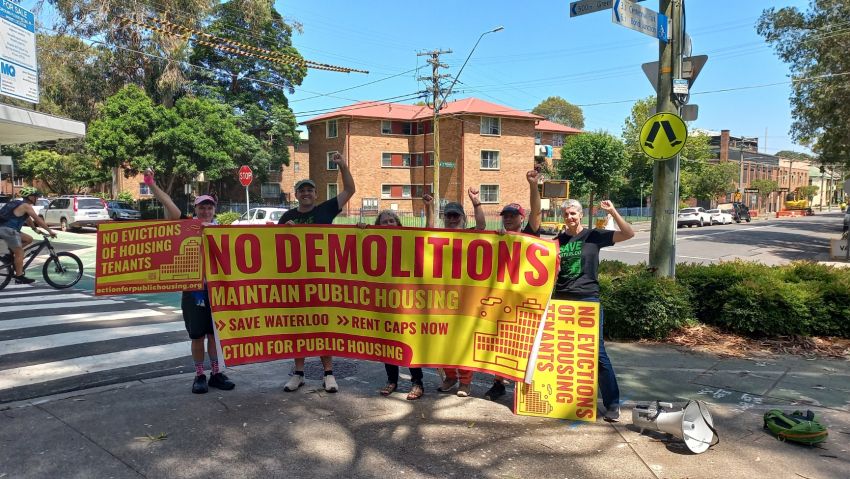
Residents in the Waterloo Estate, one of the signature “neighbourhood estates”, built by Labor governments after World War II, are fearful of being pushed out of their apartments and losing the connections they have built up over decades.
More than 130 homes in the Cope Street and George Street low-rise apartment blocks in inner-city Waterloo will be destroyed within weeks, Homes NSW told residents at a Waterloo Redevelopment Group meeting on April 15. The demolition will start at the end of the month.
Many who have already been moved out are long-term residents.
The estate, which once housed more than 2000 public homes, was built in stages between the 1960 and 1980s. The low-rise accommodation was built from the late 1940s.
Karyn Brown, a Waterloo resident and housing campaigner, told Green Left: “There is no need for more luxury apartments in Waterloo.
“But there is a desperate need for permanent, genuinely affordable housing — public housing. The Labor government should be refurbishing the existing public housing and building more.”
The Waterloo estate is located close to the CBD and is well serviced by public transport.
Brown believes that because of the government’s privatisation plans, it has been allowed to deteriorate. “Tenants have been demonised and blamed for the decay, which is being used to justify the wholesale destruction.”
However, tenants have taken things into their own hands and worked with NGOs, academics and other volunteers to “improve the estate’s amenity and safety”. She said this has led to services growing to meet locals’ needs.
Brown said tenants had been living in limbo for more than 10 years. “We still don’t know where we will end up. Labor claims that we can stay in the area but, as more and more public housing is sold off, that is not true. The new social housing, run by charities, will charge more for rent, meaning many residents will not be able to stay.”
Labor has contracted private developer Stockland to build the new housing. Allegedly 30% of the 3300 will be “social” housing and 20% “affordable” housing, which is set at 80% of market rent.
“It means they will not be affordable to low-income people who live there now,” Brown said.
Nevertheless, NSW Labor is talking up its “social housing renewal” project, even though it went to the 2023 election promising not to privatise or demolish public housing.
“Both categories indicate that NSW Labor is intent on privatising what is not theirs to sell off. ‘Social housing’ is not public housing, as a private charity provider has control. And ‘affordable’ is a very rubbery concept. It depends what you can afford.
“Public housing tenants only pay 25% of their income in rent. Many people do not know the difference, and the government is trading on that.”
In the 1970s, the Builders Labourers Federation helped Waterloo residents battle to save the suburb from being cleared by authorities. Now, residents in the public housing estate and others are putting up a fight against Labor’s privatisation and gentrification plans.
Brown said an influx of wealthy households will “mask the needs of the remaining low-income households”.
Waterloo comprises a culturally diverse community, with a proud Aboriginal history.
Data from NSW Family and Community Services indicates that close to 50% of residents are 60 years or older. About 10% identify as First Nations and 31% are from non-English speaking backgrounds. About two-thirds of residents live alone.
The ratio of green space to housing is also very good — with generous parklands attracting vibrant bird life.
Brown said Labor’s demolition plans should be illegal, especially in a housing crisis.
“The state built these homes with public money. Contrary to the government’s talking points, this estate was designed to last. The homes were for war veterans and others, who had done their bit for the country.
“Now, Labor claims they were not built to last this long! Yes, they are deteriorating, but that is deliberate neglect. We need to protect well-built low-cost public homes.
“Most of those who have already been forced out have gone to 70 new social housing units above the Waterloo Metro Station. It made it possible for neighbours to be rehoused together, if they wished. But as there are no more new builds in the area, this won’t be the case for the other 600 or more people who are to be shoved aside, despite Labor’s promise to keep the community together.
“Some people will be moved to places where they will lose their social and community connections.”
Labor said residents “have the right to return” once the renewal is complete. Brown said no one knows when that will be. She added that it also means that a community housing provider will become their landlord, which brings with it “many variables”.
“It does not provide the sense of security of tenure, or of rent payable, that public housing does. The right of return also depends on eligibility, meaning many tenants fear having to choose between housing and their job.
“Even in a housing crisis, Labor has not been persuaded to go back to the drawing board. This is because it is governing for the developer lobby, not impoverished or older residents who cannot easily fight back on their own.”
Brown said when more than 65,000 people are on the waiting list for public housing and some 300,000 homes sit empty every night across the state, there are plenty of other practical and humane options than to demolish well-built, low-cost public housing.
[Sign the petition calling on Labor to stop the demolition of Waterloo. Join the Refurbish, don’t demolish Waterloo protest and the radical walking tour.]