
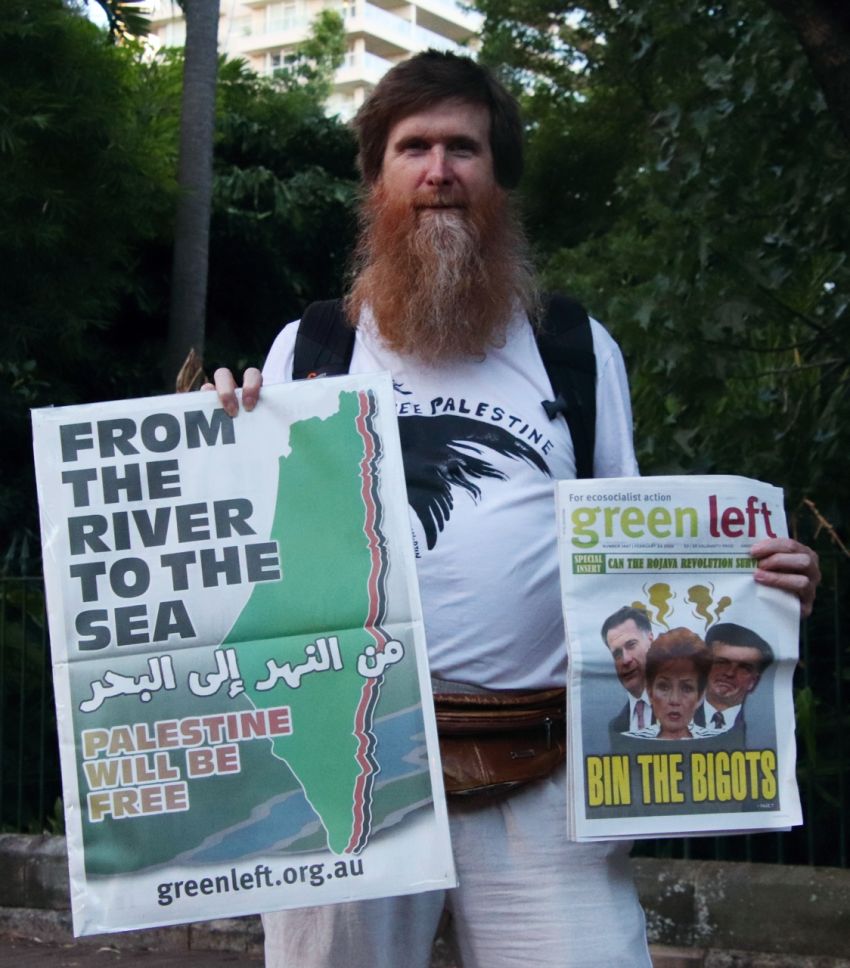
Twenty Palestine justice activists were arrested by Queensland Police Service (QPS) at the Not Our Law rally in Magan-djin/Brisbane on April 18.
Their “crime” was to display or speak the illegal phrase “From the River to the Sea”. The outcome was not unexpected because the protest was designed to highlight the absurdity of these acts being criminal offences.
The arrestees now face charges based on the offence of recital, distribution, publication or display of prohibited expressions, contrary to section 52DA of the Criminal Code Act 1899 (Qld).
To prove this crime, which carries up to two year’s prison and/or a fine of $25,035, it has to be shown that a reasonable person might feel “menaced, harassed or offended” by someone saying “From the river to the sea” and “Globalise the intifada”.
The first is a popular chant that the pro-Palestine solidarity movement has been using over the last nearly 3 years of Israel’s genocide in Gaza. The second is hardly used by anyone in Palestine protests.
This particular Justice for Palestine Magan-djin rally was not the first time police went in hard over words arranged in a certain way.
The Liberal National David Crisafulli government and the QPS arrested people protesting the law just a few hours after it first took effect. But as the law does allow for the use of the phrases “in the public interest”, those charged will likely be found not guilty.
Alex Bainbridge, a Green Left journalist and Socialist Alliance member, was arrested for allegedly breaking the law. He now faces time in jail for making a speech which explained why the laws were wrong and carrying a sign stating that the public has a right to know that the phrase “is a freedom slogan, not a message of hate”.
Justice for Palestine Magan-djin is launching a High Court challenge to the law.
NSW Premier Chris Minns wants to pass similar laws, but as many of his anti-protest laws have already been found to be unconstitutional he says he will wait to see how the Queensland challenge goes.
Sydney Criminal Lawyers spoke to Bainbridge about the weekend of protest against the law in Magan-djin/Brisbane. Bainbridge is also active in Justice for Palestine Magan-djin.
Justice for Palestine Magan-djin organised a rally to oppose the laws that specifically ban a couple of political slogans. Arrests were made. Can you fill us in on what happened?
There were 22 people arrested over the course of the weekend at three different events. Friday night was the John Farnham inspired flash mob. People were singing the song Two Strong Hearts, which has the line ‘like a river to the sea’, which is similar to the banned expression ‘From the river to the sea’.
That was a light-hearted action poking fun at the laws and it also tested out how police would react.
There was an important legal point there. When the law was first drafted, there was a provision that it proscribed expressions and the attorney general was then going to insert the specific expressions into the regulation.
This would have proscribed the expression and it also was going to ban similar words or expressions that could be confused for it.
But the government changed its mind at the last minute. It took out the provision for the attorney general’s action and instead, inserted the actual slogans in the bill. So, the law now only proscribes the explicit expression of those phrases that were going to be ruled out.
A few weeks before the weekend of action, one person held a sign that said, ‘From the Sea to the River’. Police threatened that person with arrest and they did take the sign down in the end.
It was not clear if the police would arrest people for singing a John Farnham song. As it turned out, only a few police turned up on the Friday night. The officers said they were only monitoring community safety, not the expression of the words.
I filed the notice of intention to the police for the Saturday action — an opportunity for people to explicitly say the proscribed expression.
The police told me that they had taken legal advice and were only going to enforce the exact expressions found in the legislation. That advice must have made them realise that what they were threatening around arresting people over different forms of the expression was not legal.
But they made 20 arrests on the Saturday of people who said the phrase or carried a sign or a banner or wore a T-shirt with the phrase on it.
The Sunday protest did not intend to challenge the law. It was a solidarity action with those who were arrested the day before. But a couple of people were arrested, however, for saying the proscribed expression. I had a bail condition preventing me from attending.
Some of these conversations you were having with the police must have seemed absurd?
Yes and I can’t believe these laws will stay. They are just too absurd. Justice for Palestine is bringing a High Court challenge.
I face two charges; one for saying the expression “From the river to the sea, Palestine will be free”. The other was for holding a sign with the same words.
So, one for holding a sign and saying the expression under the same offence?
Same offence, two different charges.
Why did you deliberately break the law?
The law is a draconian overreach. I don’t think the government should be arresting people over a simple phrase which, I would argue, it is projecting a false meaning onto these phrases.
The CLP says these phrases are messages of genocidal intent against Jewish people and that they are therefore antisemitic.
Of the two banned phrases, I have never heard “Globalise the Intifada” chanted at a rally. “From the river the sea, Palestine will be free” is regularly chanted at rallies.
It is not a message of hate; it is a message of freedom and equal rights for the people of Palestine and for all people, living between the Jordan River and the Mediterranean Sea.
Given that Israel is perpetrating a genocide, a finding by the United Nations Commission of Inquiry as well many international human rights organisations, such as Amnesty International and the International Association of Genocide Scholars, it is reasonable to call for equal rights for all peoples.
The International Court of Justice, the ultimate arbiter, will make a formal ruling in the future. But, for now, it has said, more than two years ago, that genocide is plausible and ordered provisional measures that Israel must undertake to ensure that genocide is not being committed.
The Genocide Convention tries to prevent genocide; the International Criminal Court said Israel and other countries must take certain measures to ensure that genocide is not being committed.
The ICC has also found that Israel did not implement the provisional measures and issued additional ones. And the same thing happened again.
So, while the ICJ has not made its final decision about genocide, based on the facts it has made a formal finding about plausible genocide.
Israel is committing genocide. That is not a word to throw around lightly. People have the right to contest that finding but to do that they would need to have a really strong case.
It is not enough to just say Israel is not committing genocide in Gaza.
In the context of an actual genocide, in which the Australian and Queensland governments are complicit, chanting slogans calling for justice are warranted. It helps build a movement against genocide which then puts pressure on governments to stop aiding and abetting genocide.
NSW Premier Chris Minns was the first politician to suggest banning both the slogans now illegal in Queensland, around the time of the Bondi Beach shootings.
I suggest it goes back to the Zonist movement’s conference on the Gold Coast. It was there that the call was made to prohibit that phrase. The shooting at Bondi was an atrocity at Bondi, and the Zionist movement has used it to push their campaign against the movement for justice in Palestine.
David Crisafulli has jumped at the chance to ban these slogans. Hi government has passed a swag of draconian laws, including harsh youth justice laws targeting First Nations kids. What has been the reaction to this?
One of Crisafulli’s signature policies was to target kids as young as 10: “Adult crime, adult time” was his slogan. The laws are a human rights abuse in their own right. He has also attacked safety standards for workers, and trans rights for young people.
While Crisafulli has brought in these draconian measures, he is also a conscious of not going too far, too fast.
The attacks on the Palestine freedom movement are also an abuse of political freedoms which, as you point out, even the NSW government hasn’t done as yet.
Justice for Palestine will launch a High Court challenge to these laws. Where do you see this going?
There will be a challenge and the details will be out soon. A number of lawyers are working on it. While these things are never certain, it is plausible that these laws will be struck down.
In terms of the cases against people who said the prohibited words, the assertion that their actions could be seen to be “harassing” or “menacing” are false.
To be charged on the basis that somebody might be offended is an extremely low bar to set. People get offended because of all sorts of things and that should not be criminalised.
The law allows for people to say or use these phrases in some contexts. The legal advice we have been given is that people who said the phrase on April 18 were doing it “in the public interest”.
My sign said: “It is in the public interest for people to know”. My speech elaborated on what that means.
Exactly how the courts will interpret this law is an unknown. There is a good chance that it will be defeated in the High Court and, if it isn’t, there’s a good chance that the police will not be able to prove their case as there was a lawful excuse to use the phrase.