
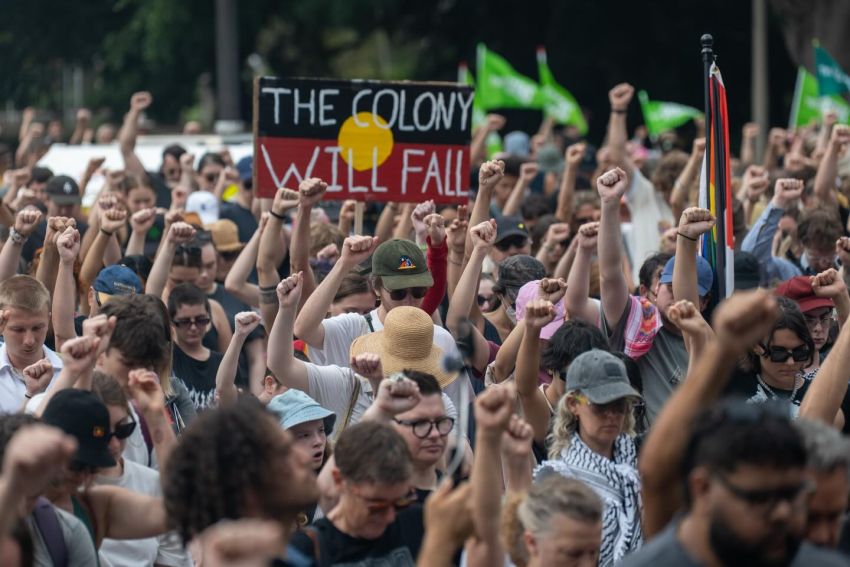
Thirty five years on from the federal government’s Royal Commission into Aboriginal Deaths in Custody, the situation remains dire across Australia, with one prison in Western Australia reporting the deaths of two women in as many months.
The National Indigenous Times (NIT) reported on April 18 that a 40-year-old woman was found unresponsive in her bed at Bandyup Women’s Prison in Boorloo/Perth, noting that only a month prior, another woman — Patricia Howell — had died in the same institution.
A vigil for Howell — who died on March 16 — was held at Bandyup on the eve of the royal commission’s anniversary with her mother, Priscilla Kelly, telling the media that her daughter had needed more support than she had been given by the state.
“It’s sad to know that she was locked up in a little cell like that,” Kelly said.“She should have had more help.”
Independent Senator Lidia Thorpe — a Djab Wurrung, Gunnai and Gunditjmara woman — said the repeated deaths showed “the racist violence of the system”.
It is crucial to note that many of the 8600 people incarcerated in WA in particular have not been convicted, but are on remand. This is particularly bad in Bandyup, where a 2023 audit showed “record population growth”, specifically among Aboriginal women on remand.
WA Chief Justice Peter Quinlan told the ABC’s Nadia Mitsopoulos: “More than 40% of the people who are in prison are not there because they’ve been convicted and sentenced, but are there because they haven’t got bail for offences that they are still to be tried for.”
Throughout Australia, the prison and judicial systems continue to reflect what Amnesty International has described as a “persistent failure of governments to act, and the entrenched cycles of harm abuse, and injustice faced by First Nations Peoples in custody”.
In total, 630 Aboriginal people have died in custody since the 1991 royal commission and many of its 339 recommendations have yet to be put in place.
Uncle Rodney Dillon, Amnesty Australia’s Indigenous rights advisor and Palawa Elder, said that if 630 Aboriginal people had died at once “this would have been regarded as a massacre, yet no authority has been held accountable for this long-running tragedy.
“This ongoing massacre would not have occurred had the commission’s recommendations been fully implemented. Yet they continue, even as recently as just weeks ago.”
The human rights group has raised specific concerns about Australia’s criminal age of responsibility — which is 10 years, despite the Convention on the Rights of the Child recommending it be raised to 14 — and the need for independent inspections of detention facilities by United Nations (UN) officials.
Despite the federal government signing a treaty assenting to such visits, officials have been turned away, as was the case in Queanbeyan in 2022, when NSW Corrections Services refused entry to UN officials, claiming they had not received “prior approval”.
At the time, NSW corrections minister Geoff Lee said it was “unnecessary” for the UN to visit the state’s prisons when other countries — such as Iran — should be assessed instead.
Amnesty has called for an end to solitary confinement, the use of spit hoods and holding children in adult prisons. It has also urged the federal government to properly ratify the Optional Protocol to the Convention against Torture.
The over-incarceration of Aboriginal people — underpinned by systemic discrimination — was one of the royal commission’s key observations. This pattern has continued, with a Bureau of Statistics report last year showing that Aboriginal and Torres Strait Islander prisoners accounted for 37% of all prisoners, despite comprising only 3.2% of the population.
The number imprisoned had also jumped 10% in one year — to 17,432 people — with the average age being 33.9, younger than the median (36.6 years).
Given the numbers and composition of the prison population, it could be argued that the Australian prison system deliberately and systematically targets First Nations people and disenfranchises them. People have elsewhere referred to this as “original accumulation”, meaning that the prison system is a logical extension of the British First Fleet.
In addition, the fact that 76% of Aboriginal people currently in prison nationally have been a prisoner before clearly indicates that the prison system is not designed for rehabilitation or restitutive justice.
Decades on from a touchstone royal commission that aimed to change all this, the situation remains diabolical.