
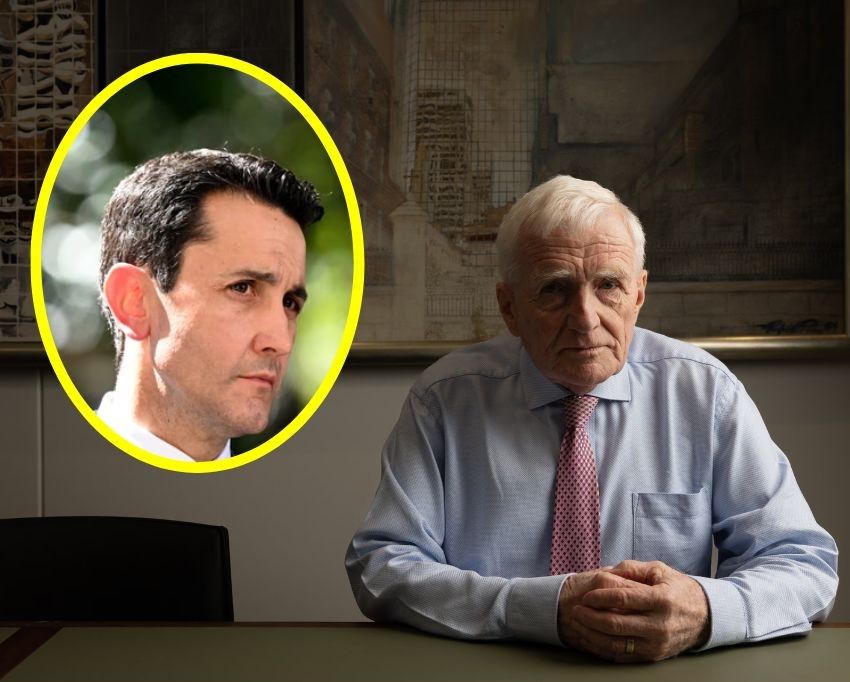
In a feat of enterprising delusion and sinister suppression, Queensland’s Liberal-National government has decided to deal with what it regards as an antisemitic problem in its state.
After last December’s attacks on attendees of a Hanukkah event on Bondi Beach that left 15 people dead, governments are insisting that a blight has gripped the continent.
Premier David Crisafulli announced on February 8 that he was “delivering strong, decisive action to combat antisemitism [and] address terrorist-motivated offending to make Queensland safer”.
As with other parts of the country, antisemitism has been singled out as the exceptional hatred, so unique as to require singular laws and singular treatment. (Others, such as Islamophobia, do not merit similar attention.) In doing so, lawmakers betray the cardinal principle of laws: keep the subject matter general and avoid the temptation towards exceptionalism.
Despite existing federal laws already targeting protest, prohibited symbols and prohibited organisations, the states are proposing legislation that further stifles speech and lawful assembly.
There is little evidence that Queensland has an antisemitism problem, but the conservative government is sure that its measures are “making Queensland safer after Labor failed to crackdown on antisemitism during their decade of decline”.
Its Fighting Antisemitism and Keeping Guns out of the Hands of Terrorists and Criminals Amendment Bill 2026 (Qld) is being rushed through the review process with just seven days for public submissions.
The prohibitions demonstrate an uneducated approach to Middle Eastern politics and religion; Islamic State is bracketed with Hamas; protesters are not permitted to display the Hamas flag and emblem, nor the Islamic State flag. Hezbollah and Nazi symbols are likewise prohibited.
But the bill itself does not expressly ban these symbols. We only know this from the ministerial release by Crisafulli and the Queensland Attorney-General Deb Frecklington, suggesting that executive fiat and arbitrary determination will be the norm.
What matters is that the prohibited symbol is publicly distributed, published or publicly displayed “in a way that might reasonably be expected to cause a member of the public to feel menaced, harassed or offended”.
Penalties for displaying them will range from six months to two years of imprisonment. Language itself is targeted, with a maximum of two years imprisonment for using outlawed expressions.
The bill fails to understand that protests, because they are often the product of those who are aggrieved and outraged, will and should offend. The proposed legislation also grants the attorney-general powers to target “the public distribution, publication, public display or public recitation of a prescribed phrase to cause, menace, harassment [sic] or offence, applicable to: ‘Globalise the intifada’ [and] ‘From the river to the sea’”.
Again, these two expressions are not explicitly mentioned in the bill but in the joint ministerial statement.
Future prohibitions can be expected to be based on the musings of a politician. With added absurdity, there is no requirement, in making a prohibited expression regulation, to have either an actual victim or the need to cause actual harm.
Critics include Terry O’Gorman, Queensland’s most prominent defender of civil liberties. In his capacity as vice president of the Queensland Council for Civil Liberties (QCCL), he made a sensible critique of the government’s effort to ban the phrases in question.
“The meaning of both these phrases is highly contested. To many Jewish people, the phrases are slogans that can escalate tensions and fear. To those using the phrases, particularly in anti-Israel public demonstrations, these phrases can be used to oppose Israel’s actions in Gaza and in the increasingly violent West Bank settler movement.”
In O’Gorman’s view, given that such phrases had ambiguous meanings, much dependent on the political stance of the recipient, they should not be banned unless accompanied by an incitement to violence.
“Indeed, banning any slogan in public protests particularly gatherings that does not contain an immediate incitement to violence is an unjustified attack and limitation on freedom of speech.”
In its submission to the Justice, Integrity and Community Safety Committee (the Committee), the QCCL also argues: “A clear distance needs to be kept between words and wounds, not least because words are usually offered as the alternative to violence. Only words which incite or very closely resemble violence should be unlawful.”
The views of Jonathan Rauch, articulated in his Kindly Inquisitors, are cited on whether racial epithets are speech or bullets. “My own view is that words are words and bullets are bullets and that it is important to keep this straight.”
The right-wing think tank, the Institute of Public Affairs (IPA), is also troubled by the bill. IPA research fellow Margaret Chambers reproached the legislation for not addressing “the underlying problem” of “sectarian attitudes”, while taking issue with the futility of ministerial powers to ban certain phrases.
This “will do little to prevent people from privately subscribing to the ideology or adopting alternative phrases to express the same ideas”. In her submission to the Committee, Chambers further observes that debate on “major public policy questions would be constrained if the Minister believes it would incite hostility”.
This could cover criticism of the Commonwealth’s migration program or “state government proposals for ‘treaties’ based on citizens’ racial background”.
In summary, the IPA said the bill confers extraordinary powers on a single minister leading to overreach; it enables the government to criminalise political speech using “ambiguous and subjective standards for unlawful phrases”; and had inadequate safeguards to limit ministerial power.
Which people is this bill meant to protect?
Queensland Jewish Board of Deputies President Jason Steinberg expressed his approval of the proposed assault on language and symbols. “This Bill moves beyond words and delivers real, practical protections for our community and for all people targeted by hate.”
Neither practicality nor reality applies to this exercise; after the bill’s inevitable passage, there will be much mischief and little by way of addressing the disease. The patient of free speech will, however, be euthanised.
[Binoy Kampmark lectures at RMIT University.]