
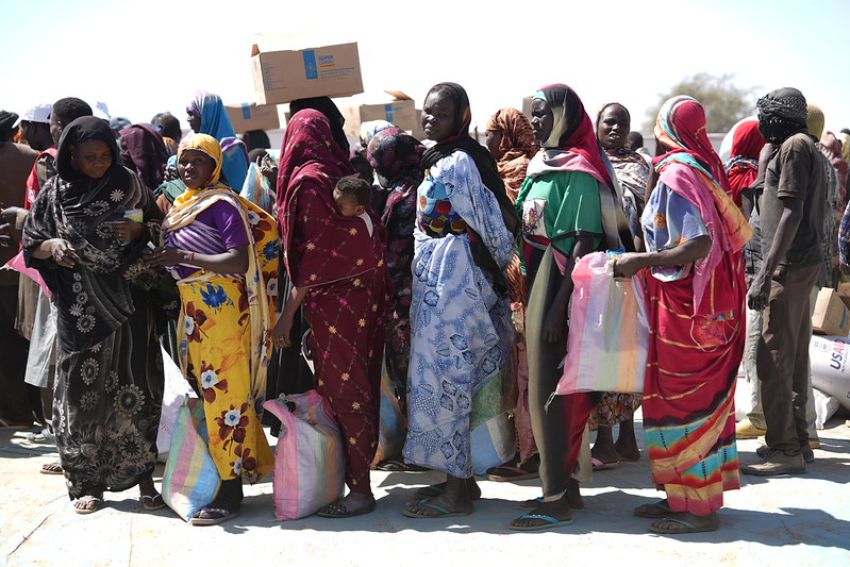
“We can only expect worse to come” in Sudan if the war is not stopped, United Nations High Commissioner for Human Rights Volker Türk warned the Human Rights Council on February 9, as famine conditions expand in the country facing the highest levels of hunger in the world.
Apart from Gaza, which has been suffering Israel’s genocidal war since October 2023, there are only two officially declared ongoing famines in the world — both in this North African country, in the throes of a civil war raging for nearly three years.
One of them is in South Kordofan State’s capital, Kadugli, gripped by famine since last September, following a prolonged siege by the Rapid Support Forces (RSF), fighting its former ally, the Sudanese Armed Forces (SAF), since April 2023.
Also besieged further north was the state’s second largest city, Dilling, where hunger levels “are likely similar to Kadugli, but cannot be classified due to insufficient reliable data — a result of restricted humanitarian access and ongoing hostilities,” the UN had said.
‘Temporary’ relief
Earlier, on February 3, the SAF announced it had broken the siege on Kadugli, days after making a similar advance, taking control of the supply routes to Dilling in late January, reconnecting the two cities to North Kordofan.
With the markets re-supplied, prices of essential food items in Kadugli have dropped to a fraction of what they had surged to under siege, Sudan Tribune reported on February 8.
However, the Famine Early Warning Systems Network had cautioned in its report on February 5 that the relief for its residents may only be “temporary”. It warned of the possibility “that famine will persist through May in the absence of a ceasefire and sustained humanitarian access. It is expected that the towns will remain heavily contested, and the risk is high that renewed siege-like conditions will be re-established between February and May.”
Drone attacks on food trucks
Türk also highlighted this volatility in his briefing to the Human Rights Council on February 9. Although the SAF and its allied armed groups have broken the siege on these cities, “drone strikes by both sides continue, resulting in dozens of civilian deaths and injuries”, he added.
Two days before, on February 7, the RSF had killed at least 24 people (including eight children, among them infants) with a drone strike on a humanitarian convoy transporting residents fleeing the fighting in South Kordofan State’s Dubeiker area to North Kordofan in the city of Rahad.
A day earlier, one was killed and many more wounded in the drone attack on a convoy of the World Food Program (WFP), en route to supplying aid to the displaced people sheltering in North Kordofan’s capital, El Obeid.
Building earthen walls around El Obeid, the SAF is holding out against the RSF to defend this strategic city enroute to the national capital, Khartoum, from the Darfur region in western Sudan. The RSF has taken control over most of this region after overrunning North Darfur State’s capital, El Fasher, also in the throes of famine since last September.
After laying a siege for over 500 days and starving the residents of this last major city in the five states of Darfur holding against the RSF, the paramilitary overran its defences in late October. Barely two months later, satellite imagery analysis by the Yale Humanitarian Research Lab had confirmed that the city had been depopulated by the RSF after likely killing tens of thousands of its residents.
“My office sounded the alarm about the risk of mass atrocities in the besieged city of El Fasher for more than a year,” Türk added in his briefing, regretting, “The threat was clear, but warnings were not heeded.” He went on to warn, “I am extremely concerned that these violations and abuses may be repeated in the Kordofan region,” which has become the centere of fighting since the fall of El Fasher.
Famine-conditions spread in Darfur
An estimated 127,000 people have managed to escape El Fasher and its surrounding areas, according to the International Organization for Migration. A large number of them fled towards the Chadian border, sheltering in northwestern reaches of Darfur in towns like Um Baru and Kernoi, and further west in the border town of El Tine, where militias allied with the SAF and local self-defence groups are still holding fort against the RSF.
With this influx increasing the strain on the limited resources of these remote towns, Integrated Food Security Phase Classification (IPC) data released on February 6 confirmed that hunger levels, already classified as “catastrophic”, have exceeded the “famine” threshold. Over half of all children in Um Baru, and 34% in Kernoi, are suffering acute malnutrition.
“Many other conflict-affected or inaccessible areas may also be facing similarly catastrophic conditions; however, the full extent remains unknown due to limited access and uncertainty over how rapidly conditions are deteriorating,” the IPC report added.
With millions suffering malnutrition across Sudan, especially in Darfur and Kordofan regions, Action Against Hunger has warned that “more than 375,000 people are at real risk of starvation”.
[Reprinted from Peoples Dispatch.]