
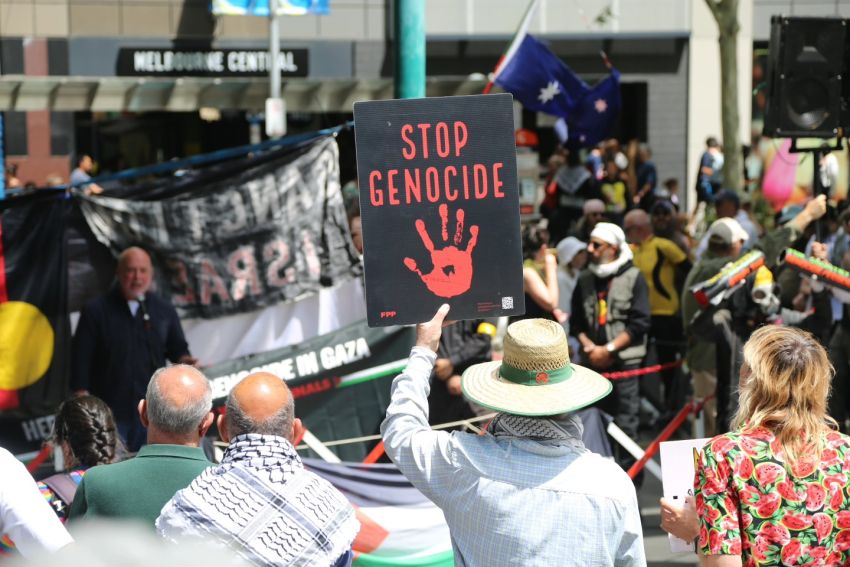
Responding to the Australian National Imams Council (ANIC), which had lodged a complaint about the new hate speech laws, Attorney-General Michelle Rowland said they will not impinge upon Muslim religious leaders’ ability to criticise foreign governments or political ideologies.
Before the laws were passed last month, concerns were raised about whether the listing of “hate groups” might be a means to suppress the pro-Palestinian movement and stamp out criticism of Israel’s genocide in Gaza.
INAC president Imam Shadi Alsuleiman had written to Rowland concerned that the new laws prevented criticism of Israel and Zionism, the political doctrine for its settler-colonial project.
The reply letter addressed to Alsuleiman, reports the Sydney Morning Herald, was co-signed by home affairs minister Tony Burke.
The ministers’ suggestion in their letter that Muslim clerics and the general public can criticise Israel runs counter to how Rowland had explained the law to the ABC’s 7.30.
Rowland and Burke’s confirmation that criticising Israel and Zionism will not fall foul of the law appears problematic because the new hate group laws are so broad; there is no guarantee that criticising a political entity is protected if it is to be considered by some to be a part of a religious identity.
The ministers’ letter to the ANIC provides false assurance. Labor might be able to ensure one reading of the law, but another government may take a different view.
Rowland and Burke’s letter states that various hate crime measures in the Combatting Antisemitism, Hate and Extremism (Criminal and Migration Laws) 2026 will not “prevent legitimate, nonviolent criticism of the actions of a foreign country or of particular political ideologies”.
This suggestion covers hate group laws, the heightening of penalties around hate crimes and the tightening of visa rules.
As their title suggests, the laws were brought in primarily to “curb anti-Semitism”, or prejudice against Jewish people, in the wake of the December 14, 2025, Bondi Beach terrorist attack on a Jewish religious event.
They have been pushed through at the same time as a plan to combat antisemitism is being implemented by all levels of government, which includes adopting the International Holocaust Remembrance Alliance definition of antisemitism, which provides 11 examples of the prejudice, seven of which involve Israel.
The definition can be weaponised so that criticism of Israel is considered an assault on Jewish identity and, therefore, prejudicial — even though the Federal Court has recognised that this is a false conflation.
Rowland told David Speers on 7.30 on January 20, when the hate group laws were passed, that if someone linked to a group “accuses Israel of genocide or apartheid” and “Jewish Australians do feel intimidated” and the court finds a reasonable person would have this same reaction, then that group can be banned.
An ANIC representative said the response from Rowland and Burke had not eased community’s “heightened anxiety” around what can and can’t be said; many fear the laws could be weaponised.
The spokesperson noted that the language in the laws is exceedingly broad and lacks precise boundaries.
‘Hate group’ regime
Sitting under new part 5.3B of the Criminal Code Act 1995, the “hate groups” regime is designed to protect the community from the broad net of “social, economic, psychological and physical harm”, by banning groups that engage in or promote hate crimes.
The head of Australian Security Intelligence Organisation (ASIO) assesses a hate group, then tells the Australian Federal Police minister and, if they agree and get the attorney-general’s approval, then the governor-general lists the group as banned.
ASIO can have a group listed based on assessing it has “advocated or engaged in politically motivated violence or engaged in the promotion of communal violence” or that there is a risk that the group might do this in the future.
Hate crimes include the federal hate crime offences, which were passed early last year, that capture behaviour such as advocating or threatening violence against a targeted person or group or their property.
A targeted group is distinguished by “race, religion, sex, sexual orientation, gender identity, intersex status, disability, nationality, national or ethnic origin or political opinion”.
Further conduct captured as the new hate crimes regime involves publicly inciting hatred against a person or a group, due to “race or national or ethnic origin”, that would constitute a preexisting offence under federal, state or territory law, or would cause a member of a targeted group “to be intimidated, to fear harassment or violence, or to fear for their safety”.
The activity that can lead to being listed as a hate group is also retrospective. No-one making up this group of three people or more, has to have been convicted of a hate crime and nor does the minister need to provide procedural fairness. That means that the individuals involved do not have to be notified that there is a case and there is no appeal once the decision is made.
Following a decision that members of a group are “prohibited”, they can be prosecuted with a range of criminal offences.
Hate group members can be taken to court after being charged over directing a hate group, or being a member of, or recruiting for a hate group, or training with one. They can also be arrested for providing support for, or funding to, a hate group. These criminal offences carry steep prison time.
Speers asked Rowland about a scenario involving an organisation that campaigns against Israel’s genocide in Gaza and asked if whether this causes some Jewish Australians to feel intimidated and they complain about it, then the group would be regarded as a hate group.
Rowland said if ASIO assesses criticism of Israel to be also criticism of the religion of Judaism, or of Jewish identity itself, it would not be progressed.
Despite the Federal Court of Australia recognising that these are separate things, ultimately it would be up to the ASIO boss to make the initial assessment.
[Paul Gregoire writes for Sydney Criminal Lawyers, where this article was first published.]