
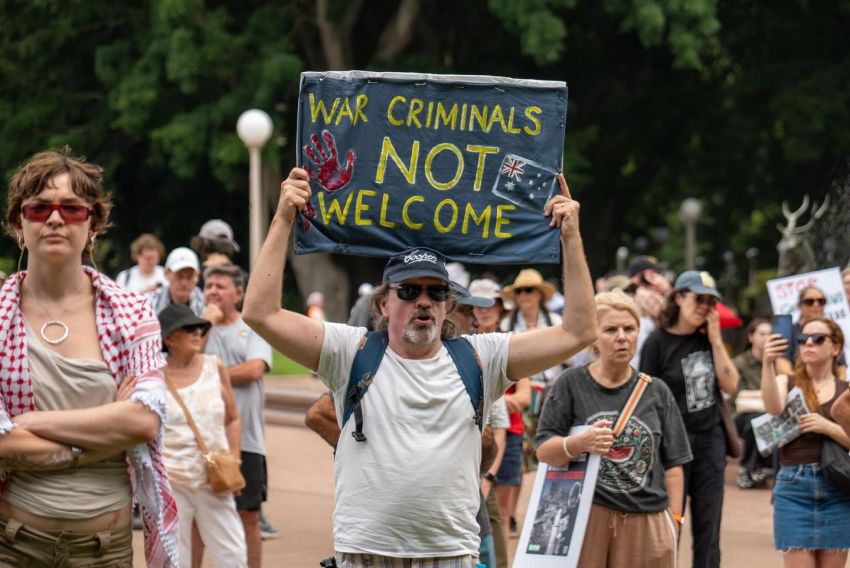
Labor’s invitation to Israeli President Isaac Herzog to visit Australia came amid the anguish following the Bondi Beach attacks on attendees of a Hanukkah event, which left 15 dead.
Prime Minister Anthony Albanese argued that inviting Herzog would “build social cohesion”. The Australia/Israel Jewish Affairs Council said it would “send a powerful message of solidarity and support … following the tragic events at Bondi and the surge of antisemitism across the country”.
These claims of approval ignore the serious prospect that legal grounds might arise regarding Herzog’s visit, not to mention the public protests that it will cause.
Australia, being a party both to the UN Genocide Convention and the Rome Statute, which establishes the International Criminal Court, must be wary about the injunctions of membership.
A determined opposition is keen on foiling the visit. On January 30, the Hind Rajab Foundation, the Jewish Council of Australia and the Australian National Imams Council announced they had sent Attorney-General Michelle Rowland, home affairs minister Tony Burke and the Australian Federal Police (AFP) a joint legal complaint to have Herzog arrested or barred from entering Australia.
As Israeli Prime Minister Benjamin Netanyahu would be unlikely to visit Australia, given the International Criminal Court’s arrest warrant, the complaint asserted that as “the Prime Minister of Israel is not permitted to visit Australia, the President should not be allowed to act as his surrogate”.
The complaint implores the authorities to do any of three things: Refuse or cancel any visa held by Herzog under the Migration Act 1958, which covers character and public interest grounds; Refer him to the AFP for investigation under the Criminal Code Act 1995, the Geneva Conventions Act 1957 and Australian hate crime legislation; and ensure Australia’s compliance with international obligations to investigate and prosecute those who enter the country who are reasonably suspected of committing serious international crimes.
The group cites in its body of evidence Herzog’s “Entire nation” declaration, of October 2023, in which he claimed that no civilians in Gaza were “uninvolved” in the attack on Israel by Hamas; the grotesque denials of famine in August last year, suggesting that images of chronic starvation featuring Palestinian children had been “staged”; and the broader endorsement of military operations entailing the commission of war crimes.
Reference in the complaint is made to a December 2023 visit by Herzog to the Nahal Oz military base, where he provided encouragement to troops two days before their “wanton destruction” and “flattening” of the town of Khuza’a in Khan Yunis.
The complaint also rejects any application of head of state immunity, citing the Nuremberg Principles and international law as removing that shield when it comes to the commission of such grave offences as genocide and war crimes.
The complaint is accurate in drawing attention to Herzog’s incitements to collectively punish an apparently complicit populace in Gaza.
South Africa’s proceedings against Israel in the International Court of Justice, alleging acts of genocide in Gaza, cite Herzog’s remarks from October 12, 2023: “It’s an entire nation out there that is responsible. It’s not true this rhetoric about civilians not aware, not involved. It’s absolutely not true … and we will fight until we break their backbone.”
The submission also notes a social media post by Herzog showing him addressing reservists and writing messages on bombs destined to be used on Palestinians.
The September 2025 analysis by the UN Independent International Commission of Inquiry on the Occupied Palestinian Territory, including East Jerusalem, and Israel, which found Israel’s conduct in Gaza after October 7, 2023, to be genocidal in nature, also references Herzog’s October 12, 2023, remark, further adding those words of blame that Gazans “could have risen up”.
In the commission’s view, the Herzog had damned Palestinians to equal responsibility for the attacks on Israel on October 7 that year.
Such a statement, along with similar ones by Netanyahu and then Israeli defence minister Yoav Gallant, constituted “direct and public incitement to commit genocide” under the Genocide Convention.
AFP Commissioner Krissy Barrett has also been reminded, in a submission by the Australian Centre for International Justice, along with two Palestinian non-government human rights organisations, the West Bank-based Al-Haq and the Gaza-based Al Mezan Center for Human Rights, that Australia has obligations to investigate “credible allegations of serious international crimes” and has domestic laws permitting “the initiation of an investigation” into their commission.
Even if immunity was enlivened for Herzog, it would not prevent the AFP “from undertaking preliminary investigative steps, including seeking a voluntary interview with Herzog upon his arrival to Australia”.
The AFP states that Division 268 of the Criminal Code Act grants the Commonwealth “jurisdiction to investigate core international crimes that occur offshore. However, it is not usually practical for the AFP to do so.”
Ideally, the AFP would rather that the country where such alleged offences had taken place pursue the matter.
Investigating such crimes would also pose problems, among them evidentiary matters regarding location, identifying and locating witnesses, the occurrence of crimes in an ongoing conflict and the unwillingness of foreign governments to assist.
Australian lawmakers have also shown themselves reluctant to block the visit.
The waters were tested in an attempt by NSW Greens Senator David Shoebridge to suspend standing orders on February 3 to move a motion seeking the government’s rescinding of Herzog’s invitation.
“When someone is accused by the United Nations of inciting genocide, you don’t invite them for tea, you don’t give them a platform, and you certainly don’t welcome them as a guest of honour.” Shoebridge’s effort was thwarted by a large Senate majority.
At this point, Herzog’s five-day visit is scheduled to take place. Nationwide protests during that time will deliver him the welcome he deserves, and a citizen’s arrest might be in order.
[Binoy Kampmark lectures at RMIT University. Find and attend an anti-Herzog protest near you.]