
Political interference in arts programming threatens Australia’s cultural ecosystem. However, the collective resistance of artists and cultural workers is a powerful force in protecting this vital part of society.
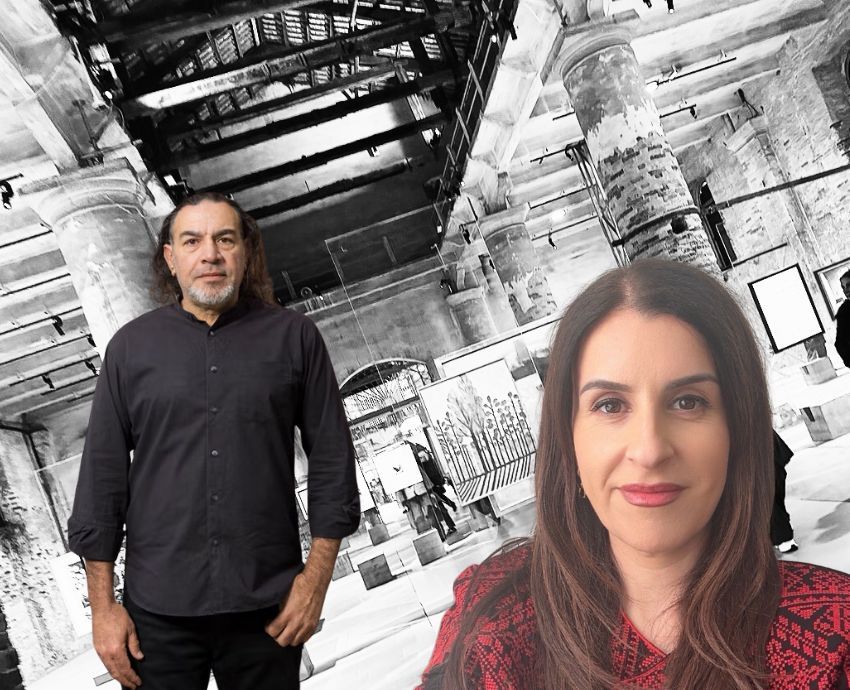
Palestinian-Australian writer and academic Randa Abdel-Fattah had her invitation to speak at Adelaide Writers’ Festival revoked on January 8, with the festival board claiming that “it would not be culturally sensitive to continue to program her at this unprecedented time so soon after Bondi”.
South Australian Premier Peter Malinauskas explicitly backed the move, saying he was “fundamentally opposed” to Abdel-Fattah’s inclusion, because it “runs contrary to current community expectations of unity, healing and inclusion”.
Malinauskas also claimed, unconvincingly, that he “do[es] not suggest in any way that Dr Abdel-Fattah or her writings have any connection with the tragedy at Bondi”.
This intervention is part of a wider attempt by supporters of Israel to silence the Palestine solidarity movement by connecting it to the Bondi massacre, and a racist smearing of Palestinians and Muslims by drawing an association with terrorism.
Laurie Izaks MacSween, member of Jews Against the Occupation ’48, told Green Left: “I refute absolutely that the pro-Palestine movement has anything to do with, or can be blamed for the horrific attack in Bondi. It is disgraceful and dishonest.
“There is a deliberate conflation of Judaism and the Zionist project of Israel in this claim, which erases traditions of Jewish radical thinking, revolutionary action and solidarity with others to fight for social justice.
“Zionism is a supremacist political movement,” Izaks MacSween said. “It’s our responsibility as Jewish people not to be silent or bow to censorship, and to stand with oppressed people.”
The coordinated suppression of the Palestine movement and favouring of Israel’s interests explicitly devalues Muslim life in Australia, with its concerted support of Israel’s imperialist Zionist project.
Simultaneously, in this conflation of Zionism with Judaism, the political establishment arguably feeds into actual antisemitism — a hatred of Jewish people based on Israel’s actions, and the false belief that Jewish people wield malevolent global power. This sabotages the very “unity, healing and inclusion” that Malinauskas claims to support.
The response to the board’s actions, however, was decisive. More than 180 writers and speakers withdrew from the festival in solidarity with Abdel-Fattah and in protest at the board’s conflation of the Palestine movement with antisemitism and the Bondi massacre.
In the days that followed, Adelaide Writers’ Week board members and director Louise Adler resigned, and the festival was cancelled. Afterwards, Adelaide Festival Corporation apologised to Abdel-Fattah and invited her to speak at next year’s festival.
This sequence of events follows a similar pattern to the Creative Australia board — the country’s arts funding body — cancelling Lebanese-Australian artist Khaled Sabsabi last year from the Australia Pavilion for this year’s Venice Biennale. Sabsabi’s work critiques Western imperialism from an Arab-Muslim perspective.
The board’s decision came about at the insistence of Liberal Senator Claire Chandler, overriding the decision of the Creative Australia selecting committee. The cancellation was met with public outcry from artists and arts workers, with a series of open letters and public statements, leading eventually to the reinstatement of Sabsabi as the Australian representative in Venice.
These events reflect a political force beyond the ongoing efforts to suppress Palestinian, Arab and Muslim voices in Australia: the collective power that artists hold to resist this suppression and force cultural institutions to change course. On both occasions, the resistance of creatives and cultural workers overrode political intervention and changed the narrative of how the artist and their work are understood.
What these political attempts at de-platforming artists do, however, is interfere with one of the few places in society where people of differing experiences and standpoints can exchange views, listen, reflect, empathise, disagree without dehumanisation and engage in critical thinking.
At a time when political views are often pieced together by social media content — and where algorithms reaffirm our existing views — cultural meeting points are valuable spaces that must be protected from censorship.
Without such political interference, the arts have the potential to offer an antidote to social divides exacerbated by Israel’s genocide in Gaza, and in other places. For example, for those who believe all support of Palestine is an expression of antisemitism, attending a talk by a Palestinian writer and engaging on a human level with their loss of land and life may make it harder to hold that claim.
Furthermore, without political interference, the work of creatives concerning other pressing world issues — such as Iranian-Australian writer Shookofeh Azar, whose writing explores life under the Iranian regime — would have an opportunity to build understanding and solidarity.
If political intervention in the arts continues unchecked, the consequences will be profound. In censored societies, cultural life becomes hollowed out and reduced to safe representation stripped of political meaning. When culture loses its capacity to question power, the soul of society is starved and democracy erodes alongside it.
Artists must continue to resist in this way and stand up for each other, just as cultural institutions must learn not to cower to reactive and cynical interference from pro-Israel, anti-Muslim lobbyists.
Even with visionary and inclusive programming, however, the exclusivity and elitism of the arts limit its capacity to challenge power structures. Those who have the time to attend Adelaide Writers’ Week, or the money to fly to Italy to attend the Venice Biennale, tend to be economically and educationally privileged — and the ideas explored are generally limited to comfortable sectors of society.”
For art to speak for and to the working class, and to enable a drastically more just society to be imagined, more efforts should be made to support grassroots community arts spaces, on top of free and cheap ticket options.
When artists organise, the creative potential of a society can be protected. If they don’t, censorship can become normalised.
Cultural spaces are vital to the life of our communities, and collective resistance remains the only viable defence. This form of response must be sustained, expanded and grounded in solidarity, or the erosion of cultural freedom will continue unchecked.