
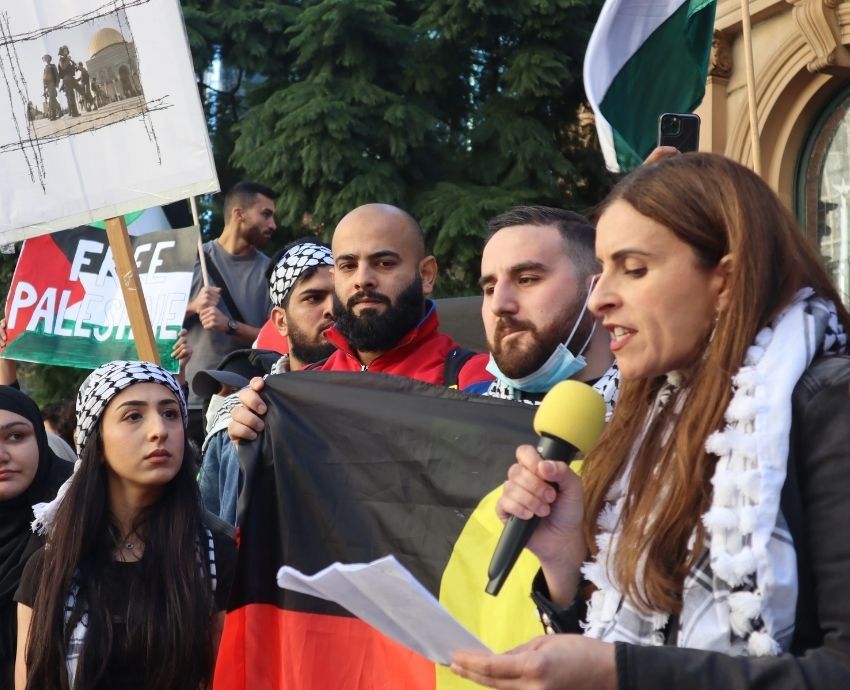
Public outcry over the exclusion of high-profile Australian-Palestinian author and academic Dr Randa Abdel-Fattah from the Adelaide Writers’ Week (AWW) culminated in the event being cancelled on January 13.
The festival board said on January 8 that Abdel-Fattah was advised that it “do[es] not wish to proceed with her scheduled appearance” at AWW, which was due to start on February 28.
There was a huge backlash to the board’s decision, with more than 100 of 124 authors boycotting the event in solidarity with Abdel-Fattah. This happened within a matter of hours of the board making its decision public.
Overwhelming support for the boycott was evident in a plethora of social media comments from members of the public, authors, artists and critics. Many said the decision was a blatant attempt to censor free speech and that targeting a Palestinian author was racist.
Abdel-Fattah has publicly criticised Israel for its genocide in Gaza and its settler-colonial ambitions in the West Bank.
The event has now been cancelled, after more than 180 authors and speakers dropped out in protest. The entire board — including director Louise Adler — has resigned, except for a city council representative, whose term expires next month.
AWW said it disinvited Abdel-Fattah because “it would not be culturally sensitive to continue to program her at this unprecedented time so soon after Bondi”. The board stated it came to this decision based on “her past statements”, but did not give further context. Paradoxically, it also conceded that it “do[es] not suggest in any way that Dr Abdel-Fattah or her writings have any connection with the tragedy at Bondi”.
Why, then, did it link Abdel-Fattah to the Bondi Beach attack on December 14?
There is ample reason to believe that the South Australian government was involved in the AWW’s decision. When questioned, Premier Peter Malinauskas denied his involvement, stating that by law, he is unable to direct the board.
However, he added: “When asked for my opinion, I was happy to make it clear that the state government did not support the inclusion of Dr Abdel-Fattah on the Adelaide writers’ week program.”
He reiterated his support for the AWW’s decision in a subsequent interview, and went as far as to directly link the author with the terrorist events in Bondi, telling the media on January 13: “Can you imagine if a far-right Zionist walked into a Sydney mosque and murdered 15 people? Can you imagine that as the premier of this state, I would actively support a far-right Zionist going to Writers’ Week and speaking hateful rhetoric? Of course, I wouldn’t, but the reverse has happened in this instance, and I’m not going to support that either.”
The AWW board has set up a committee to oversee its review and guide decisions about AWW, now and into the future. Since the AWW has now been cancelled, a new board will be set up.
Given this, we can only wonder which government agencies and external experts will be involved in the board’s decision-making? Will the law change to “lawfully” include government and external experts’ influence in the cultural literary space? Whose voices will be included? Whose will be excluded?
The good reputation of the Adelaide Festival and Writers’ Weeks has been built on the free exchange of ideas and debate. It is an annual cultural event that draws people from around the world and brings communities together.
The hypocrisy of silencing a pro-human rights Palestinian voice at a cultural literary event — intended to be an intellectual exchange of ideas and words — is palpable.
The board needs to give serious consideration to which communities it seeks to serve and engage and if it really does “provide the best opportunity for the success and support of the Adelaide Festival, [and] for Adelaide Writers’ Week”.
The board’s apology on January 13, affirming that AWW will not go ahead, was a further insult to the author and those who had decided to boycott the event. It did not acknowledge the ill-advised decision to silence Abdel-Fattah but rather talked about “how the decision was represented”.
The AWW and the premier’s weaponising of the Bondi atrocity can only be seen as the politicisation of a tragic event to suppress freedom of expression and silence marginalised voices.
As Louis Adler chillingly warned in her opinion piece in the Guardian on January 13: “AWW is the canary in the coalmine. Friends and colleagues in the arts, beware of the future. They are coming for you.”
[Editor’s note: Adelaide Festival Corporation published a statement on January 15 retracting its previous January 8 statement, inviting Abdel-Fattah to speak at next year’s AWW and apologising “unreservedly” to her.
Abdel-Fattah said on January 15 that she accepted the apology and will consider the board’s invitation to participate in next year’s event “at the appropriate time”. She said the recent episode has highlighted the “profound lack of racial literacy in our public institutions”, “need for urgent anti-racism education” and “need for public institutions to have safeguards against political interference by lobbyists”.]