
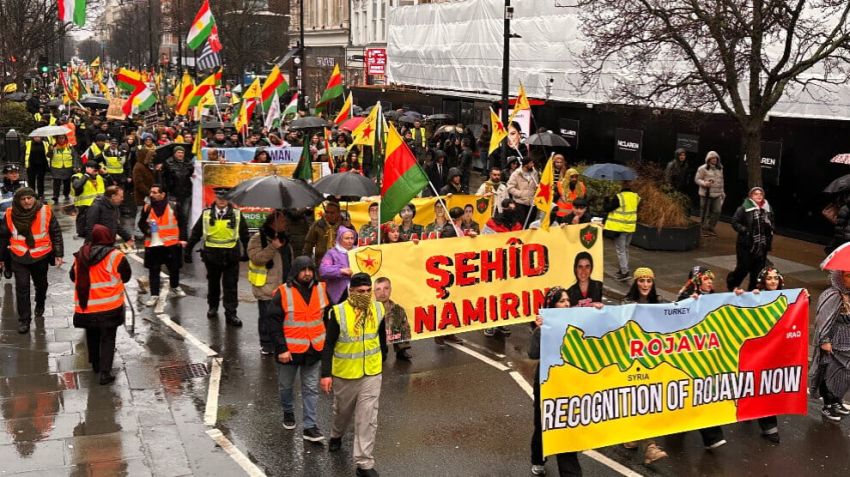
The collapse of the Bashar al-Assad regime in Syria demonstrates how quickly power can change. While Syria’s instability was well known, January’s events have been startling. Sarah Glynn outlines the sequence of events that have reduced the yellow triangle of the Kurdish-led Autonomous Administration of North and East Syria — which covered more than a quarter of the country — to the main centres of Kurdish habitation and forced the Kurds into an uncertain process of integration with the Syrian Transitional Government (STG). Glynn argues that it is clear that the STG and Turkey had planned this operation for a long time, while dragging out negotiations and waiting for a propitious moment.
Timeline of treachery
March 10, 2025 — Mazloum Abdi, commander in chief of the Syrian Democratic Forces (SDF), and Ahmed al-Sharaa, interim president of Syria, sign an agreement to work towards integration of the Autonomous Administration into the administration of the Syrian state. It is an outline framework within which executive committees are meant to agree on detailed implementation by the end of the year.
March 13, 2025 — The STG adopts a new constitution that gives dictatorial powers to the president and is criticised as being in clear contradiction of the agreement with the SDF.
April 1, 2025 — A further agreement is signed between the SDF and STG concerning the two autonomous and predominantly Kurdish neighbourhoods of Aleppo: Sheikh Maqsoud and Ashrafiyeh. These have a combined population of about half a million and are isolated from the rest of the Autonomous Administration. The SDF agrees to withdraw from the neighbourhoods, but is left in control of internal affairs, with lightly armed, internal security forces.
Although the March agreement includes a ceasefire throughout Syria, Turkey’s mercenary militias continue to attack the Autonomous Administration. These attacks lessen as focus turns to the “peace process” with the Kurdistan Workers’ Party (PKK) in Turkey, but they never stop.
Negotiations on the March 10 agreement are slow. Meetings are cancelled by Damascus. Verbal agreements are never put into writing. It is clear that Turkey is putting pressure on Damascus not to agree to any form of regional autonomy.
Meanwhile, Damascus restricts movement from the Autonomous Administration to government areas. This combines with the continued attacks to make daily life difficult.
End of 2025: — Turkey blames the SDF for failing to reach an integration agreement, threatening a military option and promising support to Damascus should they attack the Autonomous Administration.
January 4 — A negotiating meeting between the SDF and STG seems to be nearing an agreement, but before an announcement can be made it is abruptly terminated by the Syrian foreign minister, who is close to Turkey.
January 6 — Following a meeting in Paris facilitated by the United States, Syria and Israel announce that they have come to an agreement. This effectively removes Israel as a potential threat to Turkey’s plans for the north of Syria. Syria is now divided into zones of Turkish or Israeli interest; and with Israeli interests secure, the US has no more need for the SDF to balance Turkish power. As a Syrian official will later tell Reuters, “the Syrian government received a … message from Turkey that Washington would approve an operation against the SDF if Kurdish civilians were protected”.
That same afternoon, STG forces — including the Turkish-backed militias, which have been incorporated into the Syrian army — attack the Kurdish neighbourhoods of Aleppo, breaking the April 1 agreement. In scenes reminiscent of Gaza, they label residential areas military zones and then bombard them. They also target hospitals and round up and abduct civilians, claiming they are combatants. The internal security forces are no match for the fighters ranged against them, who are equipped with Turkish tanks and drones and heavy weapons.
January 9 — European Union Commission President Ursula von de Leyen promises al-Sharaa a political partnership and €620 million. While they are meeting in Damascus, STG forces are pounding residential neighbourhoods in Aleppo.
January 11 — The US mediates a ceasefire, and the remaining security forces leave Aleppo. Dozens of civilians are dead, hundreds disappeared and 150,000 displaced. Many of the attacking fighters have been involved in atrocities committed against Alawites and Druze, and also the Kurds in Afrîn. Videos of atrocities against captured Aleppo residents appear.
January 13 — The Kurdistan Democratic Communities Union — the umbrella group that includes the PKK — puts out a statement that describes the attacks as “a sabotage to the ceasefire and the ‘Peace and Democratic Society’ process”.
The Syrian government, after massing its forces, declares two more SDF-controlled regions as “closed military zones” and targets for attack. These are areas that the SDF took over after the fall of Assad in an attempt to link up with the autonomous Aleppo regions.
January 16 — Al-Sharaa signs a decree giving some rights to the Kurds, at the same time as increasing military bombardments against the SDF areas. This is a decree, not a constitutional change, and appears to be directed at appeasing Western criticism.
With attacks escalating, the US mediates another ceasefire, and the SDF agrees to retreat from the two areas under attack.
January 17 — Before the SDF retreat is fully completed, the STG breaks the ceasefire to ambush retreating troops. It then continues to attack further areas for which there was no agreement for an SDF retreat. The US protests, but takes no action to back up its words.
Fighting is taking place on many fronts, and tribes once loyal to the SDF are changing sides.
Abdi meets with US ambassador Tom Barrack and leaders of the Iraqi Kurdistan Democratic Party in Erbil. There is no public statement.
January 18 — Fighting intensifies and it becomes clear that any idea that the attacks would stop at the Euphrates River was wishful thinking. The SDF is forced to retreat to the Kurdish heartlands (which are home to the majority of the Kurdish population, but remain ethnically mixed).
The STG’s physical attacks are combined with a mendacious propaganda war that attempts to destroy the SDF’s reputation.
STG forces release ISIS prisoners in Raqqa.
Under existential pressure, Abdi agrees to an outline ceasefire and integration plan with al-Sharaa that would see the end of almost all of the gains of the Autonomous Administration. Barrack, who mediated the agreement, congratulates “Two great Syrian leaders, driven by the shared vision of liberating their country and people from tyranny.”
January 19 — Despite the agreed ceasefire, attacks against the SDF continue to escalate.
STG forces capture Ain Issa and the Tishreen Dam, isolating Kobanê.
There are further mass releases of ISIS prisoners by STG forces. While SDF fighters die defending the prisons, the Global Coalition to Defeat ISIS — including the US, Germany, France and Britain — does nothing.
A meeting between Abdi and al-Sharaa in Damascus fails to produce results as the STG attempts to impose total surrender.
Videos circulate of atrocities committed by STG fighters — beheaded prisoners, humiliation and abuse of captured women.
The SDF general command calls on all Kurds everywhere to unite behind Rojava and join the resistance.
Kurds pour into the streets. International protests focus their anger on US embassies.
The Syrian government’s Ministry of Endowments calls for mosques to celebrate conquests and victories against the Kurds. It opens with the same Quranic verse chosen by Saddam Hussein as the name for his genocidal campaign against the Kurds of Iraq.
January 20 — The SDF announces that it has had to withdraw from al Hol, the camp for ISIS families that has long been described as a “ticking time bomb”.
US President Donald Trump shares a message from French President Emmanuel Macron that begins, “We are totally in line on Syria”; also a gushing endorsement from NATO Secretary General Mark Rutte for his “incredible” accomplishment in Syria.
In all the places Kurds live, there are mass protests. Some of the biggest are in Sulaymaniyah, in the Kurdistan Region of Iraq (KRI). Kurdish unity is emphasised everywhere.
Young Kurds from Turkey breach the frontier to support their brothers and sisters in Syria. Others cross into Syria from the KRI.
Barrack, fresh from yet another meeting with the Turkish foreign minister, shares a long social media post in which he makes clear that the US has no more need for the Kurds, and that the al-Sharaa government is its new partner in the fight against ISIS.
A four-day ceasefire is announced.
January 21 — Videos circulate showing packets of “modest” clothing to be given to women in Raqqa, an STG fighter vandalising SDF graves and an ISIS flag flying over a Raqqa gate.
Reports from Tabqa, recently taken over by the STG, describe abductions, looting and the enforcement of black veils. People who had worked with the Autonomous Administration are especially targeted.
The US announces that it is transporting ISIS prisoners to Iraq — suggesting that it has little confidence in its new STG partners to keep them safely locked up.
Kobanê is under siege without water or electricity. The small city is crowded with internally displaced people who have escaped the STG advance.
January 22 — After a video is shared of an STG fighter displaying the severed plait of a dead Kurdish woman fighter, women start plaiting their hair as a symbol of resistance.
January 24 — The ceasefire is extended for a further 15 days.
The Kurdish Red Crescent reports that at least five children have died from the cold in Kobanê.
January 25 — Despite the “ceasefire”, the STG attacks villages. A child is killed, others are wounded.
A United Nations convoy is able to bring some basic supplies to Kobanê, but this is far from enough.
Ilham Ahmed, co-chair of international relations for the Autonomous Administration, reveals that the STG has been executing captured SDF fighters.
Abdi states that the Kurdish region “is our red line”, saying “We will fight until the last person remains.”
January 26 — The STG’s education ministry publishes a decree on Kurdish teaching. Although it describes Kurdish as a “national language”, it only allows for it to be taught as an optional elective for two hours a week.
January 27 — Abdi goes to Damascus to talk with the STG.
Trump tells reporters, “I had a great conversation with the highly respected President of Syria. That area is working out very well, so we are very happy about it.”
January 28 — The Autonomous Administration estimates that there are now about 350,000 displaced people who have fled from areas taken over by the STG.
The STG arrests the co-chair of the Syrian Democratic Council and the media director of the SDF in Deir ez-Zor.
Al-Sharaa visits Moscow and is welcomed by Russian President Vladimir Putin, consolidating Russia’s U-turn towards its former enemy.
January 29 — The bipartisan Save the Kurds Act is introduced into the US Senate.
Motions for protection of the Kurds are passed by the Dutch parliament, the Parliamentary Assembly of the Council of Europe and the Catalan parliament.
January 30 — An agreement is announced between the STG and the Autonomous Administration, facilitated by the US and France. It seems to offer more than on January 18, but the proof will be in the implementation. Will it merely buy the STG political space before unleashing renewed violence? Or can the Kurds pressure international powers to break the cycle of agreement-concessions-attacks? One thing is certain: the struggle goes on.
[Sarah Glynn is a writer and activist. Visit her website and follow her on X and Bluesky.]