
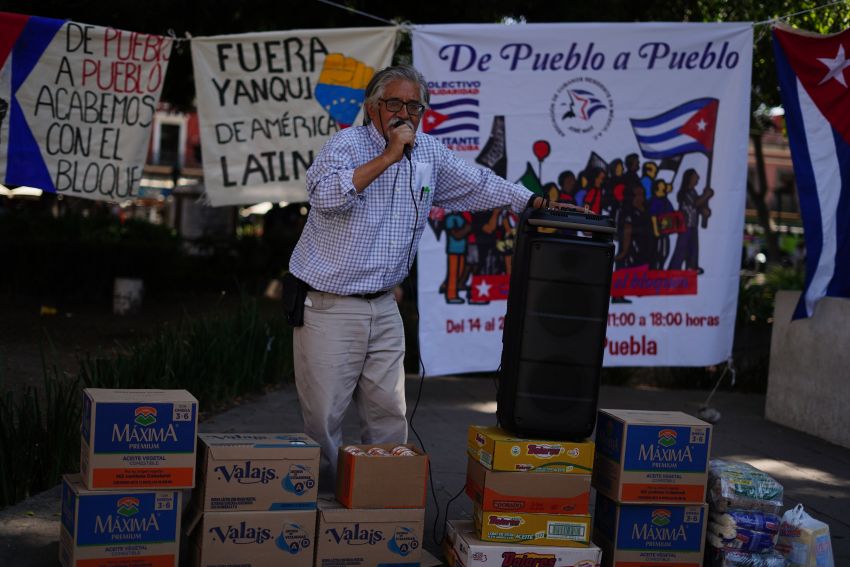
This past week, Mexicans around the country have been donating many tonnes worth of food, medicine and supplies, such as batteries and hygiene products, to Cuba. Movements and activist organisations have set up tents, stands and speak-out spaces to receive donations in main city squares, as well as further collection points in pubs, universities, cultural and resistance spaces and more.
This follows a January 29 executive order from United States President Donald Trump that would apply tariffs to countries supplying Cuba with oil. Mexico was the second-largest supplier of petroleum to Cuba after Venezuela last year, and since the order, has not sent oil, though the government did send 814 tonnes of humanitarian aid on two ships last week.
Since the signing of the North American Free Trade Agreement (NAFTA, now USMCA) with the US and Canada in 1992, Mexico’s economy has been made highly dependent on exporting to, and importing from the US, and increased tariffs would have a significant impact.
Cuba, meanwhile, is suffering severely from the lack of Venezuelan and Mexican oil shipments, in addition to the blockade the US already has on the country. Over recent years, Cuba has installed solar power panels and now generates 38% of its daytime electricity from solar, but for the rest of its energy and for all its public transport, it needs oil. As a result, people now have no way to get to hospitals, to work, or meet other needs, there are difficulties pumping water, delivering liquefied gas and water in trucks, and blackouts are lasting six hours to most of the day, every day.
A resident of Havana told Green Left that Mexico’s first shipment of aid was being distributed around the capital city, primarily to babies, children and the elderly. With the fuel shortages, distribution beyond ports is difficult. Rosa María Rizo Constanten, vice-president of the food division of the Cuban Department of Internal Trade, confirmed that food donated by Mexico would go to children, pregnant people and at-risk individuals.
After causing the fuel shortages in Cuba, White House press secretary Karoline Leavitt stated on February 18 that Cuba “is a regime that is falling (sic), their country is collapsing, and that’s why we believe it is in their best interest to make very dramatic changes very soon”.
Many Mexicans feel a strong solidarity and empathy for the residents of the nearby island, with the resistance there demonstrating what Latin Americans are capable of, in light of US domination and violence in the region.
“There are strong ties between Mexicans and Cubans, especially among the left, the unions and social organisations,” Juan Pablo Prado Lallande, a Mexican international relations professor. told the BBC. “There has historically been social closeness between Mexico and Cuba; historical and cultural affinities, as well as a shared past under Spanish colonialism.”
“You can’t strangle a country like this, it’s very unjust,” said Mexican President Claudia Sheinbaum. “We’re going to continue supporting (Cuba) and taking all necessary diplomatic actions.”
Residents of Mexico City mobilised, on February 15, outside the Cuban embassy to express their solidarity and demand an end to the blockade and that countries be allowed to send oil to Cuba.
Here in Puebla, like many cities and towns around the country, activists set up a collection point in the main square on February 14, which is open daily from 11am to 6pm. Another has been opened in the mathematics and physics department of the Meritorious Autonomous University of Puebla.
“We can’t allow the Cuban people to suffer like this. Cuba has always shown a lot of solidarity with other countries, including Mexico. They’ve sent us doctors and during the pandemic, vaccines,” Libertad Pérez Iniesta, a member of the Puebla Cuba Solidarity Committee, told Green Left at the Puebla collection point.
When the US military kidnapped Venezuelan President Nicolás Maduro, “we felt so angry”, Pérez said. “Here in Mexico, we believe we have to take up this struggle because they have their sights set on us as well. And much of the world. People to people, we have to support each other.”
She said that at one collection point they received more than two tonnes of donations in the first few days, including one retired doctor who donated his month’s pension in supplies. She explained that the supplies would be picked up in trucks and taken to the Veracruz port, then transported on ships to Cuba.
Within two days, the collection centre in the main square of Mexico City had also collected six tonnes of supplies. That collection centre is being organised by the Va por Cuba collective and the José Martí Association of Cuban Residents in Mexico. Some people wrote messages of solidarity on the boxes or packaging, including “Stay strong, Cuba!” and “With love for the Cuban people, from Mexico”.
People hung a giant Cuban flag across a kiosk in the centre of the main square of Chilpancingo, Guerrero state, and the Political National Popular Socialist Group is receiving donations of medicine and food there until the end of the weekend. In Guerrero, there are also temporary collection centres in Iguala, Chilap, and Acapulco.
There are many other collection points, including in Tlaxcala, Veracruz, San Miguel de Allende, León and Oaxaca. Further, the governing party Morena has also opened up collection centres around the country, and the Mexico City party secretary for communications said the humanitarian aid would be sent directly to the Cuban embassy in the capital.
The Zapatista Army of National Liberation, along with over 150 other Mexican collectives and groups, released a statement calling for solidarity with the Cuban people, stating that Cuba, after “more than 60 years of ... aggression by the US government, is being brought to the limit” and called for solidarity from the “people of the world ... to prevent the suffocation of the Cuban people”.
“In the face of Yankee imperialist aggression, the only alternative is human solidarity,” said one participant in the Chilpancingo collection point.