
The tragic killing of Kumanjayi Little Baby, a five-year-old Warlpiri girl, in Mparntwe/Alice Springs has sparked an outpouring of grief and shock across the Northern Territory.
Kumanjayi went missing on April 26 from Ilyperenye/Old Timers town camp — a type of Aboriginal residential town that is a legacy of colonial segregation. It sparked a five-day search, comprising 300 people from her family, local community and wider town.
Her body was found near the Todd River on April 30. Later that day, police found the suspected killer — who had been apprehended and beaten by members of the local community — and transported him to Alice Springs Hospital.
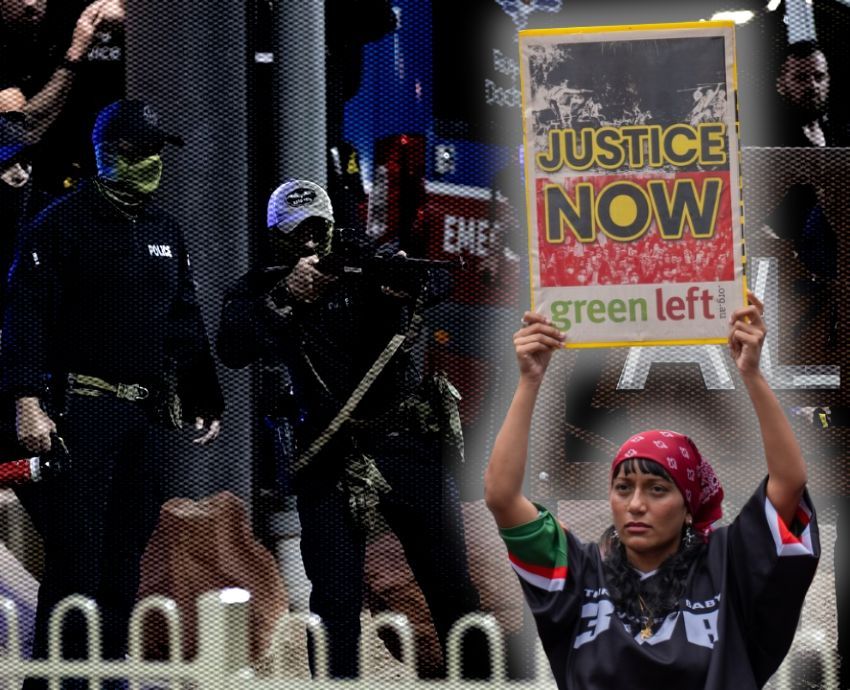
Local community members gathered outside the hospital that night in protest, which police violently dispersed with rubber bullets and tear gas.
Lidia Thorpe, Gunnai, Gunditjmara and Djab Wurrung independent Victorian senator, called for a full and transparent investigation into the crime. She also said how authorities respond to the risks women and children face from domestic violence must be scrutinised.
“This was a known perpetrator. There are questions about how this could happen so soon after his release from custody,” Thorpe said, adding she supports the National Commissioner for Aboriginal and Torres Strait Islander Children Sue-Anne Hunter’s call for an investigation into NT Corrections.
Families and communities “must not be demonised or blamed for the violent actions of one individual”, Thorpe said.
“We are already seeing racist commentary being made about Aboriginal people, and this must stop. People should refrain from sharing footage of violence online, which is only inflaming tensions.”
Darumbal/South Sea Islander journalist Amy McQuire condemned the mainstream media’s coverage of the killing, for “framing this tragedy in terms of dysfunction and deviance”, because it is “the only way” it knows “how to write stories of tragedy in our communities”.
“There have been sections [of the media] that have victim-blamed the parents, who have equated poverty with a lack of care, with no understanding of the history of the town camps,” she said.
“All of these comments and tropes are as predictable as they are inaccurate, and [they] should be condemned outright.”
McQuire said the tragedy shows the “enormous depth of care and love from Black communities towards our children” and “how the loss of any one of our children hurts us all”.
“It has demonstrated just how much Kumanjayi Little Baby was loved, and how she was loved, not only in life, but also in death.”
Arrernte and Luritja woman Catherine Liddle told NITV that the community is in “deep mourning and deep shock”. “Everyone is shaky. No one knows quite how to feel. Everyone’s devastated and heartbroken.
Robin Granites, senior Yapa (Warlpiri) Elder and family spokesperson, told NITV that the priority “must be Sorry Business and respect for cultural practices as the community mourns”.
“What has happened this week is not our way. Our children are precious, of course we are feeling angry and hurt at what has happened,” Granites told NITV on May 1.
Thorpe also called for scrutiny of systemic issues around treatment of First Nations people: “Across the country, and particularly in the Northern Territory, our communities are facing extreme poverty and a lack of basic services and support.
Governments must provide the resources and authority to empower community-led solutions, Thorpe said. “Our families hold the answers and must be trusted and empowered to lead. What we do not need is a return to the interventionist approaches of the past.
“We must examine the role of other agencies to understand how these systems have failed.”
Thorpe said the NT Police must focus on de-escalation, saying the president of the Northern Territory Police Association’s call for more force is “deeply concerning”.
“Right now, there is a youth justice inquiry and a racism inquiry underway. The evidence being heard goes to the heart of these systemic issues. The death of this child is a devastating reminder of how real and urgent this crisis is.
“These inquiries will deliver recommendations. The Anthony Albanese government must work with First Peoples to implement them, not add these reports to the shelf unanswered.”