
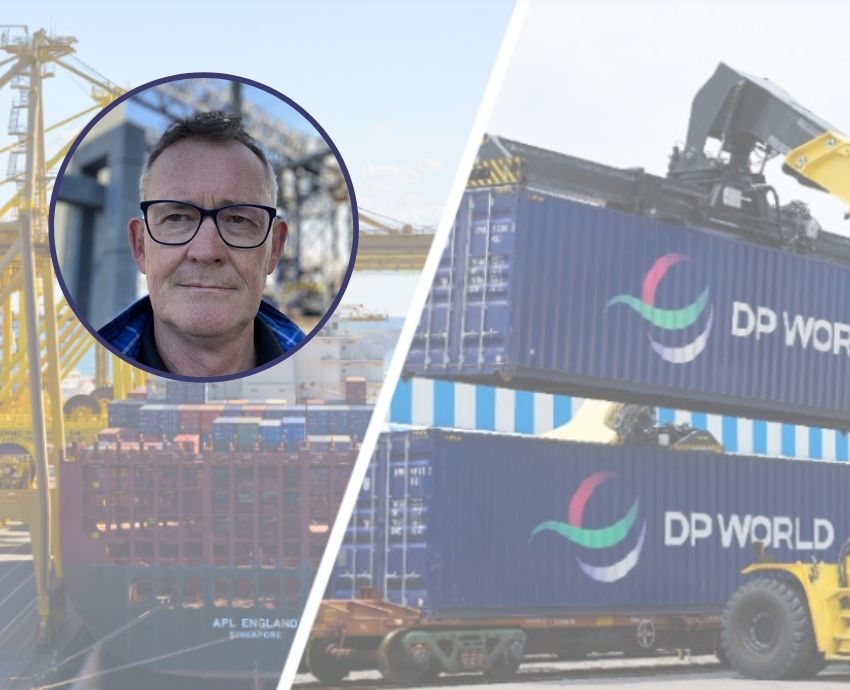
Warren Smith, deputy national secretary of the Maritime Union of Australia (MUA), told Green Left that the union is involved in a critical struggle against multinational corporation DP World’s push to automate its container terminal operations at four terminals across the country. It is a union-busting exercise, he said.
DP World, controlled by the government of Dubai and the Dubai royal family, operates out of Magan-djin/Brisbane, Gadigal Country/Sydney, Naarm/Melbourne and Walyalup/Fremantle.
Smith said that DP World plans a $600 million plus investment to “replace skilled Australian wharfies with automated vehicles and robotic cranes”.
According to the MUA, the company extracts hundreds of millions of dollars each year from businesses and consumers but pays next to no tax.
“Workers’ wages and their taxes — around $70 million in 2025 — make up the company’s primary economic contribution,” it said.
“This automation initiative is not about productivity or supply chain efficiency,” Smith said. “In fact, international evidence shows automated container terminals are less productive, more expensive to run and less safe for workers than ones operated by highly skilled stevedores.
“DP World only delivered its plan after it finalised bargaining with the MUA. It did not raise it during bargaining to avoid the union taking protected industrial action.
“There is no doubt that DP World is using the automation of Australian container terminals as a union-busting exercise against the MUA.”
Smith said AI and automation threatens union jobs, wages and working conditions — all of which have been “hard-won over decades”. He said good, secure, well-paid waterfront jobs are at risk.
“The use of AI and automation will not stop at the waterfront. Most industries and workers are under threat from the for-profit use of new technology. This is why we are developing a huge campaign against DP World, AI and automation, and its use by corporations for profit over community need.”
Smith said the automation challenge at DP World reflects a global corporate trend to sideline workers and to use technology without safeguards.
“Our fight is for workers’ dignity, collective bargaining power and the right to shape technology use in our workplaces,” Smith said.
The Iran war oil shock has promoted the MUA to call on the Anthony Albanese Labor government to swiftly regulate AI in strategically significant supply chain sectors, like stevedoring and port services.
The Centre for International Corporate Tax Accountability and Research (CICTAR), alongside the MUA, launched the Job losses and profit shifting at DP World: How AI automation threatens Australia’s economic wellbeing report at Parliament House in Canberra on March 23.
It set out how DP World’s large-scale AI automation threatens up to 1000 jobs. It would replace skilled, unionised roles with driverless vehicles and remote-operated cranes. The report suggests that DP World’s primary goal is to cut labour costs and boost profits, not improve supply chain efficiency.
DP World’s push conflicts with Labor’s National AI Plan, which requires worker and union consultation.
The MUA is campaigning for a variety of supply chain sovereignty policy measures to help inoculate communities and the economy from global shocks and interference, including the recent oil crisis brought on by the United States and Israel’s illegal war on Iran.
The CICTAR/MUA report recommendations include: enforcing transparency and accountability for AI systems in the workplace; protecting worker data and banning invasive surveillance practices; ensuring safety, job security and public benefit are prioritised over corporate profit; guarantee full bargaining rights and protected industrial action when AI or automation is introduced; and strengthening tax transparency while cracking down on profit shifting and offshore royalty payments.
When the report was released, MUA national secretary Jake Field said that a cyber attack on DP World’s Australian ports two years ago showed that embedding AI and automation software entrenches the risk of foreign interference in essential port infrastructure and that this would be “pure insanity”.
“This company’s only economic contribution to Australia is through payroll tax and the income tax paid by its workers, who Dubai-based executives want to replace with robots. But Dubai’s robots don’t pay tax,” Field said.
Smith said there is “no question” that AI and automation are going to be key issues for the union movement over the next 10 years.
“The Fair Work Act urgently needs to be changed. Just three months after we completed negotiations for a new agreement, during which the radical AI changes were not mentioned, DP World moved to implement these measures to circumvent the industrial laws.
“Unions must have full rights to take protected industrial action to confront this AI threat. We need the unfettered right to strike and take other industrial action to protect our jobs and conditions.
“If we don’t get on top of this, the employers are going to run right over us.
“Right now, AI is being used as a union-busting tool. If these multinational companies can walk over the MUA, what chance will workers have in the finance, warehousing, manufacturing, land transport and retail industries?”