
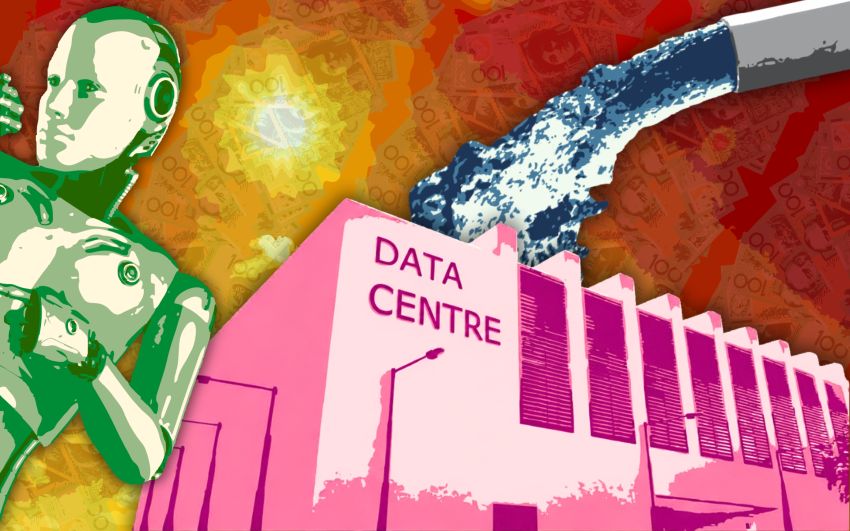
The rapid deployment of new data centres to power artificial intelligence (AI) systems, such as chatbots and generative AI, has enormous and possibly damaging implications for energy systems and the climate.
Data centres house physical hardware that allows for enormous amounts of data to be transferred and stored. They require constant power and cooling, which leads to greater energy and water consumption.
NSW Greens MLC Abigail Boyd, who is chairing a NSW Parliamentary Inquiry into data centres, told the Green Left Show that 90 have already been approved and the NSW government is considering 22 more large-scale projects.
Boyd criticised the lack of long-term planning, saying the government is approaching it from a “project-by-project perspective”. She said corporate owners should be considered as an “extractive industry” because “they are using our data for their own profit and, in the process, taking huge amounts of water and energy and setting back efforts to decarbonise the economy”.
Ketan Joshi, a climate and energy analyst, told the Green Left Show that data centres raise demand for energy and incentivise more fossil-fuel generated power.
Data centres have led to a rise in greenhouse gas emissions and power prices, Joshi said. “Analysis by the Clean Energy Finance Corporation found that no matter whether data centres build their own renewable energy or not, there will be some increase in power prices.”
Boyd said most data centres are “not paying for the upkeep and improvements to the grid that all of us are paying in our power bills”.
Joshi said data centres often have their own onsite energy generation, usually diesel- or gas-powered. One planned facility in NSW, operated by Cloud Carrier, wants to construct a 700 megawatt gas-fired power station. “It’s very, very large.”
Boyd said that is the same size as the Kurri Kurri gas-fired power station: “That’s a massive amount of gas and emissions.”
Boyd said data centres are set to use up 11% of the state’s electricity and 20% of total Sydney water usage within five to 10 years. She said the Marsden Park Data Centre in Western Sydney — which will be the largest in the Southern Hemisphere — is set to use as much energy as 140,000 homes.
While some data centres are being constructed with renewable energy power, it is often only a small percentage of the centre’s overall energy use.
Carbon credits
Joshi said many tech companies are using renewable energy credits and power purchasing deals to greenwash their data centres.
The idea is that renewable energy companies offer certificates to incentivise companies to fund the set up of new solar or wind farms. However, some companies have claimed renewable energy credits from projects that had already been completed.
Amazon recently announced eight new power-purchasing deals and claimed that all but one were new projects. However, the one already-established project, the Golden Plains Stage Two wind farm in Victoria, which accounts for 60% of the total energy, and was completed in 2022.
“Amazon cannot claim that the deal they are doing in 2026 is what got that project over the line in 2022,” Joshi said. “Amazon will take the output of that wind farm, put it against their grid emissions consumption — which we know increases demand for coal and gas and causes more emissions — and will claim they are carbon neutral.
“That has a huge effect … It ends up massively overstating success from the companies.”
While data centres can drive investment in renewables, Joshi said if the end goal is a clean, safe power system, “it is not going to help to increase renewable energy capacity two times, but increase total demand five times. That’s a net worsening of the system.”
Water consumption
OpenAI CEO Sam Altman claims that data centres’ enormous consumption of water is not a problem.
Water is needed to remove the enormous amount of heat that radiates from the hardware. Typically, data centres will take water from a river or water supply, use it for cooling, and return the hot water to the original supply.
“Water is not destroyed in the same way a lump of coal is, but it is often polluted with contaminants and very hot,” Joshi said.
He said Big Tech tries to downplay the use and impact of water consumption and that companies “go a long way to hide water consumption information so it can’t be truly scrutinised”.
They use “bluewashing” strategies to downplay impacts, including promising to build water treatment facilities in other towns, “applying the same broken thinking behind carbon and energy offsetting”.
Boyd reported that Sydney Water has already warned that data centres will lead to rising water costs for households.
Community resistance
Communities have become more aware about the impacts of data centres, but Boyd worries they haven’t been given a say about their location.
Sanaa Shah, from Sweltering Cities, who has been surveying communities in Western Sydney, said “people who live close to these data centres said there had been no consideration about the potential impacts on heat and water resources”.
She said people are also concerned about the noise pollution; data centres emit a constant humming noise, which has been compared to living under a flight path.
Other concerns are air pollution and impacts on biodiversity, as well as wider issues about the rapid growth of AI, including its role in promoting discriminatory content online.
Shah said communities are getting organised, forcing local councils to as well. The NSW Parliamentary Inquiry received 134 submissions, many of which called for a moratorium, or slow down, on new data centre approvals.
Boyd is unconvinced that we need most of the data centres in the pipeline. “Some are being used for military technology, to back up drones used to attack innocent civilians in other countries. Some are used for pure AI ‘slop’ and others are used for applications we might think are actually useful.
“We have to weigh up the resource use with what those data centres are being proposed for … and ultimately give communities a say.”
Joshi said “green” or “sustainable AI”, while theoretically possible, is not happening. “These systems have been designed from the ground up to be excessively inefficient.
“When you put in a prompt, you often get three or four paragraphs for what could have been a ‘yes’ or ‘no’, which consumes significantly more energy.”
Joshi said some companies have even set targets to increase energy consumption. “It has been developed so that you overuse it and apply it to things it doesn’t make sense for.”
Will the AI bubble pop?
Some claim that AI is just the latest tech fad that will eventually pop and fade away, like NFTs (non-fungible tokens) or Bitcoin. Joshi said there will be a re-adjustment, but the new energy demand will spur on new fossil fuel projects.
“You can imagine seeing 90% of the new projects being scrapped and thinking ‘Wow, the bubble popped’. But I look at that 10% as a lot of new fossil fuel infrastructure, gas pipelines, gas-fired power stations and extra demand on the power grid.
“We don’t talk about Bitcoin anymore because the ‘bubble popped’, but Bitcoin power consumption was higher last year than it ever has been and probably more than AI energy consumption globally. It just became more and more inefficient to get the same amount of money.”
Joshi said tech companies want AI to be baked into society “in the same way that SUVs and single-use plastics are”. “The industry knows that doing this will be profitable [for them], even if it comes with rising fascism, war and climate denial.”