
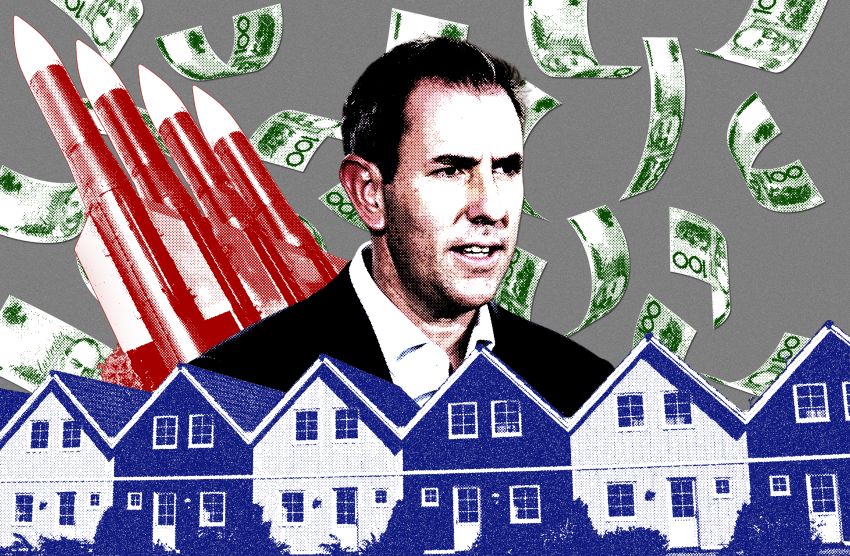
Labor spun its May 12 federal budget as “the most significant transformation of Australia’s tax system in more than a quarter of a century”.
It has trimmed back the three infamous tax perks for the rich: negative gearing; the capital gains tax (CGT) discount; and the discretionary trust tax minimisation scam.
The Coalition and Pauline Hanson’s One Nation MPs and the Murdoch media have amplified this spin by squealing like stuck pigs.
However, the truth is that Labor’s budget only partially rolls back these tax perks.
The limits on negative gearing only affect properties acquired after May 12 and negative gearing remains in place for new builds. The CGT discount will be partially wound back from July next year. The budget estimates that these two reforms will bring in extra revenue of $1.4 billion in 2028–29 and $2.3 billion the following year.
That’s a very small proportion of the $22 billion that the Parliamentary Budget Office estimated is revenue forgone from the CGT discount just this year.
Labor claims these reforms will address the acute housing crisis and bring home ownership back within reach.
But the budget papers admit the price of housing will continue to rise, only more slowly. Housing prices rose 407% between 1999 and 2026 — more than twice as fast as average incomes. As a result, median housing prices have risen from four times the average full-time earnings in 1999 to eight times.
The overall home ownership rate (including those still paying off mortgages) fell by 3% since 1981, but by 17% for younger families.
The average size of home mortgages has also grown exponentially. The Australian Bureau of Statistics said while buyers borrowed roughly three times their income in the 1980s, they are currently borrowing up to 10 times their annual income.
When the John Howard Coalition government introduced the 50% CGT discount in 1999, it accelerated the already growing gap between wages and house prices by encouraging speculation.
But Labor’s reforms will not undo the damage.
To seriously tackle the housing crisis, there needs to be a big investment in public housing, rent controls and the incomes of those hardest hit need to be raised. This budget does none of these.
Lower-paid workers will get $4.80 a week in tax cuts in 2028, but there is no income rise for the 3.7 million people trying to survive on welfare payments that have been well below the poverty line for decades.
While the budget expects inflation to rise to 5% over the year, it concedes that the prospect of further oil shocks, driven by the wars in the Middle East, could mean greater cost-of-living rises and a possible global recession.
A rise in the cost of living impacts poorer households disproportionately. Labor’s budget spin ignores the pain and insecurity flowing from the imperialist war-charged economic deterioration for these people.
The biggest budget cut, however, is $36.2 billion from the National Disability Insurance Scheme (NDIS) over the next four years. About 160,000 current NDIS participants will be thrown off and a further 140,000 will be denied access.
Meanwhile, the budget continues to funnel an additional $53 billion over the next decade to the military — a rise from 2.8% to 3% of gross domestic product by 2033. This includes $2.13 billion for the Australian Submarine Agency to bolster the AUKUS deal. The arms corporations in the United States will be the biggest beneficiaries.
The big fossil fuel corporations are also big winners from Labor’s budget.
Even before the cuts to fuel excise in response to the US-Israeli war on Iran, The Australia Institute estimated fossil fuel subsidies were $16.3 billion over 2025–26. This would have been a rise of 9.4% on the previous year, a larger increase than the 7.6% growth of the NDIS that the government was screaming about.
But the fossil fuel industry, which is raking in super profits because of the Strait of Hormuz closure, gets even more in this budget — $2.9 billion is being spent on halving the fuel excise and cutting charges on heavy vehicles, and $10.7 billion is allocated to increase fuel storage and secure more fuel.
As the Climate Council pointed out, the latest oil shock is a missed opportunity to speed up the switch to renewable power and ensure greater energy security, while cutting climate pollution permanently.
The budget also ignored the popular campaign to impose a 25% tax on gas exports, which could have raised $17 billion a year. That could have helped address the urgent social and environmental needs that the budget ignored, if not worsened.
Green Left campaigns to build a political alternative to the big business-first parties. Help us continue by becoming a Green Left supporter from $5 a month, or making a donation to our 2026 Fighting Fund.