
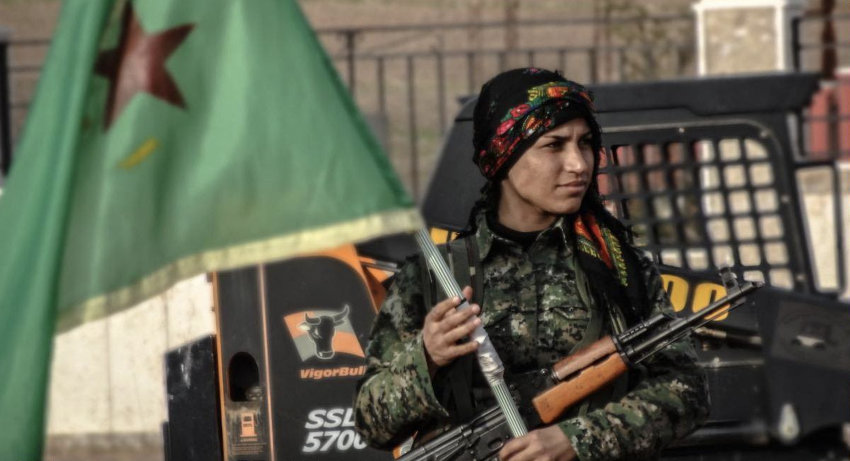
A coalition of women’s organisations in North and East Syria (Rojava) launched a mass campaign, “We are all YPJ — Self-defence is our natural right”, on April 26, demanding that the Rojava revolution’s Women’s Protection Units (YPJ) be included in Syria’s integrated armed forces.
Mass rallies have taken place in Europe and prominent women’s rights leaders from around the world have declared their support.
The campaign has six demands:
1. Recognition of the YPJ within the Syrian Ministry of Defence.
2. Preservation of the YPJ’s structure in the Rojava regions.
3. Protection and consolidation of women’s achievements in Rojava.
4. Release of detainees, return of the bodies of martyrs and disclosure of the fate of missing women.
5. Support for YPJ’s integration by relevant international actors.
6. Strengthening of women’s participation in military and security institutions.
Since the January 30 ceasefire agreement, the Kurdish-led Syrian Democratic Forces (SDF) have been negotiating with the United States-backed Syrian Transitional Government (STG) about the integration of their armed forces in a way that supports the peaceful unification of a country that has been torn by civil war since 2011.
The Kurdish-led People’s Protection Units (YPG) and the YPJ were part of the SDF, but while agreement has been made to integrate four brigades of the SDF, stationed in Rojava to assure security for the Kurdish-majority regions, the STG under President Ahmed al-Sharaa (who was once an Al Qaeda and Hayat Tahrir al-Sham commander) is balking at integrating the women fighters of the YPJ into the Syrian armed forces.
According to Meghan Bodette of the Kurdish Peace Institute, while Syrian Kurdish leaders want YPJ fighters to be allowed to integrate into these four new brigades, so far, the STG has rejected this demand because its leaders are ideologically opposed to women’s equality.
Women’s right to self-defence is non-negotiable, insists the YPJ, and its recognition within the Syrian army, whilst preserving its unique structure and command system, is part of a democratic solution and the integration process.
The YPJ says that building peace and security in Syria requires the active and organised participation of women in decision-making and security institutions.
The actual experience of the YPJ — first formed in 2013 — expressed women's will to protect their communities and defend dignity and shared living in the face of unspeakable violence and violations of human rights during the civil war, not least by the Islamic State In Syria (ISIS). ISIS controlled much of Syria and Iraq until it was defeated by the YPG and YPJ at the cost of more than 11,000 martyrs.
YPJ fighters have been the driving force in protection against terrorism and extreme violence and serve as a moral and social force that has helped protect women from violence and extremism and reinforced the values of women’s participation, equality and justice.
The YPJ has had a powerful impact on women in Syria and worldwide, said YPJ Commander Rohilat Afrin in a video statement issued on May 10.
“The YPJ is not just an armed force,” she said. It is a “culture of defending ourselves, even in our own homes. The YPJ’s strength is the strength of self-organisation.”
Recognition means peace and stability
“The recognition of the YPJ will lead to peace and stability in Syria. It will lead to diversity and to women participating in the system with strength.
“One of our fundamental goals is to defend these achievements [of the Rojava revolution] as part of that diversity and legacy that women have trusted in.”
“We are currently in the midst of discussions and we are working to reach an agreement that women are officially protected.
“This is not an extra right because fundamentally it is about taking responsibility for the legacy of the past 15 years. I can say with confidence that the YPJ is recognised by society as legitimate…
“In the framework of integration, a lot of tasks are discussed. Integration means how we will live together: the Kurdish people with their rights and other parts of society with theirs.
“Everyone must feel represented in the new Syria…
“One of our greatest goals [in these discussions] is to ensure that women’s rights in Syria are guaranteed. And the Rojava Revolution, which is a women’s revolution, is not just history that we tell each other every day…
“Within this system, within all organisations, women have proven themselves…”
Afrin added that if women’s rights are guaranteed in the constitution, this will be a guarantee for the future of the whole of Syria.
A foundational value of the YPJ is that there can be no democratic society without women’s liberation.
Women's participation and organisation within military and security institutions also aligns with the principles of United Nations Security Council Resolution 1325 on women, peace and security, which emphasises the fundamental role of women in building stability and peace, said Afrin.
Until this is achieved, Syria cannot be regarded as safe or stable, she said.
Socialist feminists in Australia have issued the following solidarity statement in support of the YPJ:
Solidarity statement from socialist feminists in Australia
We socialist feminists in Australia stand in solidarity with the freedom fighters of the Women's Protection Units (YPJ) who continue to defend the rights, dignity and freedom of women of all nationalities, ethnicities and religions that they fought for and won in the Rojava Revolution.
Women’s participation in all fields, including participating in organised community defence and protection, is a right that must be defended. Recognising the YPJ and respecting its right to continue to exist in a new Syria is essential if Syria is to have a democratic, united and peaceful future.
The statement is signed by: Sue Bolton, Lisa Macdonald, Sue Bull, Susan Price, Pip Hinman, Valeria Ledda, Aisha Sultan, Markela Panegyres, Arlo Valmai, Olivia Carney, Nova Sobieralski, Paula Sanchez, Dr Coral Wynter, Robynne Murphy, Merrilyn Treasure, Karen Fletcher, Rachel Evans, Zoe Davison, Janet Parker, Mary Merkenich, Sally Atkinson, Laura Smith, Catherine Brown, Melissa Johns, Carine Visschers, Melanie Pittard, Alexandra Rosche, Dr Kamala Emanuel, Laurie MacSween, Philippa Skinner, Sonia Qadir, Norrian Rundle, Candice Alisha, Meredith Lawrence, Jessie Rye, Sarah Hathway, Jepke Goudsmit, Juanita Spinelli, Paula Corvalan, Gabrielle McCutcheon, Chloe de Silva, Jacqueline Kriz, Aaisha Slee, Steffi Leedham, Karyn Brown, Zara Lomas, Bernadette Krone.