
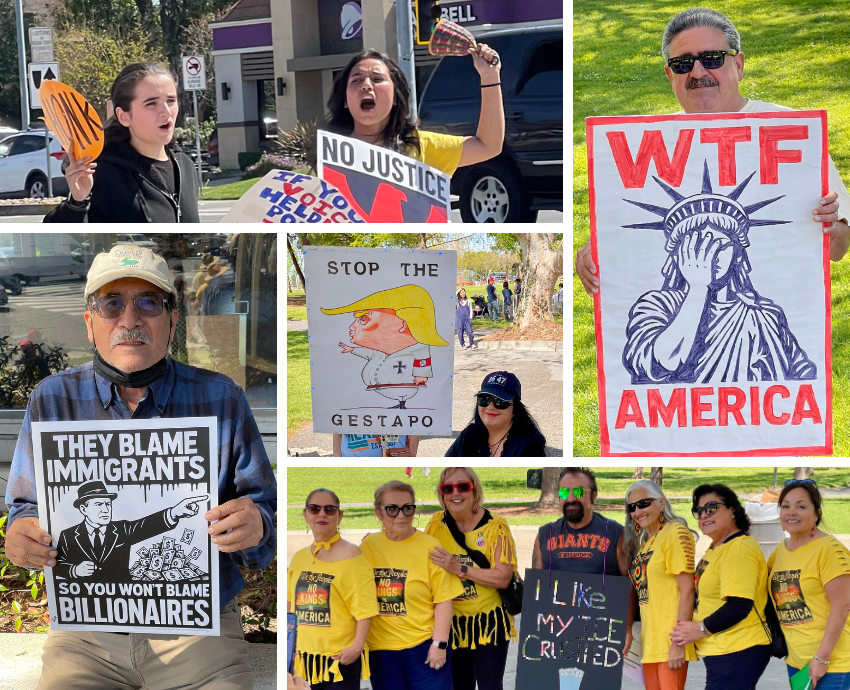
In the United States, more than eight million people marched and rallied in 3300 cities and towns across 50 states, on March 28, in the largest “No Kings” day of protest to date.
About 350 protests were held in California alone. Participants brought homemade signs featuring creative slogans such as “Resist like it’s 1776”.
More than 500 groups organised the actions, agreeing that the flagship protest would be in Minnesota’s capital, St Paul, where more than 200,000 people marched and rallied. More than 350,000 people marched in New York City, while 100,000 marched in Chicago, Boston and Washington DC.
Minneapolis and St Paul are known as the Twin Cities, separated by the Mississippi River. Minneapolis was where US President Donald Trump unleashed a lethal paramilitary operation against Latin and Somali immigrants. Mass community resistance confronted Immigration and Customs Enforcement (ICE) and Border Patrol agents as they swept neighbourhoods, targeting schools, shopping centres and workplaces, spurring solidarity actions across the country.
During “Operation Metro Surge”, ICE and Border Patrol agents shot and killed Renee Good and Alex Pretti, two white US citizens who were present at the protests.
‘Full-scale assault on rights’
Minnesota Democratic Congress representative Ilhan Omar spoke at the St Paul No Kings rally. Trump has targeted Omar with his vitriol because she is a Black immigrant from Somalia. Trump has called for all Somalis, including the large community in Minnesota, to be expelled from the US.
“Operation Metro Surge was just the tip of the iceberg. We are witnessing a full-scale assault on our rights, our institutions, and the rule of law,” Omar told the rally.
Actress Jane Fonda, famous for her opposition to the Vietnam War, read out a statement to the St Paul rally from Good’s wife, Becca, who wrote: “I am so proud to call Minneapolis my home. I can’t stop talking about how absolutely beautiful it is to see how Minnesota shows up for its people. I want to thank you for how you’ve shown up for me, how you’ve shown up for all the people victimised by this horrible moment in history.
“So many people have reached out to me and surrounded me with safety and care … The reality is I am heartbroken. I miss my wife … We were robbed of an incredible human.
“It has made people pause and take a breath and have to choose sides.”
Nekima Levy Armstrong, a civil rights attorney, who along with Monique Cullars-Doty, co-founded Black Lives Matter Minnesota, also spoke at the rally.
Armstrong, along with Chauntyll Louisa Allen and William Kelly were arrested following an anti-ICE protest at a local church, on January 18, and charged under the FACE Act, a federal law protecting access to abortion clinics and places of worship.
Celebrated singer-songwriter Joan Baez, who was prominent during the anti-Vietnam War protest movement, performed at the protest.
Independent Vermont Senator Bernie Sanders told the rally: “Let us be honest … the American people were lied to about the war in Vietnam. We were lied to about the war in Iraq. And we are being lied to today about the war in Iran. This war must end immediately.”
Singer-songwriter Bruce Springsteen, spurred on by the Minneapolis events, came out of retirement to write “Streets of Minneapolis”, which he performed at the rally, the song’s powerful lyrics ringing out:
Through the winter’s ice and cold, down Nicollet Avenue
A city aflame fought fire and ice ’neath an occupier’s boots
King Trump’s private army from the DHS, guns belted to their coats
Came to Minneapolis to enforce the law or so their story goes
Against smoke and rubber bullets, in the dawn’s early light
Citizens stood for justice, their voices ringing through the night
And there were bloody footprints where mercy should have stood
And two dead left to die on snow-filled streets, Alex Pretti and Renee Good.
Along with “Abolish ICE”, prominent banners at the No Kings protests opposed the US-Israeli war in Iran.
No support for Trump’s war
This is the first foreign war that most people in the US have been against from day one. As Sanders said, it is based on a lie. The so-called “Gulf of Tonkin incident” was used to justify the US decades-long war in Vietnam and the invasion of Iraq was based on the lie that Saddam Hussein had weapons of mass destruction.
No Kings demonstration organisers noted that 40% of protesters came from rural areas, higher than the previous No Kings protests in October, which drew more than 7 million people. More young people turned out this time, too. They don’t want to be sent to war.
Hand-drawn signs talked about affordability, as the price of petrol and food rises, accelerated by Trump’s war. Healthcare is becoming more unaffordable, while the Pentagon is spending US$2 billion a day on the war and seeking another $200 billion in funding from Congress.
Before the protests, Whitehouse spokesperson Abigail Jackson described them as “Trump derangement therapy sessions” and said the only people who cared about them “were the reporters paid to cover them”. Yet, even the pro-Trump Fox News reported that 500 groups had co-sponsored the marches. Although, it added the smear that “communists” were key players.
After the No Kings protests last year, Trump’s allies called the marches “hate America rallies”, accusing “radical leftists working as foreign agents” of organising them. USA Today reported the following morning that “some Republicans” depicted the No Kings movement “as a band of radicals, out of step with mainstream political opinion”. House Speaker Mike Johnson reportedly said the protests had brought together “the Marxists, the socialists, the antifa advocates, the anarchists and the pro-Hamas wing of the far-left Democratic Party”.
This time, there were 3300 locations (up from 2700 last October) with rallies in rural and suburban plazas and shopping centres. Organisers encouraged protesters to stay in their local areas.
At the same time, No Kings protests in major cities like New York, Philadelphia, Boston, Chicago, Los Angeles, San Francisco and Seattle were exceptionally large and diverse.
Protests were also organised across Florida, including near Trump’s Mar-a-Largo mansion and golf course — where he was playing on the day. The protest was peaceful, as was true across the country.
What next?
While media coverage always focuses on bourgeois elections as the only way to stop Trump, this is only partially the case.
Trump plans to restrict the right to vote with his “Save America” law (the Safeguard American Voter Eligibility (SAVE) Act) that will require proof of citizenship to register and vote. According to its proponents, such as Kristi Noem, this is designed “to make sure we have the right people voting, electing the right leaders to lead this country”.
The law was passed by Congress in March, but is still being debated in the Senate. Some states are planning to introduce similar laws if the federal law is not enacted.
These proposed electoral changes are one reason why so many elected Democratic Party officials joined and spoke at the events — many more than last June and October.
But that’s not why most organisers are building the movement.
Historically, mass movements have taken years, if not decades, to bring about social change. The civil rights revolution of the 1960s took more than a decade to force real change after the Supreme Court ruled in 1954 that legal segregation in education was unconditional. It took until 1964 and 1965 for Congress and the president to sign the laws to officially end Jim Crow segregation.
The Vietnam War did not end until the mid-1970s, after years of armed Vietnamese resistance and mass protests in the US and elsewhere. Most Democrats only joined the protests after the US was heading for defeat.
Women’s rights and LGBTIQ rights were won on the streets, too.
All these gains are now being rolled back by Trumpism and the imperial presidency. The US-Israeli war in Iran, Lebanon and Gaza will only end by mass resistance and protest movements. The election of anti-war candidates will likely happen in future — buoyed by a mass anti-war movement.
On the back of the successful “No Kings 3” day of protest, more “No Kings, No Trump” protests are planned for May Day.