
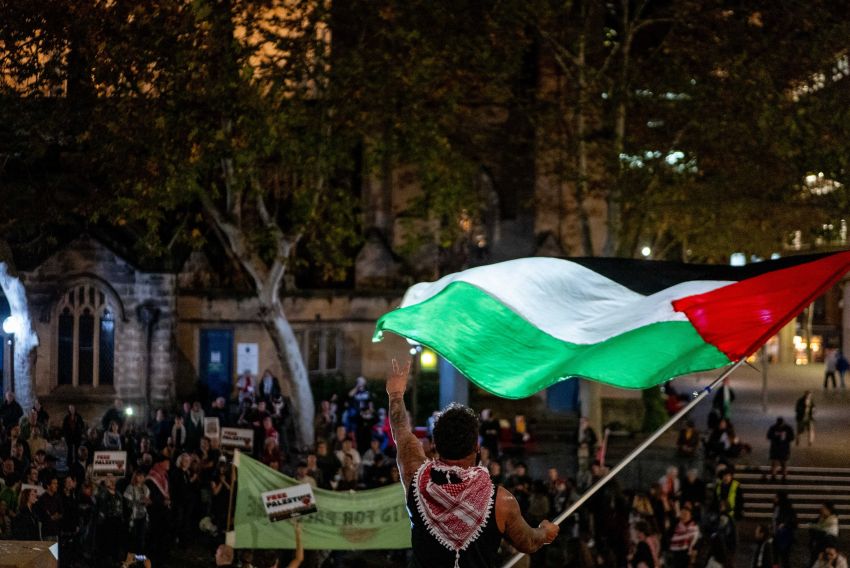
Following the Bondi terror attack and the establishment of the Royal Commission into Antisemitism and Social Cohesion, debates over public safety, freedom of expression, the legitimacy of political protest and the relationship between solidarity with Palestine is even more widespread.
Supporters of Israel are increasingly alleging that solidarity with Palestine, political protests and anti-war activism are inciting “extremism” within society. Their voices have been and amplified by the political and media establishment, and now inside the royal commission.
However, no evidence has been presented which shows a link between those responsible for the Bondi attack and the pro-Palestine protest movement. Neither has there been legal evidence showing that pro-Palestine demonstrations, or solidarity activism, were part of the planning or direct incitement of the December attack.
Importantly, the legal process surrounding the attack is ongoing. This means that many questions about motive, ideology, and possible connections remain unresolved.
Despite this, there are concerns that the commission will expand the definition of antisemitism to include criticism of Israel, or Zionism, or even pro-Palestine protest movements.
This is concerning to those who support freedom of speech.
Instead of a clear distinction between legitimate political activity and criminal violence, there seems to be a grey area emerging in which the boundaries of acceptable political expression are being redefined.
In any democratic society, this is a deeply serious development.
This process can be understood through the concept of “securitisation”, where a political or social issue becomes framed as an exceptional security matter.
Once this happens, wider surveillance, suspicion and restrictions on political expression can become easier to justify.
In this context, criticism of Israel or solidarity with Gaza may no longer be treated as legitimate political positions, but as issues increasingly viewed through a security and moral lens.
Over time, political symbols and protest language can become associated with “threat”, even when no direct evidence exists.
The danger of such a securitisation process is not limited to politics. It can also shape the social and cultural environment.
When pro-Palestine protests or political speech are repeatedly linked to ideas of danger or extremism, a kind of “chilling effect” can emerge. People may begin to censor themselves, avoid public expression, or fear being stigmatised simply for expressing political views.
What makes this even more significant is the relationship between power and knowledge. According to Michel Foucault, power does not operate only through laws and courts, but through shaping public discourse and defining what society sees as “truth”, “danger” and “acceptable behaviour”.
In other words, institutions, experts and media organisations do not simply describe reality. They also help shape and redefine it socially. During periods of fear and polarisation, this becomes even more sensitive, because the issue is no longer only the crime itself, but the way the image of “threat” is socially reproduced.
This is visible in some of the discussions surrounding the commission. There was criticism over its refusal to allow the Australian Palestine Advocacy Network or Loud Jew Collective to appear before the commission, or provide direct testimony to the hearings.
The commission’s conclusions will obviously be shaped by which voices it allows to participate.
Many Palestinians and Muslims feel that growing hostility directed toward them does not receive the same level of public or political attention.
Genuine social cohesion cannot be built by protecting one community from hatred while ignoring other forms of racism or dehumanisation.
Combating antisemitism is a moral and social necessity. The same is true for combating Islamophobia and anti-Palestinian racism.
Protecting society from hatred should not be a justification for restricting political expression, or redefining legitimate protest as a permanent space of suspicion.
In democratic societies, criminal responsibility remains individual, not collective. Political movements, protest groups, or entire communities cannot ethically or legally be held responsible for actions that have not been directly linked to them.
The absence of evidence does not prevent investigation, nor does it reduce the seriousness of the crime or the need for accountability. Democracies are tested by their ability to resist generalisation and protect public freedoms before all facts are finalised, not only afterwards.
In the end, one of the greatest dangers during periods of fear and polarisation is the use of collective shock to narrow the boundaries of legitimate political expression.
Democracy must be measured not only by its ability to protect security, but also by its ability to protect freedom of expression and political protest, especially during difficult moments.
[Shamikh Badra, originally from Gaza in Palestine, is a convener of the Coalition for Justice and Peace in Palestine and a PhD candidate at the School of Humanities and Social Inquiry at the University of Wollongong.]