
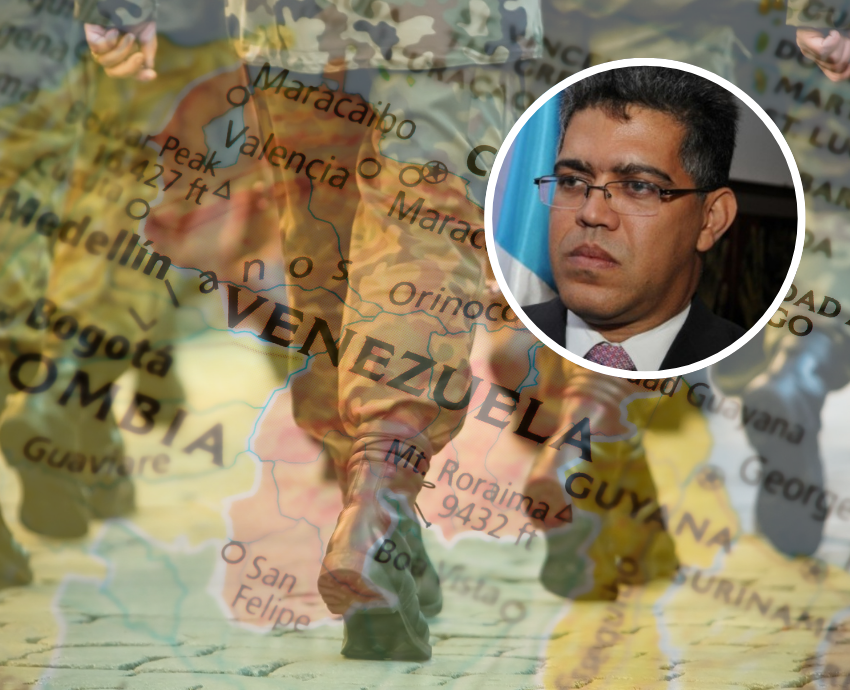
Elias Jaua is a Chavista, socialist and former Venezuelan vice-president under President Hugo Chávez. He directs the Centre for Studies on Socialist Democracy, in Caracas.
In the second of our two-part interview, Green Left’s Federico Fuentes speaks to Jaua about the response inside Venezuela to the January 3 United States military assault.
Jaua also discusses his views on the Nicolás Maduro government, the state of the United Socialist Party of Venezuela (PSUV) and popular participation today.
Read part one here, or read the full, unabridged interview at links.org.au.
* * *
What has been the mood of the population since January 3?
There are mixed feelings.
Regarding Nicolás Maduro’s kidnapping, one section of the population condemns it, but another section celebrates it and identifies with these events.
But then there is the act of military aggression and tutelage that has only just begun, which causes anguish, pain and a sense we are losing our republic.
People do not fully understand what our new status with the US is, but everyday reality demonstrates that this status is that of a state under tutelage. This generates a sense of shame, which grows stronger daily.
There is also a sense of expectation that the country’s economic and social situation will improve.
In those early days, amid the confusion and pain, among both those who celebrated and rejected the military aggression, the underlying sentiment was: “Look, everything is going to get better.” We were already imagining ourselves in a state of economic prosperity.
This was because Venezuelans — especially since Hugo Chávez’s death — have been subjected to systematic aggression, which undermined the entire system of social rights, political participation and hope in building something different.
Everyone wants the situation to improve. But there has been no significant change. Four months have passed and the day-to-day economic situation of Venezuelan families is worse than before January 3.
How can we characterise Acting President Delcy Rodríguez’s government and its actions?
The current government must be characterised, and its actions understood, on the basis that it is subject to military coercion with national resources being administered by a foreign government. That is the reality.
Now, the set of policies enacted, particularly regarding oil and mining, undoubtedly represent a step backwards with respect to the gains and achievements in terms of sovereignty that Venezuela had made over almost 100 years, and which had been consolidated and expanded during Chávez’s government.
The Hydrocarbons Law, for example, after its reform just days after the military attack, establishes that operational control of the entire oil production process, from extraction to commercialisation, can be handed over [to private hands]. This takes us back to a situation similar to the 1930s.
Very serious changes have occurred, such as allowing oil royalties to be set as low as zero. This is one of several changes that have seriously set back Venezuela’s oil sovereignty.
Given the situation, could the government be doing anything different? If so, what could be done?
I am very careful about giving advice to the government or speculating on what it should or should not do. I was in the government and I know that in government you have information that is not public, access to more precise data, which forces you to make certain decisions.
I can only say that the decision to not respond to the January 3 military attack seems to have been the right decision at the time, to prevent the total destruction of our Armed Forces and huge harm to the civilian population.
But four months on, the Venezuelan state should be denouncing internationally the coercion to which it is being subjected.
In your “Manifesto for the Democratic Republic”, you propose a “national agreement” to “declare to the world that the vast majority of Venezuelans do not accept being a state under tutelage nor a colony.” Could you explain your proposal?
You asked me, “What could be done?” Well, the answer lies in this document.
The government cannot do this alone. It must be the nation as a whole — all the political and social forces, and a broad majority of the population — united behind a political and diplomatic demand.
The republic must set a precedent so that in future it can make the needed claims over the serious acts being committed against Venezuela.
First: the unjustified, unprovoked and disproportionate military attack, which put at risk large sections of the civilian population in Caracas and other towns.
Second: the occupation, which is prohibited by United Nations resolutions that stipulate no country may plunder another’s resources. No country can be coerced into making political, economic or legislative decisions under military threat.
We must demand that the Venezuelan state be handed back control over its national income so that the state can address the serious problems caused by the political confrontation, the [US economic] blockade and sanctions, social unrest, violence, and so on, which have inflicted structural economic damage.
This is the only way to resolve the most important issues facing the population: wages, education, health, public services. There can be no prosperity without a republic.
Such a national agreement implies resolving — or at least a containment — of the national political conflict in Venezuela and establishing a democratic, electoral, political and peaceful path forward.
The decision to resolve this conflict domestically and democratically must be made by the Venezuelan nation, rather than being imposed by an occupying power.
My final point is that Venezuela must have the autonomy to formulate an independent foreign policy, which is a fundamental element of a sovereign state.
The Maduro government was criticised by left sectors. What is your assessment of the Maduro government?
Since 2018, many of us have criticised the government’s economic policy, particularly regarding wages.
Differences were also expressed over political methods that did not contribute to the national cohesion needed for a conflict of the magnitude that was looming. And on other aspects too, which were all expressed in internal and public documents.
Unfortunately, there was no space for a fraternal discussion on these and other issues.
What role is the United Socialist Party of Venezuela playing?
Any genuine spaces for discussion and debate within the party were lost a long time ago.
This closure of political spaces for debate was justified as needed in the context of escalating foreign aggression, and led to a logic of war against all enemies.
However, many of us believe that in times of aggression, we must listen even more to the people, open up the debate even more, in order to hear the diversity of views on how to address the situation.
Creating spaces for deliberation, and accepting a plurality of opinions, would have strengthened cohesion, first, within Chavismo as a revolutionary force, and then of Chavismo as the driving force behind the social cohesion needed to confront an aggression such as Venezuela continues to experience.
Venezuela has been characterised by a high level of politicisation and grassroots organisation. What is it like today?
Significant organisational structures remain both in the communes and within the party.
However, deteriorating material and social conditions have led to a decline, not in levels of politicisation — because Venezuelan society is not depoliticised — but in political participation.
Indeed, the high level of political awareness among much of the population — both opposition and Chavista supporters — enabled them to understand the shift after 2018.
They grasped that what had been a social struggle to transform the material conditions of people’s lives had again become a classic conflict between power blocs, in which the vast majority lost more every day.
This led to a decline in political participation. This decline has been reflected in high abstention levels in every election since 2015. It has also been reflected in the decline of political, social and local activism.
Among other things, people have been too busy just trying to survive. The economic situation also had political consequences on participation.
That is why the January 3 military attack occurred amid a society, on both sides, exhausted by the conflict.
Regardless of what the US planned, had the opposition possessed the organised political strength they claim to have, that day would have been the perfect opportunity to seize power through an insurrection. But that did not happen.
At the same time, we must also acknowledge a kind of hesitation among sectors that had historically supported the revolutionary process on that fateful day.