
In the 1990s, the Turkish state exercised a rule of terror in the Kurdish south-east. Villages were erased, people were disappeared and many activists were sent to jail for “life”. Thirty years on, those activists are beginning to be released into a very different world, but a world in which Kurds are still being discriminated against and persecuted by the Turkish state.
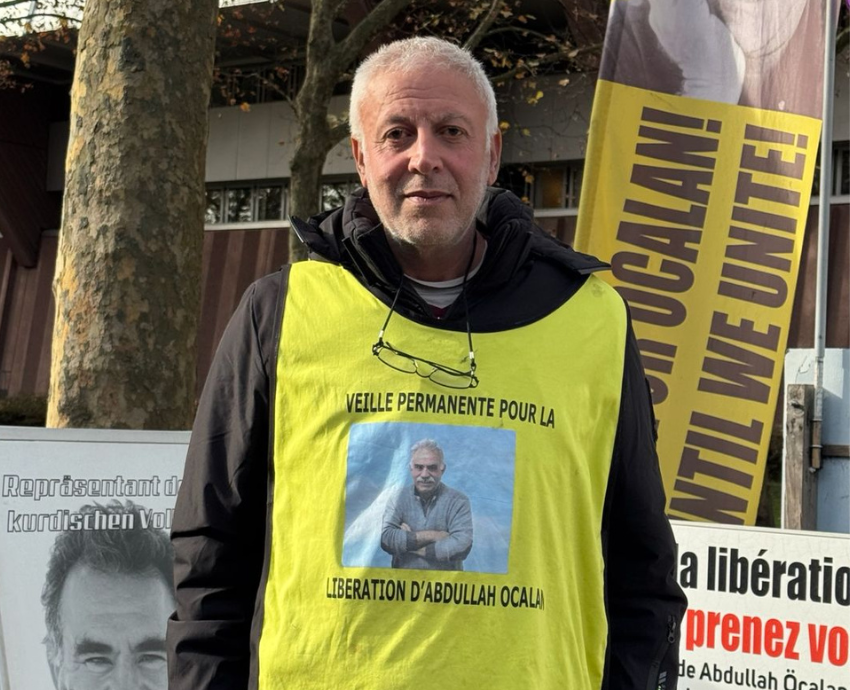
One of those released, Selahattin Mete, has been taking part in the vigil for imprisoned Kurdish leader Abdullah Öcalan outside the Council of Europe in Strasbourg, where he told me his story, with interpretation assistance from Fayik Yagizay.
Selahattin — who was born in 1968 in Akarsu, which is now incorporated into the municipality of Nusaybin — began with a simple explanation: “I’m Kurdish, and the politics of the Turkish state depend on denial and destruction in all areas of Kurdish life.”
Like other Kurdish children, he had to go to Turkish school, where speaking in Kurdish was severely punished and every day began with the student oath in which pupils dedicated themselves to the Turkish nation and declared, quoting Kemal Atatürk, “How happy is the one who says ‘I am a Turk’”.
As a teenager in the 1980s, he witnessed the detentions, the persecutions and the forced imposition of the Turkish language that followed the 1980 coup. He also saw the emergence of Kurdish resistance, especially the Kurdistan Workers’ Party (PKK), founded by Öcalan, which turned to armed struggle in 1984. Like his contemporaries, he was impressed by the defiance shown by the activists imprisoned and tortured in Diyarbakır.
From 1986–90, Selahattin and another young man stayed with Musa Anter, the Kurdish philosopher and writer who was several times imprisoned, and ultimately murdered in 1992 by the secret state, for his defence of Kurdish culture and his memorialising of the Kurds’ history of persecution and resistance. Anter’s home was near that of Selahattin’s family, and he lived as part of Anter’s household, helping him with his many guests and meetings.
In 1990, Selahattin absconded from his compulsory military service, disappearing into the metropolis of Istanbul to take part in political work and eventually deciding to join the PKK guerrillas. In early 1991, after military and political training in the Gabar and Cudi mountains and in the Kurdistan Region of Iraq, and after attending the PKK’s fourth congress, he was sent as an organiser to the Aegean city of İzmir; but in March 1992 he and another activist were detained as they walked down the street.
Torture and trial
For 15 days, Selahattin experienced “every kind of torture”, with no access to lawyers or the outside world. When, at the end of that time, he was brought to court, accused of being a member of an organisation that sought the breakup of the Turkish state by military force, he told the judge that the statements being used as evidence were written by the police and signed under conditions of torture.
Selahattin’s trial was not completed until 1996. During those four years, he was held in Buca prison in İzmir. It was crowded, but whenever the number of inmates fell, the guards had more time to try and torture confessions from the prisoners. In their court appearances, the prisoners defended their Kurdish identity and their right to speak and defend themselves in Kurdish, and spoke about the torture they had received. On the way back to prison, the accompanying gendarmes tortured them further.
At the end of his trial, Selahattin was given a death sentence, but this was changed to life imprisonment by the high court on the grounds of positive behaviour in prison. He is unsure of the reason for this, suggesting that with thousands of prisoners they couldn’t kill everyone.
A community of prisoners
After his sentence, he was sent to a prison in Aydın, not far from İzmir. At first, the prisoners were kept together in large rooms, but after 1998, a change in prison policy led to the rooms being divided into seven-man cells. Prison rules forbade them from receiving political material other than state propaganda, or any books or letters in Kurdish, and they were subjected to severe disciplinary measures, such as denial of family visits. But the prison housed many Kurdish political prisoners, including men who had been in the struggle since before the 1980 coup. They were all lifers, or condemned to death, with nothing to lose, and they were well organised and resistant to prison rules. They ran prison life according to their own plan and ideology.
It was this communal existence and organisation that the Turkish government aimed to destroy with their prison reorganisation. In 2003, Selahattin was sent to a more constricted F-type prison in İzmir with a maximum of three men to a cell.
He was moved again in August 2016. After the attempted coup that July, the İzmir prison was allocated to men rounded up for alleged links to the Gülen movement, and, along with around 50 others, Selahattin was moved to a T-type prison in nearby Ödemiş. There his cell was on two levels, with a sleeping area above and a living area with kitchen and television below, plus a small exercise yard. Although designed for eight, there were sometimes twice that number, with people forced to sleep on the floor and all sharing a single toilet and shower. The guards were mostly wounded former soldiers, with a “fascist” mentality, who initially regarded the political prisoners as enemies. Disciplinary punishments included stopping family visits or phone calls or preventing prisoners mixing with prisoners from other cells.
Matter-of-factly, as though describing a school timetable, Selahattin recounted how he and his fellow political prisoners organised their day. They would wake at 7am, and a group in charge of that day’s meals would prepare the communal breakfast, eaten between 7.30am and the 8.00am prison rollcall. They would then walk and talk in the yard until 9.00am, when they would begin three hours of education, punctuated by hourly tea breaks. The education was based on Öcalan’s books of political philosophy, which they smuggled in and hid from prison searches.
They had lunch at 12pm and went back for two further hours of education from 2–4pm. Then there was “free time”, with games of football, volleyball or chess, until dinner at 6pm. At 8pm, there was another prison rollcall. The doors to the yard would be locked for the night, at times that varied by the season. Between dinner and 10pm was more “free time”, and from 10–11pm the men read books or wrote letters. At 11pm, they turned off the lights in the sleeping area, but those not ready to sleep could remain downstairs.
Each prisoner was allowed family visits every fortnight, and on the two days each week that were allotted for visits there was no study program. Selahattin was imprisoned at the other end of Turkey from his immediate family. In his case, this was also where he was detained, but the Turkish authorities use distance as an extra punishment. His parents and siblings were only able to travel the 1500 kilometres to visit him two or three times a year, though other relatives who lived in İzmir were able to come more often.
After 30 years
In most countries there is an expectation that a “life” sentence is reviewed after 25 years, and provided the prisoner doesn’t pose a risk to society, they are freed. In Turkey, sentences are reviewed after 30 years — or in many “terrorist” cases, not at all.
Öcalan and more than 4000 others have been totally denied what the European Convention of Human Rights defines as their “Right to Hope”. In the cases that are reviewed, prisoners are often held for longer on the flimsiest and most arbitrary excuses.
Selahattin was released at the end of 30 years, but for a former friend from prison who joined us as we were talking, things were not so simple. When a prison guard had boasted that he could do anything he wanted, Selahattin’s comrade had responded by asking if the guard was a god. That quip cost him 18 months of freedom. Some have spent as much as six more years in prison.
Selahattin was still waiting for the results of his 30-year review when he heard a guard shout out: Selahattin Mete should prepare to leave. Outside, he was met by his family, and found a changed world — socially, architecturally and especially technologically. He confesses he still has difficulties mastering his mobile phone.
The struggle continues
Selahattin was out of prison, but he was still under surveillance, with strict instructions not to engage in any political or human rights activities or he would face further detention. For Selahattin, a life without political engagement was impossible, so, within a year, he left Turkey. He is now a refugee in Berlin, where he is active with German Kurdish organisations. It was as part of this activity that he was spending a week at the vigil in Strasbourg.
Selahattin is not only still politically active; he is still optimistic that he will see the changes that he has struggled and suffered for. He trusts Öcalan’s leadership and believes that the Kurds are in a stronger position than in the past; and he observes that, since 1993, Öcalan has repeated that if they are given the opportunity to act politically, armed struggle is unnecessary.
[Sarah Glynn is a writer and activist — visit her website and follow her on X or Bluesky.]