
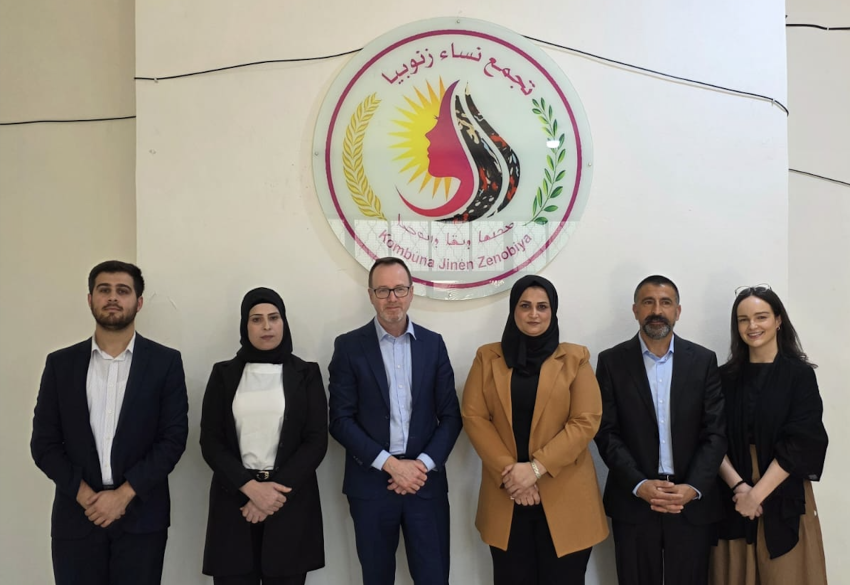
Greens Senator David Shoebridge became the first Australian parliamentarian to visit the Democratic Autonomous Administration of North and East Syria/Rojava (DAANES) on September 19–25. He was accompanied by Dr Elise Boyle, who has researched Rojava’s education system, and Greens Inner West City Councillor Ismet Tashtan and Baran Sogut, both Kurdish community activists in Sydney.
The delegation went to see what the Kurdish-led Rojava revolution has achieved. Among many achievements, since 2012, it has liberated a third of Syria from the former Bashar al-Assad dictatorship and driven out Islamic State/Daesh (ISIS) from its territory.
Shoebridge told Green Left that he met with the foreign affairs officials from the DAANES, who shared their thoughts about the future of ongoing peace negotiations with the new regime in Damascus.
“They have a goal for a pluralistic, federalist kind of structure,” he explained, “where there’s one Syria but people’s rights and identities are respected”.
Rebuilding
“They were very glad that there’d been a cessation — since about March — of Turkey’s bombing of infrastructure.
“While Turkey hasn’t removed its forces from northeast Syria [and] there is effectively an occupation in parts like Afrin, that temporary (hopefully soon permanent) ceasefire with Turkey was important to allow a safe future to be negotiated.”
Shoebridge said that while Rojava was rebuilding from a brutal civil war and Turkish military attacks, “overwhelmingly there’s a sense of security and peace”.
“Economic life is coming back, cities are being rebuilt.
“But you can’t ignore the scale of the damage. Pretty much every power station in northeast Syria has been bombed and destroyed. Power for the bulk of the population remains intermittent. It’s also dealing with a pretty brutal drought. So the country is very dry and that has impacted the agricultural sector.”
Shoebridge said he did not see a big military presence, despite ongoing attacks from ISIS and Turkish-backed militias.
Raqqa
The delegation also visited Raqqa, the former ISIS caliphate’s capital until it was liberated by the Kurdish-led Syrian Democratic Forces in 2017.
Raqqa shows the brutal scars of the occupation by ISIS and the battle to defeat them, Shoebridge told GL. However, there is rebuilding happening there, too.
“In the centre of Raqqa there was a roundabout where notorious scenes of extreme brutality played out from ISIS executions … [where] body parts had been put on display. Just down the road from that is a stadium which was a notorious torture centre.
“There are now gardens there and a sculpture. The buildings have been rebuilt around it. None of that horror is visible, but you know, the city still has the memory of it.”
The delegation met leaders of the Zenobian Arab Women’s Union in Raqqa. “The cost of the war was very clear because all around the wall [of their headquarters] are pictures of women who died fighting to liberate Raqqa.”
These women activists continue to receive death threats.
Raqqa is a predominantly Arab city and a test for Rojava’s model of pluralistic engagement and unity through democratic confederalism.
Shoebridge applauded the “radical commitment to gender equality that’s played out in the administration, even in Raqqa”.
“I think few people in Australia would understand the significance of this social, political and economic experiment.”
He said he hoped the achievements in northeastern Syria will be appreciated as a model for respecting minority rights and empowering women throughout the rest of Syria.
“I didn’t get the sense that they [sought] to impose those values. But by living those values and showing their success, it becomes a model that people may want to emulate.”
Lift the sanctions
The DAANES officials they met expressed “an absolute commitment to peace”, but were firm that they were not going to give up the precious gains of the Rojava revolution.
“If you just laid out all the challenges along the pathway to peace, it would be quite a list. But the fact that you had the administration committed to it and the fact that you know there was the set of principles signed on March 10, which seemed to be a kind of good starting point.
“No one would suggest that this is easy,” Shoebridge said, but countries like Australia should support progress towards a united Syria.
“It’s pretty clear that Australia largely just follows Washington’s call in this space. To the extent that we have a distinct interest in the region, that is often seen through our relationship with Turkey.”
The Australian government’s behaviour towards the US, Israel and Turkey comes “at the cost of saying nothing about what’s happening in Syria and refusing to even acknowledge the gains in northeast Syria”, he said.
“Syria is in the heart of the Middle East. And whilst that is in disarray and violence and is a sort of plaything of regional and other powers, we won’t be able to have a sustainable peace in the Middle East,” he said.
Shoebridge also called for the lifting of the economic and trade sanctions against Syria.
“The power infrastructure has been destroyed in northeast Syria; it’s been destroyed across Syria. Water and sewage infrastructure has been destroyed. Telecommunications infrastructure has been destroyed. They have to rebuild schools and hospitals and universities and pretty much all of those key materials [needed] are the subject of international sanctions.
“Getting a set of solar panels in a township in Syria, where they’re blessed with vast amounts of sunshine, would make a difference. A solar panel that would cost $20 here costs $100 there, because it has to be smuggled in around sanctions. They can’t rebuild some of their core water infrastructure because they can’t get the parts. Their oil infrastructure ... is running on antiquated, polluting equipment.
“I’m a Greens MP. I’m not here to promote the world’s oil industry, but oil is going to continue to be a part of the economic makeup for Syria for the foreseeable future.
“This is about allowing some infrastructure in and some investment in to remove the environmental damage and make it a cleaner and more efficient industry.”
Repatriation of detainees
Shoebridge also called for the repatriation of the 37 Australian women and children currently held in the Al Roj detention camp for ISIS detainees.
The DAANES has long urged the Australian government to take these families home.
“They want to go back. They want to reintegrate into Australia. They want to do that collaboratively with the government and they want their kids to return home to Australia.
“That was [what] we heard directly from the women themselves. They had come [to Syria] very young. They’ve been in the detention camp now for about seven years.
“Australian officials had visited at the end towards the middle and the end of 2022. Everyone had their biometrics taken, all of the necessary information given, so they could all be issued with passports.
“ASIO apparently came in and did an assessment and said there was no ASIO-based barrier for them to be returned to Australia.
“There was hope that they would all be returned to Australia at the end of 2022, but only about a third of them actually came home at that time. The rest have been told nothing [and have had] no further communication from their government, no further timetable, absolutely nothing since the end of 2022.
“You can imagine how distressing that is,” he said.
“Some of these women have made very bad choices. But they were very young women in a structure where women had minimal, if any, power. At the core of [this issue] for me are the 25 Australian kids. None of them had agency in any of this. None of them chose to be in Syria. None of them should be being punished.”