
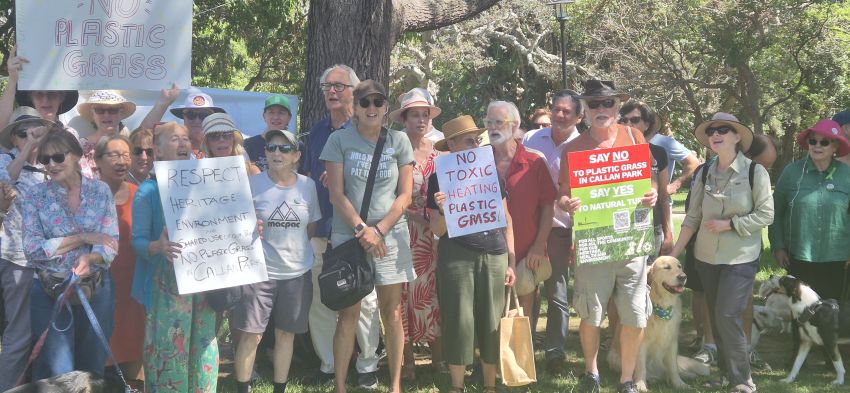
Friends of Callan Park organised a rally at the Callan Park gates on February 7 to protest the installation of plastic grass fields on two existing sporting grounds.
About 100 locals gathered under the trees that dot this iconic inner city green space to listen to a broad range of speakers pushing back against the replacement of natural grass fields.
The heritage-listed Callan Park, located on traditional Gadigal and Wangal land, covers 60 hectares. It is the largest green space in the inner west, providing space for sport, local history tours and environmental work before and since the closure of what was previously Rozelle Hospital.
Local residents have fought for the park to stay open and properly cared for throughout its history, this being the most recent battle.
The Labor-majority Inner West Council wants to install two plastic soccer fields on the grounds.
Of the two fields up for the plastic grass “make-under”, the most concerning is the Waterfront Oval Sporting Ground that sits on Iron Cove along the Parramatta River.
Mark Zihrul, a researcher for Total Environment Centre, told the rally that “the steps taken by [the Inner West Council] are not enough to prevent microplastics from leeching in to the water”.
He said that there has been a “threefold increase in microplastics in Sydney waterways” in recent years, with 90% of water samples coming up polluted, not just with microplastics, but whole blades of plastic grass
Terry Kelly, speaking for Iron Cove Balmain Tigers Cricket Club, pointed out that while plastic grass may be advertised as an all-weather option, it is not an all-temperatures option. He said it will make cricket unplayable in the summer due to the temperatures that plastic grass fields reach in comparison to their natural alternative.
These temperatures have been recorded to break 60°C late into the afternoon in summer, turning what are natural heat sinks into heat islands and threatening heat exhaustion for cricketers and those using the park recreationally.
Rally-goers and the speakers ensured that the resistance against the removal and replacement of these two busy fields should not be framed as a petty “sport issue”, but a community and ecological one.
As Ana Norte, from Callan Park Dog Lovers, put it: “Let’s not be naive … it’s never just one pitch … It sets a precedent. Precedents shape decades and shape the futures of our children. Callan Park is not a test site.”
[Friends of Callan Park is urging the community to submit objections to the Inner West Council by February 9. It has created a guide, which can be found here.]