
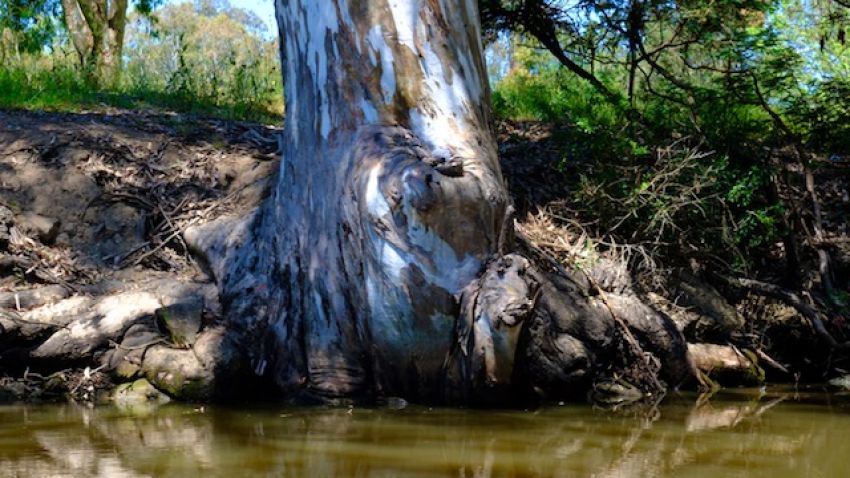
Along the quiet banks of the Sale Canal, stretching from the Port of Sale to the Thomson River in Victoria, ancient river red gums and Gunaikurnai scar trees are again at risk — not from axe or fire, but from erosion.
In places along the canal, the riverbanks have slumped away, leaving roots exposed. Elsewhere, fallen trunks lie half-submerged, the remnants of giants that stood for centuries before the soil beneath them collapsed — literally eaten away.
Built between 1890 and 1895 by teams of labourers working with bullock and dray, dredge and steam shovel, the canal provided a faster and more reliable route for trade into the growing Gippsland region of the Victorian colony. Freight from coastal ports moved through wetlands so central to Gunaikurnai life they called the place Wayput — the Heart.
Skipper Allan Lewis has been running heritage cruises aboard the 1912-built ferry Rubeena since 2013, working the stretch of canal between the Port of Sale and the historic Thomson River Swing Bridge, and has documented the decline of the riverbank.
On the cruise, Lewis points out scars still visible on some red gums, marks where bark was removed to shape canoes, shelters or hollows that were part of complex burial practices. Some of the trees are nearly 1000 years old.
Lewis said the riverbanks have been repeatedly damaged by European carp, also known as common carp, a major invasive freshwater pest.
“You can see the real damage done by European carp,” Lewis said. “They’ve had a couple of goes at destroying that bank — after the last major flood they destroyed, virtually the bank, and in subsequent floods you can see where they’ve had a go. Every time the water rises, they attack the bank and strip it of vegetation, so the bank collapses.”
He said many of the fallen trees are a direct consequence of European carp, which was introduced during colonisation and thrives in the canal’s murky waters. Their feeding strips away the plants that bind the banks together, leaving bare soil vulnerable to collapse during floods.
Lewis’s offsider, Dave Verey — a former RAAF engineer — said there is no system in place to regulate water levels in the canal during dry periods or floods.
“What they really needed was a pipeline from the Thomson, over there, through to the top of the canal, so you had a constant flow,” he said.
Dan Garlick from the West Gippsland Catchment Management Authority (WGCMA) told Green Left that proposals to increase water flows were considered by Wellington Shire Council — not as a response to erosion, but to address issues with the stagnant waters and vegetation management at the Port of Sale.
“Wellington Shire were having difficulties in relation to managing vegetation in and around the Port of Sale,” Garlick said. “Our assessment is that the proposal wouldn’t address the challenges of the erosion along the canal itself.”
Garlick says the WGCMA would work with others, including the Gunaikurnai Lands and Waters Aboriginal Corporation, to address the challenge of protecting the trees and the canal.
Wellington Shire Council spent $1.7 million in 2023 building a concrete seawall around the banks of the Port of Sale, new pile moorings and 18 double-berth jetties, creating space for 36 recreational boats.
There have been no equivalent plans announced for works to stabilise the canal’s eroding banks or protect the scar trees and ancient river red gums that line its edges.
For now, the canal continues to be eaten away, by fish and flood, erasing living cultural heritage that has endured far longer than the waterway built to serve colonial trade.