
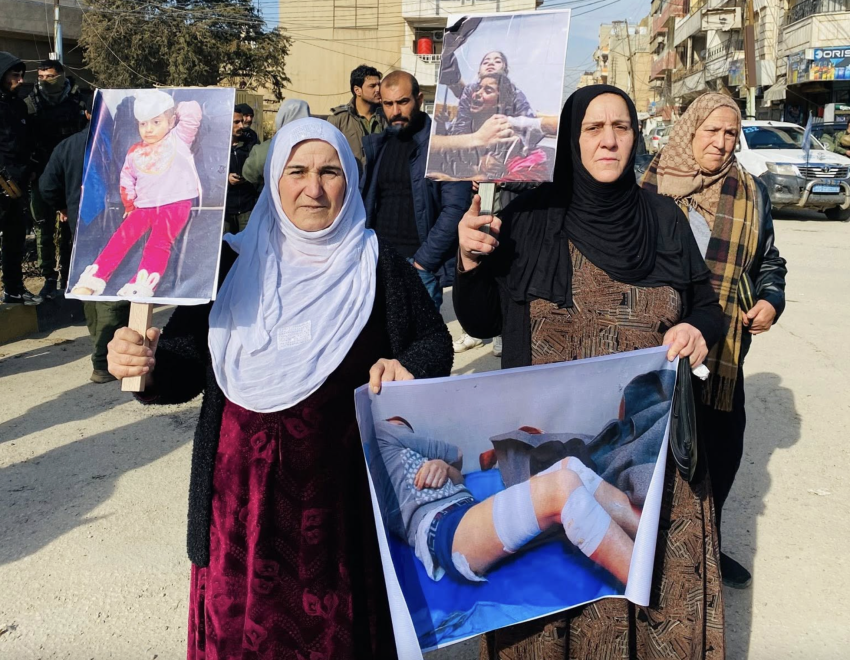
Suicide drones. Heavy shelling. Convoys of tanks and armoured military vehicles. This is the level of assault that armed factions affiliated with the Damascus government initiated on the evening of January 6 against the Sheikh Maqsoud and Ashrafieh neighbourhoods of Aleppo in northern Syria.
These neighbourhoods are home to well over half a million residents, including more than 55,000 Kurdish families. They have also absorbed thousands of Kurds displaced from the occupied region of Afrin, which was invaded by Turkey and allied Islamist groups in 2018.
Despite the dense civilian population, a violent bombardment campaign ensued, in which the Syrian defence ministry deployed tanks, heavy artillery, Grad and Katyusha rocket launchers, mortars and DShK heavy machine guns.
The intention behind the attack is unmistakable and leaves little doubt as to the objective of this latest offensive.
The people living in these neighbourhoods have already endured multiple waves of displacement, exhausted by more than a decade and a half of civil war involving the Free Syrian Army, jihadist groups including ISIS and al‑Qaeda, and numerous offshoots such as al‑Nusra Front and Hay’at Tahrir al‑Sham (HTS).
While the neighbourhoods are predominantly Kurdish, recent government attacks on minorities have driven many Druze and Alawite families to seek refuge in Sheikh Maqsoud. The area has thus become a microcosm of Syria’s diverse minority mosaic, a mosaic that appears to be the bane of the new Ahmed al-Sharaa‑led regime and its Islamist and regional ambitions.
‘Closed military zones’
The defence ministry has declared the Kurdish neighbourhoods “closed military zones”, signalling that it does not recognise the presence of civilians and is effectively commencing open warfare.
Images and video evidence from the ground, including footage released by Al Jazeera, show that the forces attacking the neighbourhoods are openly wearing ISIS insignia as they prepare to storm the Kurdish areas. These fighters are not wearing Syrian government uniforms nor do they bear official insignia, even though they are widely known to be defence ministry‑affiliated forces.
It appears that the Syrian government is using ISIS militants as a paramilitary force against the Kurds.
The regime has used similar tactics before, including on the Syrian coast, where such factions massacred Alawite communities, and in Suweida, where Druze civilians were targeted. These groups, including the 62nd al‑Amshat Brigade, also operate as Turkish‑backed mercenaries. Reports from the ground indicate that members of the brigade have been ordered to abduct Kurdish women and girls and kill others they encounter — a chilling echo of ISIS’s attacks on the Shengal region of northern Iraq, where thousands of Yezidi men and boys were massacred and thousands of women and girls were kidnapped and sold into slavery across Syria, Iraq and the wider Middle East.
The factions currently surrounding the Kurdish neighbourhoods in Aleppo include the 60–80 Division, composed of hardline elements formerly affiliated with HTS and led by a prominent HTS commander known as Abu al‑Manbij. The 76th Division, created by Turkey and known as the Hamzat faction, is led by Abu Bakr, an individual currently under US and British sanctions. The 7th Division consists of fighters drawn from multiple Turkish‑backed Islamist groups and is commanded by former HTS leader Khattan al‑Albani. All these factions are militarily experienced, brutal and deeply entrenched in the tactics of Syria’s long war.
This latest attack is part of an increasingly alarming trend — one that Kurds and other targeted minorities in Syria have been warning about for more than a year. The new al-Sharaa government appears to be a thinly disguised front for ISIS‑al‑Qaeda ideology, employing allied jihadist factions supported by Turkey to carry out unchecked massacres of minorities.
The neighbourhoods have been subjected to forced evacuations, with residents expelled from their homes so that snipers, tanks and armoured vehicles can be deployed. Such actions create an atmosphere of fear and terror, in which civilian safety becomes secondary and residential areas are transformed into militarised zones.
The regime has escalated further by cutting electricity to the Kurdish neighbourhoods — a discriminatory policy that undermines any possibility of reconciliation or trust‑building between the long‑persecuted Kurds and the Syrian state.
However different the new al-Sharaa government may appear from the Assad regime, both share a mutual desire to weaken and disempower the Kurds across Syria while employing similarly violent tactics against civilians.
The regime’s tactics are closely tied to its efforts to force the Syrian Democratic Forces (SDF) under its authority. Multiple rounds of negotiations have taken place over the past year between the SDF leadership, the Autonomous Administration of North and East Syria (AANES/Rojava), and the al-Sharaa government regarding Kurdish political integration. The most recent talks occurred on January 4, when Kurdish general Mazloum Abdi met with the defence minister in Damascus. Yet no consensus has emerged, as the regime’s ideology clashes fundamentally with that of the AANES.
The government is now openly using pressure on civilians as leverage to force the SDF to concede to its political objectives.
Deepening crisis
Interim President al‑Sharaa — also known as Abu Mohammad al‑Jolani — is the former leader of al‑Nusra Front, al‑Qaeda’s Syrian affiliate from 2012–17. He later headed HTS from 2017–25, shortly before assuming leadership of the opposition that toppled the Assad regime in December. Although he has attempted to rebrand himself as a nationalist Syrian leader rather than a jihadist figure, many remain deeply sckeptical of his efforts to distance himself from his violent past.
The al-Sharaa government is dominated by his inner circle, all drawn from HTS. Even the new constitution centralises power in his hands, reflecting a heavily Islamist political influence reframed as a national unity project. In contrast, the Kurds of Rojava have built a democratic and inclusive system that protects minorities, promotes cultural and linguistic rights, and places women at the forefront — both in the military through the Women’s Protection Units and in public and political life.
Much has been written about Rojava’s emerging democracy and its women‑led revolution, particularly their courageous resistance against ISIS. These are the courageous women who give the world the “Jin, Jiyan, Azadi” slogan (Woman, Life, Freedom). When the same factions attacked Druze and Alawite communities, the Kurds protested in solidarity, sent urgent aid, demanded an end to the attacks and opened their neighbourhoods to displaced families.
For now, Kurds and allied communities watch as the humanitarian crisis in Aleppo deepens. The seven roads leading into the neighbourhoods have been cut off by government forces, and civilians are prevented from leaving unless they pay extortionate sums. The SDF continues to call for peaceful dialogue and a more inclusive, multicultural Syria in which all minorities are protected — not only those aligned with the regime.
At present, more than 580,000 people remain under siege. Their situation is critical. The overwhelming majority are civilians — women and children — terrified by a government that should protect them. At least eight civilians have been killed and more than 60 injured, many of them children.
Peace cannot be achieved under conditions of war and siege. The responsibility lies with the Syrian government to cease hostilities against the Kurds and all other minorities. The Kurds lost 15,000 in the fight against ISIS — surely their children deserve more than to be slaughtered and torn apart by groups attempting to revive ISIS and other jihadists in the region.