
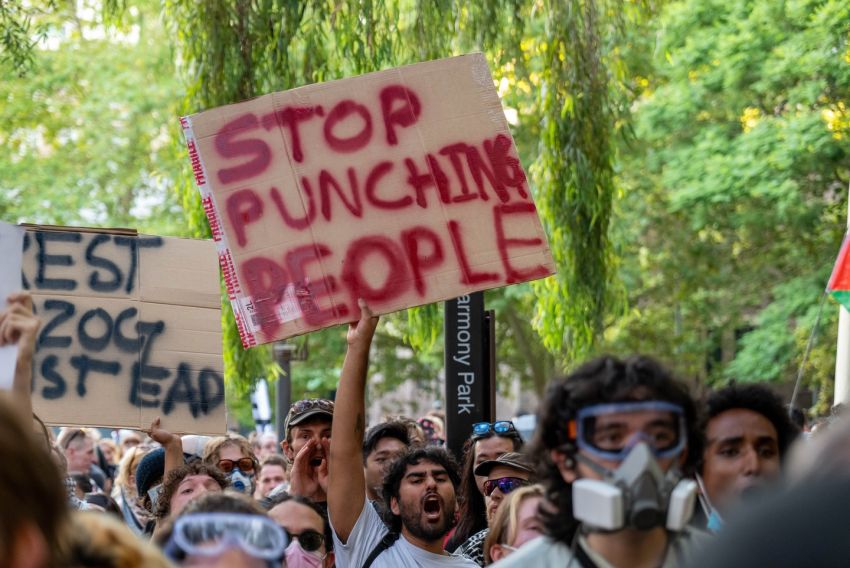
Many who witnessed the horrific police violence said they had never seen anything like it before. On February 14, the Law Enforcement Conduct Commission (LECC) announced an independent investigation into the police conduct. It will examine the policing operation as well as individual cases of unlawful policing.
One of the matters LECC should investigate is which politicians and senior police were involved in organising a massive increase in available police powers shortly before Herzog’s arrival, and what instructions were given to police on the ground about those powers.
The legislation that was used is a little-known law, called the Major Events Act 2009, under which the NSW Minister for Tourism Stephen Kamper approved a new regulation which transformed Herzog’s visit into a “major event”.
Its objects are to bring “benefits” to spectators and enhance NSW’s reputation for holding events. The act grants special powers to plan and regulate major events, including shutting off access to areas, searching people and using “reasonable force” to compel citizens to comply with directions.
It relieves the state of most liability for damage caused in the exercise of these powers.
The powers have the potential to severely impact the exercise of citizens’ political rights — which is probably why the act includes a section that a political protest must not be declared a major event. The act is designed to cover events of a “sporting, cultural or other nature”.
These police powers triggered the lack of restraint witnessed on February 9. This does not mean that police actions were lawful, but that these were the powers under which they thought they were acting.
As one constable, who was part of two lines blocking protesters from entering Town Hall Square said when questioned, “I heard something about a major event”.
Court challenge failed
The new regulation was announced on February 7, just 48 hours before Herzog arrived. The Palestinian Action Group (PAG), represented by Hanna Legal, had 24 hours to challenge the regulation.
PAG’s case was that the regulation was “unreasonable”, “disproportionate” and was created for an improper purpose of suppressing protests. Within an hour of NSW Supreme Court Justice Robertson Wright dismissing the challenge, NSW Police were already using the Major Event powers.
Before dismissing PAG’s challenge, Wright said that he found both sides’ arguments persuasive and that it was difficult to decide. But there was no hint of uncertainty in his judgment, which adopted almost all of the NSW government’s case.
The judge, who is near retirement, was described on his appointment as “a soldier, a historian and a gentleman”. His reasons were not published until two days later.
By that time, protesters had been violently flung to the ground while praying, and hundreds had been trapped and assaulted in Town Hall Square. People were blinded or choked with pepper spray. Others had been hospitalised with broken limbs or bleeding wounds.
James Ricketson, 76, had been injured in an assault by six officers and held in a cell for five hours without water before being released without charge. Videos of NSW police punching people had gone viral around the world.
Premier Chris Minns, Minister for Police Yasmin Catley and Police Commissioner Mal Lanyon defended the police actions as “reasonable” in the circumstances.
Not a political event?
Few would disagree that Herzog’s visit to Australia was the key political event of last week. Yet, key to the judgment was Wright’s determination that the Herzog visit wasn’t.
Before he arrived, Herzog defined the purpose of his visit as rebuilding Australia’s relationship with Israel. He brought a top-level delegation from Jewish National Institutions with him. This was in evidence before the judge.
Also in evidence was the fact that Chris Sidoti, who had sat on a United Nations Commission of Inquiry that found Israel was committing genocide in Gaza and that Herzog had incited it, had called for his arrest in Australia.
But Justice Wright found that politics was not a “defining” or “dominant” purpose for the visit and that it was a “cultural event”.
Herzog’s tour did have cultural aspects, such as a trip to Bondi to meet victims of the December massacre and visits to a synagogue and school. But Herzog and Zionist leaders also consistently stressed that an important purpose was to encourage the Australian government to stand with Israel.
The act has never been used for a foreign dignitary visit before or at such short notice. Until last week, no one would have imagined that this law would be used to enable police violence to be unleashed on peaceful citizens protesting against a controversial visit by a foreign head of state. But a bright idea by the NSW Police changed this.
Police concerns
As public opposition to Herzog’s visit grew and likewise support for a peaceful march from Town Hall to Parliament House during Herzog’s visit, senior police became concerned that the new anti-protest law, passed on December 23, might not be sufficient to stop a big march.
The ban over most of the CBD and the Eastern suburbs was extended on February 2. On the same day, according to evidence tendered in last week’s court case, NSW Police advised the government that the Major Events Act, with its extensive powers, could help avoid any risks to Herzog during the visit, advising, “Police will be empowered to address any behaviour which poses a security threat or risk to the Presidential visit”.
It is worth noting that nothing was ever planned at the protest related to a security threat or risk to Herzog. That was also in evidence.
The Cabinet office then prepared a minute, setting out arguments, including ones for and against protests, for Tourism Minister Kamper to consider before making his decision. He was then told to sign, but not date, his recommendation, which was agreed to by the NSW Executive Council and gazetted on February 6.
In arguing that the regulation had been declared for the improper purpose of suppressing protests, PAG’s barrister Felicity Graham relied on the timing of events and material in the Cabinet minute. She also relied on Minns’ media conference on February 7, in which he announced the Major Event.
Minns talked about 3500 police, fines of more than $5500 for disobeying directions and needing to prevent “the clash of mourners and protesters”. The latter seemed to be an idea of Minns’ own making because there was never any plan for protesters to be near mourners.
Keeping us ‘safe’?
Justice Wright agreed that it would be improper for the purpose of the regulation to be the suppression of protests. But he found that protests could be suppressed if it was consistent with the goal of facilitating “safety and crowd control” and that there was no intention on the part of the minister or any other relevant person to “adversely affect any protest or right to protest except to the extent reasonably appropriate to facilitate the conduct of the visit”.
He agreed that there was no evidence that the protest would interfere with the president, but found that it did not matter.
When Graham argued that the powers in the Regulation could lead to unjust treatment of citizens, even those who were not protesters, the judge appeared exasperated. He assumed that officers act “reasonably”.
That turned out to be wildly optimistic. If the purpose was to keep us all safe, it had the opposite effect.
PAG is considering an appeal. The event is over, but there are many potential cases against the police and the act restricts liability and compensation. It might also be possible to raise implications of the Major Events Act on “freedom of expression”, which was not attempted in the short one-day hearing.
A protest was held near Parliament House on February 13, to which a woman, who suffered broken vertebrae, delivered a speech from her hospital bed.
“We will not be silent. He [Minns] needs to take full responsibility for this and the laws that were passed. The police who did it need to take responsibility.”
If the Major Events Act can validly be used in protests, it needs reform. Imagine if the UN decided to hold a major climate conference, backed by fossil fuel interests, in Sydney? The whole city could be shut down to protesters.
Accountability for this disaster must start at the very top and run through to the police on the ground.
[Wendy Bacon is an investigative journalist with has a long history in promoting independent and alternative journalism. This piece was first published by Michael West Media.]