
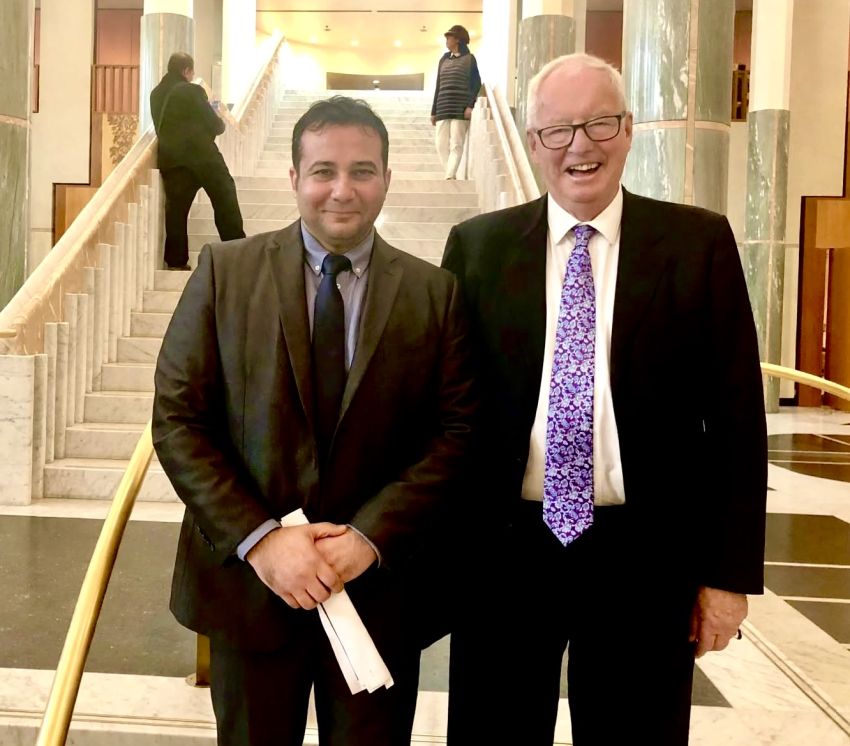
People will remember Peter Manning’s long career in media, politics and academia. They will rightly remember his years at the ABC, from Four Corners to leading news and current affairs.
But I want to write about the Peter I knew: he was a friend, who gave solidarity a human meaning that went well beyond public statements and political positions.
I first met Peter at a seminar at the University of Sydney in 2014. We talked for a long time. He was there with his partner Carol. He was warm and easy to be around. It did not take me long to realise that his support for Palestinian rights was not just something he brought out for public occasions.
For Peter, solidarity was something you did. He wanted to know the people affected by it, to hear their stories, to understand what they were going through and to be there if someone needed advice, support or a bit of help.
Palestine, for Peter, was a question of justice, rights and human dignity; it was never abstract. He saw the people behind the headlines: families, friends, people with names, stories and ordinary lives.
That is what made Peter’s solidarity different; it meant trying to understand why injustice happens, how politics, media and power shape people’s lives and then asking what you can actually do, even if it is something small.
Peter understood international solidarity. For him national borders did not limit our moral responsibility. He knew you do not need to share someone’s experience to stand beside them, but it is enough to recognise their humanity and right to freedom and justice.
Peter also understood that some voices find their way easily into the media and public life, while others are pushed to the margins.
Maybe that is why Peter cared so much about listening to people who were not always heard, and about creating space for others to speak. He did this in all the small things; a phone call to check in, advice at a difficult time, reading a draft and giving me his thoughts.
Palestine was part of Peter’s life in many ways — in his books and writing, in his friendships, in the keffiyeh he wore, the food he enjoyed and in the people he chose to stand beside.
Our friendship also moved beyond public events and political discussions. Peter became close to me and to my family, including when I graduated from the University of Sydney and when my father died during the war in Gaza.
Peter was one of those people from whom it was difficult to hear the word “no” when someone was needed support. He was generous with his time, experience and his contacts.
Peter spent many years at the centre of Australian media institutions and later turned a critical eye on the media itself.
He cared about how Arabs, Muslims and Palestinians were represented, about who was given the chance to speak and who was left out of the frame. These were never just academic questions; they were connected to how he saw other people and how he listened to them.
I learnt a great deal from Peter’s long experience in journalism, politics and academia. His encouragement was never just polite — he would ask questions, disagree sometimes, offer advice and share what he knew.
Then came the war in Gaza and my life became consumed by grief and worry, which meant we were not in touch as much as before.
Peter also loved the ocean and the beach; we used to swim and race each other. He considered himself a great swimmer. We used to challenge each other and argue, jokingly, about who was the better swimmer.
Some of my best memories are of him laughing. The jokes usually started quickly and sometimes we would barely stop. He had a great sense of humour.
Today it is hard to put into words how sad I am to have lost a dear friend.
My deepest condolences and love go to Peter’s family, to his friends and colleagues in journalism and academia, and everyone who worked with him at the ABC and elsewhere.
Peter taught me that real solidarity is not only about declaring where you stand. It is about making that position part of the way you treat people.
Farewell, Peter. The next time I go to the ocean, I will think of you. And maybe, just this once, I will let you have the title you always liked to claim without an argument from me: “The great swimmer”.