
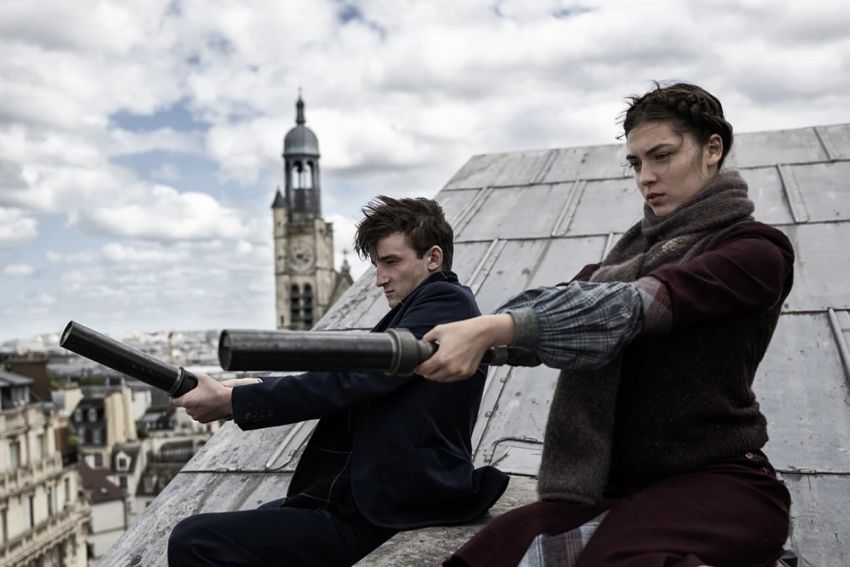
De Gaulle: Résistance
Directed by Antonin Baudry
Starring: Simon Abkarian as Charles de Gaulle, Florian Lesieur, Anamaria Vartolomei and Simon Russell Beale
2026
In cinemas
“Whatever happens, the flame of French resistance must not and shall not die,” proclaimed Charles De Gaulle in a speech broadcast on BBC radio in London, June 18, 1940, as France surrendered to Nazi Germany.
De Gaulle, a French army officer, had refused to capitulate to the Nazis and Marshall Petain’s collaborationist Vichy government, instead escaping to London and proclaiming himself the head of the France Libre (Free France) government in exile.
De Gaulle: Résistance is the first of a two-part 2026 biopic, La Bataille de Gaulle, depicting De Gaulle’s rise to leadership of the French Resistance during World War 2.
The diptych was directed by Antonin Baudry (Wolf’s Call) and is based on the book, A Certain Idea of France: The Life of Charles De Gaulle, by Julian Jackson.
De Gaulle’s story is intertwined with that of Fernand Bonnier de la Chapelle (played by Florian Lesieur), a young French patriot who, along with Jewish resistance fighter, Livia (a fictional character played by Anamaria Vartolomei) struggles inside occupied France to organise resistance to the Nazis and the collaborationist Vichy regime.
Set between June 1940 and December 1942, De Gaulle stakes his claim as head of the FL government to be sole leader of the French resistance struggling against the British government led by Winston Churchill (played by Russell Beale) and the Franklin Delano Roosevelt administration in the United States.
The Free French Forces (FFI) managed to establish an operational base in France’s African colonies, with allied weapons, money, supply lines and intelligence. Most importantly, African soldiers played a key role in the anti-fascist resistance and an estimated 21,000 served in different theatres of war from 1941–44, including the Battle of Bir Hakeim.
At Bir Hakeim, 3700 FFI troops held off 30-45,000 soldiers who were part of the German Afrika Corps – an expeditionary force led by Erwin Rommel between May 26 and June 11, 1942. This enabled trapped British forces to escape German encirclement in Libya and inflict a crucial defeat on Rommel’s forces at the Second Battle of El Alamein, in late 1942.
Since having been released, the biopic has been a huge hit at the French box office, drawing 5 million people since its June release. It has especially been a hit amongst young people for whom, according to French historian Alya Aglan, “There is emotion, there is information they didn’t know and it resonates with today’s youth, particularly in the run-up to a presidential election in which we will find ourselves in a very divisive situation.”
Costing £80 million to make, the two-part film was initially a box office flop, but the film’s distribution company Pathe organised watch parties hosted by social media influencers, such as Inoxtag (Inès Benazzouz). Local councils also offered free tickets for students to see the film and eventually news of the film spread by word of mouth.
According to US public historian Tad Stoermer, the film’s popularity among young people is a response to fear about the rise of Marine Le Pen’s far-right party, Rassemblement National (National Rally, RN), which is seen as the inheritor of the Vichy regime, and is full of fascists and Nazi sympathisers.
De Gaulle has been cast as the “embodiment of resistance” as well as the “providential man or woman” who can save France. In reality, none of the resistance groups formed in 1940 and the years following, spanning the political spectrum — from Communists on the far-left to Monarchists on the far-right — were waiting for a saviour such as De Gaulle to rescue them.
It wasn’t until 1943 that Jean Moulin (played by Felix Kysal) was able to organise all the different scattered resistance groups into one national organisation, the National Council of the Resistance (NCR). In De Gaulle: Resistance, while you see some of the dangers facing the resistance, there is a lot that is left out of the story.
Noticeably absent from the film is the presence of the Communist-led resistance groups, such as Francs-Tireurs et Partisans (FTP), which formed in 1942 and which, by 1944, had grown to 100,000 men and women. The FTP was one of the most effective resistance groups in occupied France.
The Soviet Union, which played a huge in defeating Nazi Germany in WW2 is barely mentioned in the film.
Another absence is that of the Special Operations Executive (SOE), an intelligence organisation formed by the British government in 1940, whose agents, intelligence, weapons, cash and supplies were essential to resistance operations within France and the rest of Nazi-occupied Europe.
As a former diplomat and advisor to Dominique de Villepin, perhaps it’s not surprising that Baudry has presented us with the dominant Gaullist version of history that centres De Gaulle as the “great providential man of history”.
Despite not the showing nearly enough of the complicated realities of the French resistance, I still enjoyed De Gaulle: Resistance and hope that part two De Gaulle: Liberté (showing in Australian cinemas from October 19) will not reduce the role of the Resistance in liberating France from Nazi occupation.