
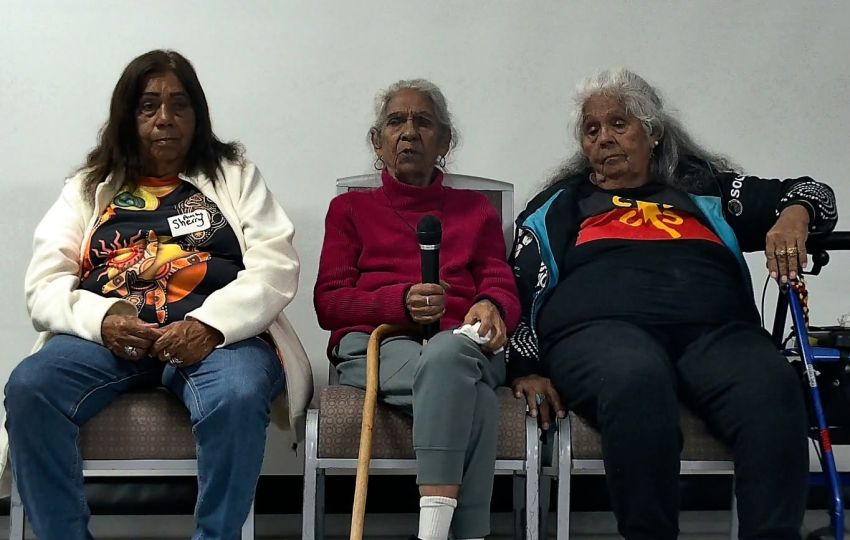
Traditional water owners from the northern Murray-Darling Basin gathered in Moree in June for three days to, as Gamilaroi Traditional Owner Aunty Polly Cutmore put it, “enforce our existing connections to water and Country”.
The Gamilaroi Water Carriers, a new First Nations women-led group, drew 40 Elders to discuss cultural and personal connections to local rivers and the challenges regarding water rights and environmental degradation.
They said the government needs to recognise First Nations’ cultural rights and pay compensation for historic dispossession.
The group was brought together by Cutmore, a water rights campaigner and a founder of the Mehi Centre. She was a member of the Boobera Lagoon Crown Land Committee and the NSW Gwydir First Nations Environmental Water Group and participated in the advisory group of the Murray-Darling Basin Aboriginal Water Entitlements Program.
“We’ve been intentionally left out when decisions are made about water,” Cutmore said. “We are calling for the recognition of Aboriginal cultural rights and compensation for historic dispossession.
“We have to bring our cultural law back. Look what they have done to our river — our river is dying, and we have a cultural obligation to care for it.” She said the Elders represented the Gamilaroi, Wiriyaroi, Wiradjuri, Bigambul, Ngarabul and Kwiambul nations.
The Elders shared personal histories of living by the river, the hardships of daily survival and the pride in maintaining traditions. They discussed water theft, pollution from cotton farming, the lack of compensation and concerns that over-irrigation was leading to local rivers dying, possibly within five years.
“Irrigation has destroyed the ecosystems that support the river and it’s killing us,” said Aunty Marlene Weribone, who grew up and raised her family on the Mehi River. She said as every living being depends on water, Aboriginal women need to continue collective action to reclaim what has been taken to protect future generations.
“We, the Elders of this Country, have never been told about what is going on with our rivers,” said Gamilaroi Elder Sheila French. “Decisions have driven the ongoing theft and alienation from Country and culture. Compensation must now be a priority.”
French highlighted women’s resilience in carrying water and keeping families going, and called for united action by Aboriginal women and communities to stop government and industry from profiting from stolen land and water.
Women from Wiradjuri Country said governance and accountability for sustainable water has failed and that environmental and health impacts of river mismanagement have been severe.
The women want governments and large agricultural interests to restore the rivers to be safe, drinkable and free-flowing.
They fear the proposed release of a carp-killing virus could harm broader ecosystems (insects, birds and other fish) and contaminate Country.
Intensive cotton and broadacre farming are depleting and polluting rivers, especially in the Northern Basin, and the adverse impacts are spreading south.
“Blackwater” events, where severely depleted oxygen levels lead to water becoming toxic, is linked to mismanaged flows and agricultural practices. The women are concerned that ill-health, including cancers, are linked to degraded water quality.
Sherry Fernando, who was born at the Moree Mission and later lived on the Moree Common, where water had to be hauled in 44-gallon drums, moved to Mungindi on the Barwon River on the NSW-Queensland border.
She said the river has gone from being uncrossable to dry and attributes this decline to industrial-scale cotton farming and on-station water storage, such as at Cubby Station.
Fernando said cotton degrades the soil, which reduces the capacity to grow food, threatening livelihoods and food systems. She said cotton must not be made a priority over food security.
Water is life
Women from the tablelands, Ngarabul, Goondiwindi and Bigambul Country said rivers hold their stories, ancestors and responsibilities, and women’s leadership and ceremony are central to cultural continuity and law.
Vicki Duncan, from the MacIntyre, Ashford area, Avril Chapman from the tablelands, Ngarabul Country, and Sue-anne Dancey from Goondiwindi, Bigambul Country, said: “Water is life, law, and lineage; rivers are ancestors, not resources. Rivers are living beings with agency, the Serpent — Guardian. Current management and extraction regimes sever our cultural connections and their ecological function.”
The environmental decline of the river systems is obvious: From clear, living waters to muddy, low-nutrient systems with reduced biodiversity.
Drought and over-extraction intensify scarcity. They said restoration requires cultural governance, protection of sacred places, rebalancing flows and community-led planning grounded in indigenous knowledge.
Jacqueline French, a Gamilaroi woman who grew up in Moree, said Aboriginal communities have long experienced water theft and a deliberate loss of access to water resources. She said this weakened communities and encouraged Moree women to investigate and push to restore the mission’s water licence.
It was agreed that rebuilding and protecting community water infrastructure is an important goal. Connection to rivers for water to drink and wash, places to fish, cook, gather and hold ceremony, is also central to family life, childhood and identity.
Women’s knowledge and teaching of Country places rivers at the centre of daily life and traditional beliefs. The knowledge of a woman’s role in relation to water is passed down by aunts and grandmothers.
Waterways were once clear, flowing rivers; abundant fish, mussels, turtles; regular swimming, spearfishing, washing and communal life on riverbanks. Now, the rivers are degraded, muddy and have reduced flows, which leads to fish kills; fewer animals (like koalas, platypus) and erosion.
Many families now rely on bottled water and boiling tanks for their basic needs.
The Gamilaroi Water Carriers say industrial cotton and large-scale irrigation are the cause of much greater harms.
They have specific concerns about the chemicals used in crop dusting, as well as the over-extraction of groundwater and the disruption of natural aquifers. They question governance and accountability and say restrictions on access to waters and lands is a feature of colonisation. They want Aboriginal voices in the decision making on water, and said meetings since early 2000s have led to little or no action.
“We’ve got a lot of healing to do,” Cutmore said. “But we know how to protect this country, how it’s supposed to be, how it’s supposed to flow, how it’s supposed to be connected and how we’re connected to it.
“The river is our mother, it is a part of us. It’s where we come from; it holds our DNA. We want her back.”
The Gamilaroi Water Carriers group is calling for compensation for the loss of cultural and economic rights tied to water, arguing that water licensing, water markets and entitlements were imposed without the free, prior and informed consent of Traditional Owners.
The Mehi Centre, based in Moree, has called for redress in its submission to the Murray-Darling Basin Review.
“Given the recognition of First Nation prior and continuing ownership of the continent, and the almost complete loss of First Nation rights in relation to water, there is a strong case that Basin First Nations people are entitled to a levy as a form of restitution for past wrongs and dispossession of their water resources.”
Cutmore said it is “time the colonisers recognise and pay restitution for the loss of our rights, never acknowledged and never ceded”.
She said road diversion and illegal levy banks changes water flow. “Then I find out that they started trading water … There’s been issues around the governance of water with Aboriginal People — we have not been at the table to talk about this stuff. It’s always been taken over by the irrigators. We don’t have to comply with their rules.”
“The river is a living being and we need to recognise this. No one owns water. Water belongs to everyone. It belongs to the land and the animals first. We need our voice, knowledge, experience, culture and lore brought back to make sure that life is given back to the land, water, country, animals and our people, so everything thrives.”
• • •
Gamilaroi Water Carriers statement from the Moree gathering
“We, Elders, assert that rivers are living beings and the lifeblood of culture and community. We have documented severe decline tied to cotton, irrigation, chemicals, dams and governance failures. We call for First Nations-led action to restore flowing, habitable rivers, protect the aquifers, the special cultural places and the living beings of the river, and to hold governments and industry accountable.
“Being daughters of the river, Elder Women stand up to reclaim their rights to speak for Water and Country as it is our obligation under cultural law and the recognition that the rivers are living parts of the Mother that we inherited and must ensure is in good condition for future generations.”