
Building on the momentum following Zohran Mamdani’s historic victory last year, the Democratic Socialists of America (DSA) have won several primaries, defeating establishment Democrats in the lead-up to the midterm elections in November.
Green Left’s Isaac Nellist was joined by Ella Teevan, a member of the DSA’s National Political Committee, its highest leadership body, to discuss the midterms, Mamdani’s record and how the DSA can build on its successes to strengthen the fight against President Donald Trump’s far-right agenda. This is the first of a two-part interview. Read part two here.
Teevan is a featured speaker at the upcoming Ecosocialism 2026 conference in Magan-djin/Brisbane. To book tickets, visit ecosocialism.org.au.
* * *
What do the DSA’s recent wins in the Democratic primaries reveal about the political situation in the United States?
I think what it reveals is that socialism has broken containment. It’s really exciting and I think the shift really happened in the past few months.
Chris Rabb won in Philadelphia, DSA candidates swept the primaries in New York City, then Melat Kiros won in Colorado, and it showed the public what we already knew in DSA: that socialism can win everywhere.
It’s a national phenomenon, it's so much bigger than Mamdani, and DSA is being taken seriously as an electoral force both by regular people and also by establishment parties and media.
It turns out that socialist ideas are popular!
We already knew after the Bernie Sanders campaign that people are looking for an alternative to our two major parties — the Democrats and the Republicans.
Trump is starting so many foreign wars and interventions, ICE [Immigration and Customs Enforcement] is literally kidnapping and killing our neighbours and regular people are feeling this crisis of affordability.
Meanwhile, the Democratic Party is rolling over dead, and they are similarly responsible for the genocide in Gaza and the extreme levels of wealth and income inequality.
So, DSA is here and ready to provide not just different ideas, but also organisation and even hope to those people who believe it’s possible that we could live in a different kind of society.
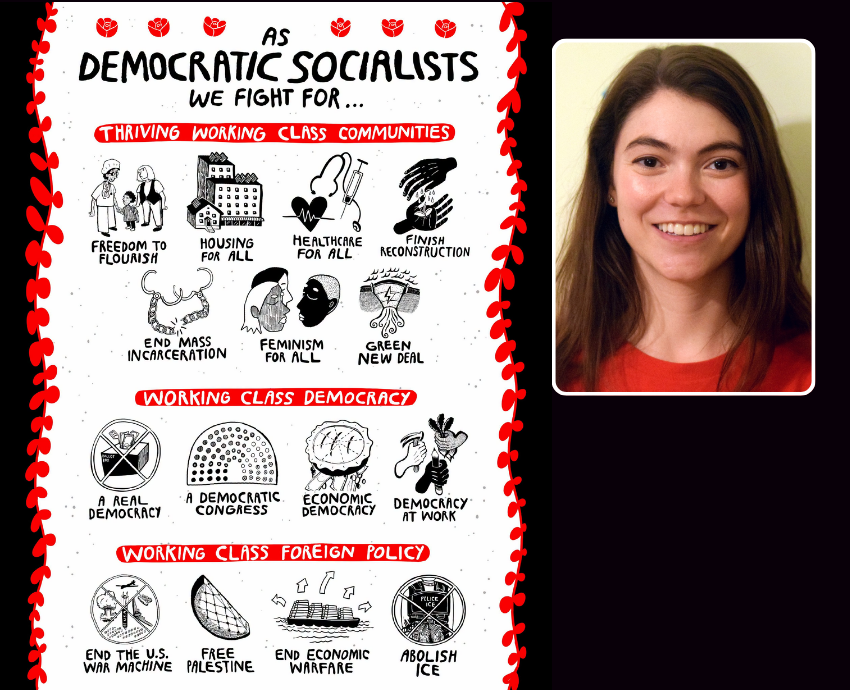
We have a right-wing news network, Fox News, which posts clips that try to paint DSA as scary and extreme by talking about our program, Workers Deserve More. They point to things like healthcare for all, free Palestine, abolish ICE, or changing our voting system to be more democratic … Then you see people in the comments say “Oh, this is what socialism is? I guess I’m a socialist”. So that’s really exciting to see.
Of course, this new power comes with new attacks on DSA. The centrist think tank Third Way plans to spend US$13 million [A$18 million] on opposition research on us.
The New York Times is going back to running hit pieces about how all DSA does is fight itself. That might play to the affluent liberals who read the NYT, but to me, it says that the establishment is scared. So, we are doing something right.
To look ahead, we may have up to seven socialists in Congress, eight if you count Bernie Sanders in the Senate — he’s not technically a DSA member but has done so much to bring people into DSA, starting in 2016.
There are so many possibilities with a true socialist bloc in Congress. It’s worth nothing that we had “The Squad” in 2018 — made up of Alexandria Ocasio-Cortez (AOC), Rashida Tlaib, Ilhan Omar and Ayanna Pressley — which was more of an informal group that largely became known because of how the media framed it.
We are doing something much more intentional this time, and DSA is much bigger and more like a party. DSA plans to work with these socialists in office to advance the demands of our Workers Deserve More program.
It will be important to work out if we actually want to pass policy, or think we can, given we are still a small bloc. This would have to happen after 2028, if the Democratic Party retakes Congress and the presidency.
Another option is to play an agitational role, to call out the total inadequacy of the Democratic Party and bring more people into the socialist movement.
As for labour struggles, the biggest event on the horizon is May Day 2028. A couple of years ago, the leadership of the United Auto Workers union proposed that unions align their contracts to all expire on May 1, 2028, and use it to increase workers’ leverage and put a spotlight on labour struggles.
To date, only a few unions have done this, but there is still a possibility of using May Day 2028 to bring labour struggles to the fore.
Our vision of electoral work is that it supports labour organising and class struggle. So DSA electeds [elected representatives] from Congress to City Council could play a role in making May Day a huge show of force — and a starting point for an eventual new party.
DSA acts like a party in many ways, even though election laws intentionally make it very difficult to get the formal, legal designation.
But eventually, we will stop running on the Democratic Party ballot line and form a true party of our own — a party of working people to oppose the two parties that currently represent the interests of billionaires and CEOs.
We also support moving the US to a system of proportional representation, because, right now, the two-party system effectively keeps anyone but the Democrats and Republicans out of power.
We also need to grow DSA dramatically, while maintaining our socialist character — which is a tricky balance.
We recently hit 120,000 [members], making us the largest socialist organisation in US history. In absolute numbers, it’s still smaller as a proportion of population than Eugene Debs’ Socialist Party [which peaked in the first decades of the 20th century].
So, 120,000 is great, but still more marginal than we would like to be. Imagine a DSA of 200,000, 500,000 or 1 million dues-paying members, who all participate in our organisation’s democracy and organise in their local chapters for socialism.
Finally, there is the question of whether DSA endorses in the 2028 presidential primary, and if so, which candidate. This is the most hotly contested debate in DSA right now and I can’t say too much, except to say that we are in the middle of a democratic process to decide the answer to that question.
What impact could the upcoming midterms have on domestic politics? Could we see DSA and DSA-backed candidates make further gains? How real are Trump’s threats to ignore or overturn the results?
Looking at the 2026 midterms, I think there is a distinct possibility that popular discontent with the Republican Party might sweep the Democratic Party back into power.
That might make a few affluent liberals happy, but I don’t think that is going to meaningfully change things for people who are suffering from this crisis of affordability or are watching while the US kills people abroad and sends weapons to Israel.
That’s why I think it’s really important what our socialists in office do.
As I mentioned, it’s likely that the seven DSA-endorsed Congressional candidates will win: Tlaib and Donovan McKinney from Michigan; Kiros from Colorado; Darializa Avila Chevalier, Claire Valdez and AOC from New York; and Rabb from Pennsylvania.
The role of these socialists will be agitational, rather than trying to pass reforms, at least until 2028.
It’s likely that the Democrats will win in 2028, though we don’t know. Even so, a Milquetoast [moderate] Democrat in the White House will not fix all of our problems.
But having an agitational role can be a really good thing. Imagine having a staunchly pro-Palestine bloc in Congress for the first time ever.
Of course, they will be under immense pressure to cave to the Israel lobby and to the forces behind US foreign policy — and already some have stronger records on Palestine than others.
Imagine seven DSA congresspeople all calling together to end US military funding to Israel, to end the devastating economic warfare on places like Cuba and Iran … imagine them putting out the same message about Medicare for all, and how the Democratic Party is on the side of healthcare CEOs and not regular people who are filing for bankruptcy or becoming unhoused because of their medical bills.
These socialists in office have the ability to demonstrate to people that another kind of society and government is possible, just the way Sanders and Mamdani have done. It needs to go beyond viral videos and raising expectations; they should be calling for people to join DSA.
There is also potential for material gains, if socialists use our leverage, particularly in the vote over who is going to be Speaker of the House (presuming the Democrats take back the house this year). The presumptive nominee is Hakeem Jeffries, who’s a centrist Democrat. Socialists in Congress could withhold their votes for him unless he agrees to certain conditions, such as supporting Medicare for all or an arms embargo on Israel.
We have seen attempts at this in the past. The Squad tried to do this under [President] Joe Biden, but they squandered a lot of their bargaining power.
This time, it is really important that DSA electeds work closely with DSA’s federal socialists in office committee, to coordinate their votes and then actually vote “no” to a speaker candidate if they don’t agree to our demands.
In terms of Trump’s threats, it’s hard to say how real they are, but my guess is that Trump will — at least rhetorically — challenge the results. That is his modus operandi.
The Republican Party knows it can’t secure a majority unless a tonne of people are blocked from voting … and that’s what Trump is trying to do.
We should be alarmed at the erosion of our already sclerotic democracy. The Republicans’ “SAVE America Act” would dramatically restrict who can vote by requiring the kind of documentation at the polls that many voters just don’t have.
One estimate is that 12% of registered voters don’t have the documentation that would be required to vote.
If Trump and his administration do try to overturn the results, I’m not sure we have the popular organisation and muscle to fight back yet … I know a lot of the liberal non-profit organisations and NGOs are thinking about this.
For instance, a large motivation for the big “No Kings” protests over the past couple of years is to get people ready to protest if there were an attempt to overturn the results.
Mamdani’s win was an important victory for the left. How would you assess his first seven months in office?
Isn’t it lovely to have a socialist mayor of New York whose decisions we can pick apart? What a great problem to have.
I would say Zohran’s first seven months have been largely positive for the socialist movement, but there are a few important caveats that we shouldn’t overlook.
I should preface this by saying I’m not a New Yorker, and New Yorkers are famously proud of their city and being from there so I can’t claim to know what it was like to canvas for him or be at his victory party, though I’ve heard it was electrifying.
I think the most important aspect of Zohran’s victory is that it has given people a visible example of what socialism and DSA are, which has led directly to socialism breaking containment as we talked about earlier.
So many people that we talk to either know and like DSA because they like Zohran, or they don’t yet know DSA. [Then] we say that Zohran is one of us and they say: “Oh, I like him!”.
On a related note, a close comrade of mine recently said to me: “I have to tell you Ella, you were right, I was wrong, Zohran has been good for socialism.”
Their fear was that Zohran would be under intense attacks from both parties and the mainstream media, and there would be every incentive for him to turn away from principled socialism. And when that compromised vision failed to deliver, all the people who were inspired by him would get the impression that socialism can’t actually do anything for them, and they would check out of politics or go back to one of the other parties — and DSA and socialism would be severely set back.
Luckily, that has not come to pass, and Zohran has been largely committed to representing democratic socialism rhetorically and to delivering material gains for people, demonstrating that the government can do things to make our lives better, and go after billionaires and tax the rich.
He is still vocally pro-Palestine, despite the omnipresence of these bad faith allegations of antisemitism. He said he would like to arrest Israeli Prime Minister Benjamin Netanyahu if he came to New York.
His administration has won US$1.2 billion [A$1.7 billion] in state funding for universal childcare already; they are building new public bathrooms, new affordable housing [and] publicly owned grocery stores. The pied-à-terre tax on second homes worth more than $5 million — part of his promise to tax the rich — is currently going forward, despite a lot of legal challenges.
There is a question about what it means that Zohran is doing these things “for” New Yorkers, rather than these victories coming out of “bottom-up” fights that would grow people into socialists, labour militants or organisers.
It is going to take a huge amount of popular power to pass his more ambitious plans, such as full, universal free childcare, and it would be a huge missed opportunity if Zohran doesn’t use his significant charisma and communications skills and competency to bring people into DSA or other organisations.
Despite all of these successes, there have been contradictions within the Zohran administration and places where DSA has had to stake out an independent position and even put pressure on his administration.
I could get into specifics, but the most important deficiency of his tenure so far has been his hesitance to use his “bully pulpit” [prominent position] to go after establishment Democrats, to mobilise supporters in mass struggles to achieve the toughest parts of his agenda and his use of language around realigning the Democratic Party and claiming he is going back to the New Deal era of the Democratic Party. That’s not DSA’s policy or its outlook on the Democrats, and it’s not even really historically honest about the best of the New Deal era.
There was also a moment at the start of his term when he endorsed the sitting governor of New York for re-election at the same time as she was locked in a fight with the city’s nurses union, which was on strike.
Zohran has been a strong supporter of organised labour in the city, especially delivery and rideshare workers so far, but the nurses strike incident shows that his attempts to build relations with the establishment wing of the Democratic Party do create tensions with his commitment to socialist politics.
Still, despite these limitations, there is no denying what Zohran’s campaign and mayoralty have done to grow DSA and popularise democratic socialism. I never thought when I joined DSA in 2018 that we would have a socialist mayor of New York City and seven DSA electeds in the house.
[Read part two here.]