
It’s no secret that the far right is on the rise in several European countries, capitalising on the rising cost of living, health and education and lack of access to housing — largely laying the blame on immigration and the “failure” of multiculturalism.
In Ireland, a wave of far-right protests in 2022 targeting refugee and asylum-seeker accommodation sites was followed by a racist riot in Dublin in November 2023, in the aftermath of a stabbing attack. More recently, pogroms targeting refugees and migrants in Belfast took place between June and September this year.
Paul Murphy – Teachta Dála (a member of the Irish parliament, TD) for Dublin South-West, representing the People Before Profit-Solidarity (PBP-S) alliance, has played a leading role in building the movement against this tendency in Ireland.
Murphy recently spoke to Green Left, explaining that the Irish far right started gaining traction in online spaces during the COVID-19 pandemic, before taking a significant step forward during Europe’s refugee crisis in the wake of Russia’s invasion of Ukraine.
This allowed far-right figures and groups to grow in influence as asylum cases rose, going from “an entirely marginal, entirely peripheral almost entirely irrelevant force in Ireland” to one that had a notable presence on the ground in some communities, being able to elect some councillors and influence populist national parliamentarians.
As the number of Ukrainian refugees arriving in Ireland has declined since its 2023 peak, these groups have maintained their narrative through the targeting of International Protection Accommodation Services (IPAS) centres, which host asylum seekers from various backgrounds.
“They employed very racist rhetoric — suggesting that these people were a danger, tapping into fears that people have,” Murphy said.
Along with scaremongering, the far-right suggested that these centres were “luxury accommodations that homeless Irish people weren't getting — when in fact, they're terrible and overcrowded”.
Murphy said that in response to the scapegoating of refugees, “the government ended up adopting a lot of effectively far-right policies, forcibly making people homeless”, including deciding not to open any more IPAS centres. “Any single man who arrived here was made homeless. Not just homeless, made to rough sleep.”
Cost of living crisis fuel for far right
Murphy said the far right then turned towards a feigned concern for the cost-of-living crisis, which – alongside housing – has been a key challenge in Irish society since the 2010s.
However, although far-right activism around immigration has slowed, it has continued to influence how people understand rising costs and the lack of housing supply.
“If you asked a random person in the street four or five years ago: ‘Why do we have this housing crisis?’, they would have said that this is about the developers, the landlords, the political parties that represent those interests,” Murphy said.
“People would have put forward a basic class analysis of the housing crisis.
“Whereas now, there's a chance that if you ask a random person [this question], they would attribute it to ‘so many people coming in’.”
Murphy said the government “is delighted for this narrative to emerge” and “adds to it significantly because it distracts from its own responsibility”.
Recent protests around the cost of “green” diesel, which is used widely in agriculture and taxed at a different rate, were widely supported, but all of the identified leaders had connections with the far right and or spouted far right ideas, said Murphy.
“They blockaded ports and they won considerable concessions in the context of a generally passive working class and an absence of social movements — with the exception of Palestine,” Murphy said.
Contest for leadership
“We supported it, [but] we said ‘there's a problem with this leadership, and the trade union movement needs to take the lead’,” said Murphy. Regarding the demand for cheaper diesel, “It can't just be about bringing the price of fossil fuels down, we need free public transport, we need to have retrofitting, we need to get away from reliance on fossil fuels...”
Murphy said that a “big positive” is that the trade unions are now “stepping onto the pitch in terms of the cost-of-living crisis” and there have been “unprecedented turnouts and votes for strike action across the public sector”, in pursuit of demands around cost-of-living protections and wages.
Far-right electoral formations — such as the quasi-fascist National Party, the Irish Freedom Party and a smaller outfit, Ireland First – have been hindered by internal squabbles and disorganisation. However, Murphy said the dominance of far-right narratives has grown the populist right, which now attracts 12–13% of the vote, shared between Independent Ireland and Aontú (Unity), according to opinion polls.
One cultural expression of this is the shifting meaning connected to the Irish tricolour flag. In the past, Murphy said the flying of this flag signified an attachment to the Irish revolutionary tradition, but recently, this has changed.
“There was a campaign linked to the ‘Raise the Colours’ movement in Britain, where people were putting up union jacks in working-class communities, in public streets or lamp posts, but also in people's houses.
“Now, you go into any work class community, you'll still see some of these flags. Definitely some of them may have been to do with sporting events, or maybe put up by old republicans.
“But a significant amount of it is about sending a message, an anti-immigrant message and about making people feel unwelcome in their community.”
Responses
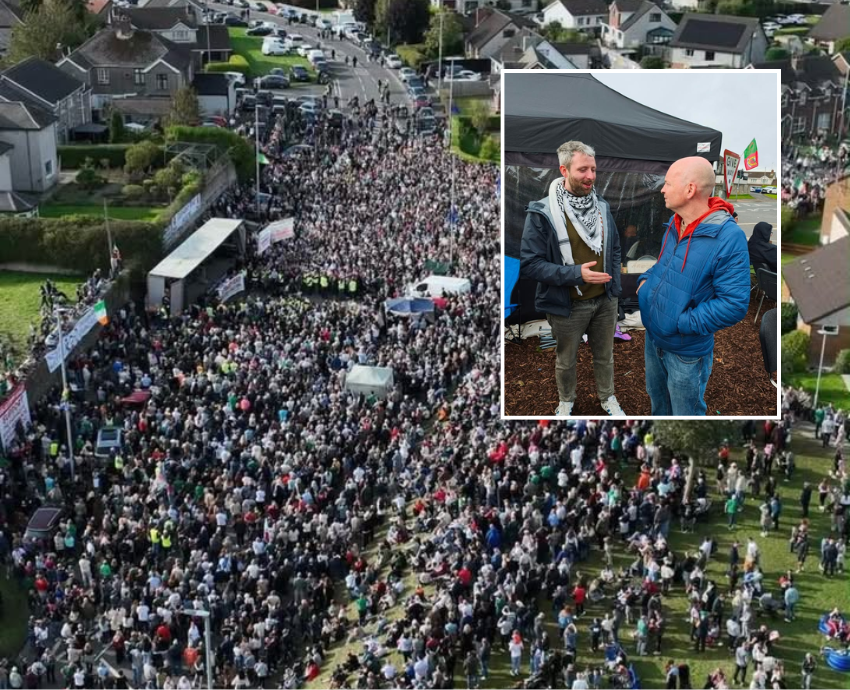
In spite of these trends, Murphy contends that there is a growing movement against the far right, with large mobilisations occurring in response to racist attacks and rallies.
“There’s an international phenomenon whereby the pendulum has moved to the right, and that in turn is radicalising a lot of people to the left, who are saying, this is not the type of society I want to live in.
“There have been good mobilisations in response to the upsurge in the far right. In Belfast it was 20,000 people, in Derry there was a big protest, and in the south we’ve also had similar.
“At our biggest, we’ve been able to significantly outnumber them, although our protests happen on different days: the far-right [protest] happens on a Saturday, and the counter protest is called a few weeks later.”
However, Murphy said it was important for the left to try and organise counter protests on the same day, to have the opportunity to speak to working-class people who might be convinced away from far-right talking points.
Murphy said the PBP-S alliance has a three-stage process for addressing the far-right.
“One is building broad, anti-racist, anti-far-right alliances locally and nationally — a broad section of people on a very broad basis,” he said.
“Two, try and build a harder core of anti-racists and anti-fascists who are prepared, for example, to counterprotest against the far-right.
“Three – and this is a really crucial bit – continue to deepen our connections in the working-class communities where the far-right is leading things. That’s essential, to keep open the possibility of discussions with people.”
Murphy said upcoming mobilisations show the left and the unions taking a stand on the cost of living and other social issues and PBP-S is leading the opposition to attempts by South Dublin Council to raise council rates by an average of 25%.
“We’re putting a huge amount of energy into organising street meetings and protests. It’s mainly about countering this increase, and responding to an attack on the more vulnerable parts of the working class.
“But it’s also an opportunity to talk to people about the far right. When you bring people into activities, you enable them to feel more powerful than powerless, and you have the chance of winning the argument that the problem is ‘up there’ as opposed to ‘down here’.”
A full public sector strike is also happening on October 14 – the first in several years. And then there is the movement in solidarity with Palestine, which has “played a role in the past few years in holding the line on things sliding further to the right,” Murphy said.
“It’s the biggest social movement we’ve had over the past three years, [with] thousands of people involved in activism for Palestine. And the far-right clearly doesn’t know how to deal with that.”