
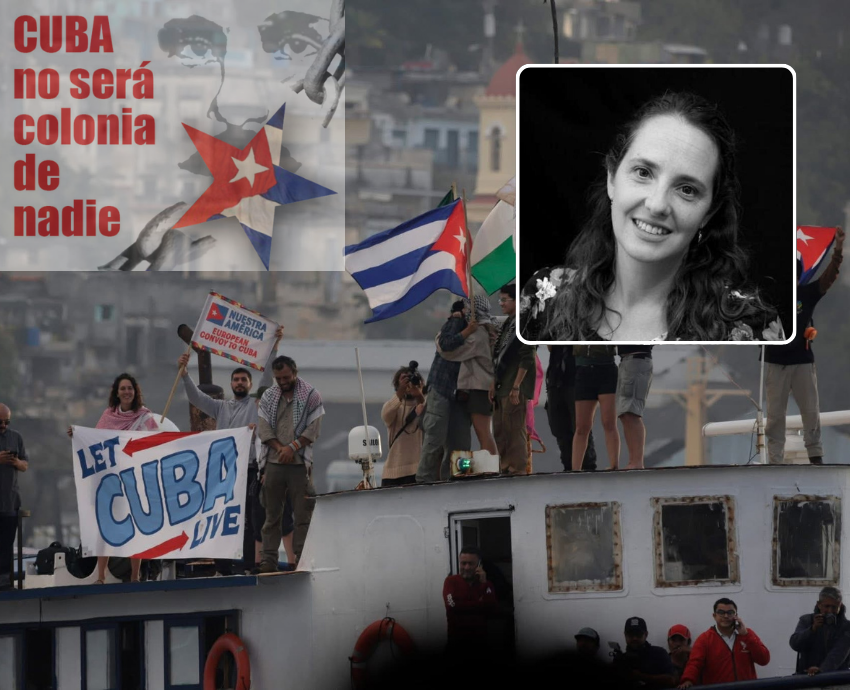
Cuba solidarity activist and scholar Helen Yaffe was a keynote speaker at the Ecosocialism 2026 conference held in Magan-djin/Brisbane, Australia, in September. The following is an edited transcript of her presentation to the opening night panel: “Resisting Trump’s New Colonialism”.
* * *
The current United States government has made it clear that they intend to achieve what they call “regime change” in Cuba by the end of the year. This is the accumulation of mounting pressure from the US blockade [against Cuba] over many years.
In December last year, the US started to seize Venezuelan oil tankers, and that included some that were destined for Cuba.
Cuba hasn't had normal oil shipments since December last year. Then on January 3, the US carried out its military operation [and] bombed four states in Venezuela.
They abducted the President [Nicolas] Maduro and his wife, Celia Flores, and said: “That's it, no more oil for Cuba.” And they certainly kept their word.
During that military action, 32 Cubans died, mainly security personnel who were in Venezuela, precisely to defend the President Maduro from attack. That had a really big impact on Cuba.
Economic warfare
By the end of the month, on January 29, Donald Trump issued the first of two executive orders. He labeled Cuba as a threat to the national security and foreign policy of the US, and effectively imposed an oil blockade, by saying that any country, company, or entity that delivered oil to Cuba — whether it was a commercial contract or a donation — would face all-round sanctions and tariffs.
And there's also the implication of the US military attacks on Venezuela and the fishing boats [in the Caribbean Sea], which have led to the deaths of more than 200 people and have just been carried out with total impunity by the US.
Many commentators believed that Cuba would collapse immediately within weeks, and it hadn't a few months later. So, on the 1st of May, when 5 million Cubans went out to celebrate International Workers' Day, Trump came out with another executive order, which was followed by packets of sanctions on the 7th of May.
They've been [added to] almost every week since, and they massively extend the extraterritorial application of sanctions, punishing any entity that engages with Cuba.
[Sanctions were] always part of the US blockade, but this has been taken to a whole new level. So, most companies, countries, and so on, are terrified now of sending even humanitarian aid to Cuba.
Now, what is this about? Well, we have to go back to the original objective of Cuba policy, as kind of encapsulated or formulated in this, what was then a secret memo, written by Lester Mallory, a US diplomat, on the 6th of April 1960 — before the major nationalisations in Cuba, before Cuba had declared that the revolution was socialist.
In this memo, Mallory recognises the popularity of the Cuban government, and recognises the influence of communists, and says that an internal opposition is not present at the moment. And so the only possible means of getting rid of the government would be to undertake to weaken the economic life of Cuba, denying money and supplies, to decrease monetary and real wages, to bring about hunger, desperation, and overthrow of the government.
This second Trump administration, with [Secretary of State] Marco Rubio at the helm, has pushed that policy to its extreme. Now, the US blockade is not just one piece of legislation. It's a very complex, overlapping set of different laws and legislation.
The first such law dates back to 1917, the Trading with the Enemy Act. Cuba is now the only country on that legislative book.
People think that it only became extraterritorial — that the US only applied the blockade to other countries — from the 1990s, after the collapse of the Soviet bloc. But actually, that character was built in from the 1961 Foreign Assistance Act.
In the first Trump administration, there was a maximum pressure strategy pursued, which saw at least 240 new sanctions, actions and coercive measures, including during COVID-19, when the United Nations was calling for an end to sanctions regimes. US President Joe Biden — despite having been the vice president to Barack Obama during his rapprochement [with Cuba] — left those sanctions in place and even added a few of his own.
Silent genocide
Now, within two weeks of the oil siege, on the 29th of January, the UN Human Rights Office was already warning about the situation, [saying that] intensive care units and emergency rooms are compromised as are production, delivery and storage of vaccines, blood products and other temperature-sensitive medications.
In Cuba, more than 80% of water pumping equipment depends on electricity.
Power cuts are undermining access to safe water, sanitation and hygiene. The fuel shortage has disrupted the rationing system, and the regulated basic food basket has affected social protection networks, school meals, maternity homes, nursing homes, with the most vulnerable groups being disproportionately impacted. That was [from] a report in February — a few weeks after the siege began.
Since then, the situation has continued. Cuba has had one oil shipment from Russia, which was in early April. It took a couple of weeks to refine and was basically used up within a couple of weeks.
Now, with the increase of sanctions, there are 7000 shipping containers in ports around Cuba, or which haven't left their ports [of origin], because they've been threatened by the US. And they have goods that Cubans have paid for, the state or small and medium businesses have paid for: food, medicine, solar panels. And they are refusing to unload in Cuba.
So this is, without doubt, an attempt at a silent genocide.
Infant mortality has more than doubled since 2019. So for anyone who was looking for evidence of casualties, it is now there. There is also a fall in the survival rate of cancer patients from 85% to 65%.
In other words, people are now dying in Cuba, which has had a blockade for nearly seven decades; it's had economic warfare for nearly seven decades, but has worked so hard to protect the population.
It is really at capacity and people are dying. The Cuban foreign minister, Bruno Rodriguez, has just come out with a statement because they had a vote in the UN yesterday [September 9] — in the UN Human Rights Commission — which condemned the oil siege and the other things I've talked about.
And their report shows that economic warfare has cost Cuba US$8 billion between March 2025 and February 2026. And this adds to a cumulative cost of the blockade since its beginning of US$178.7 billion — for a small island nation.
They don't have fuel for rubbish collection. And so, rubbish has been mounting up and people have been setting controlled fires to it.
When I was in Cuba last month, I was actually surprised that this was the only big pile of rubbish that I saw burning, because they've made a huge effort.
Communities are responding by cleaning up their neighbourhoods and dealing with the rubbish.
Military threat
There has also been the constant threat of military action [by the US against Cuba]. And many analysts believe that the US military is waiting for a violent uprising, a protest, in order to use that as a pretext to intervene.
So the question is, will there be an uprising?
And of course, what have given the imperialists hope are the July 11, 2021 protests, which were the first nationwide violent protests since the revolution and only the second violent protest [since] one in Havana in 1994.
That [2021 protests] was in the midst of the COVID-19 pandemic and surge around the country and really difficult circumstances.
And of course, there was a lot of money and funding poured in by USAID [US Agency for International Development], which is constantly trying to foster internal opposition.
I was in Havana when [the 2021 protests] happened and was able to witness the exaggeration of what had happened by the international media.
But it's encouraged this notion that all they need to do is squeeze Cubans a bit harder and there'll be a protest and they'll have the excuse to intervene.
It's true that today local protests are happening on a regular basis in response to blackouts.
When I arrived in August, the first night I was there, there was a blackout that lasted 36 hours, which also [affected] my Cuban home [and] stopped the water from pumping.
And I could hear people out banging pots and pans. That is very normal today. And the Cubans are living with that reality — [so] protests are normal.
On the other hand, on May Day, more than 5 million marched and 6 million signed a petition to defend the revolution.
So the question is, when the [international] media goes to Cuba, what are they looking for? What are they reporting? Because I'm sure a lot of you will have been reading stuff and thinking, “oh my god, it's over in Cuba … any minute now there's going to be an uprising”.
I was also [in Cuba] in January, a few days after the abduction of Maduro in Venezuela. And this was when the remains of those Cuban security personnel were returned to Cuba.
It was a really horrible day. It was cold and raining and yet thousands of Cubans came out … young Cubans as well, just to pay their respects.
‘We will not submit’
They were upset and very hurt that their Cuban compatriots had been killed. But when I asked them, are you scared? They said, “absolutely not … we will not submit”.
So where is this resolve coming from?
We're talking about resisting Trump's new colonialism, and I would say that for Cuba and Cubans, it's that deeply ingrained commitment to the ideas of sovereignty and social justice. This has been part of the Cuban struggle since the struggle for independence from Spain and from semi-colonial subjugation under US imperialism.
Even while fighting against the Spanish, Jose Marti, the hero of national independence, warned about the US’s aim to dominate Cuba. Marti said this is a matter for the whole of nuestra America (our Americas), because they will use Cuba as a springboard to extend power to the South.
So the political and ideological commitment to sovereignty and social justice bridges the struggle of Marti, the revolutionary struggle, and the adoption of socialism after the Cuban revolution.
And socialism is seen as the best solution to tackle Cuba's underdevelopment as a colonised nation.
The Cuban government has always been ready to dialogue with the US. It's been very clear about that. But it will not negotiate its sovereignty. And that means it will not negotiate or allow interference to determine its political and economic system, which includes its commitment to social justice.
Cuba can survive because it has a socialist planned economy, which is very important. It means it can control scarce resources. It has the organisations of the masses and local authorities working together to resolve local problems. It has a culture of community and social duty, which is this notion of solidarity.
They have their creativity. They talk about “inventar, inventor”. They invent solutions and they resolve problems.
And they have massive investments in science and technology for domestic solutions.
Finally, revolutionary Cuba wrote the rule book on resilience. And imagine what it could achieve if it was left in peace; if it was finally given the chance to prosper and not just survive.
Viva Cuba!