
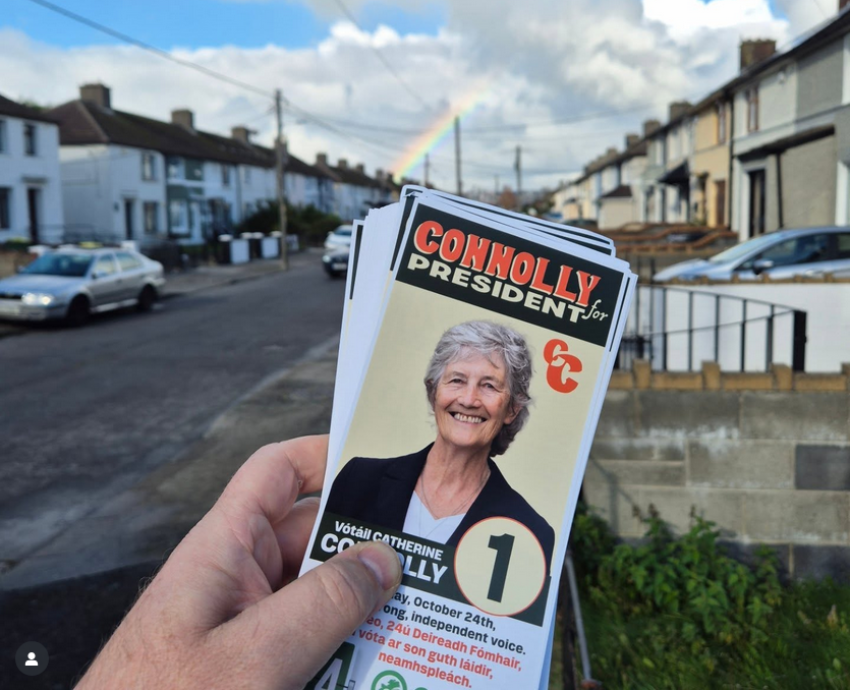
In a historic victory for the left, Catherine Connolly won the Irish presidential election on October 24, becoming the first left candidate to win a majority of votes in a national election.
Connolly won with the largest percentage and largest total votes of any presidential candidate in the Irish state’s history, on a platform that included opposing Israel’s genocide in Gaza and aspirations for a more just and equal society.
The campaign united a broad spread of left-wing groups, including People Before Profit (PBP), the Social Democrats, the Green Party, the Labour Party, Solidarity and Sinn Féin, as well as independent activists.
Paul Murphy, a Teachta Dála (member of the lower house of the Irish Parliament) for PBP, played a big part in Connolly’s campaign. He told Green Left that its success came “seemingly out of nowhere”, but has “raised people’s sights and gives people hope that we could have major social movements again on a range of issues”
The presidential position in Ireland is mostly ceremonial, with limited real power. “The importance of the victory doesn’t come from the victory itself, but rather the context that it came in,” Murphy said.
“Ireland has historically had two centre-right parties of the political establishment — Fianna Fáil and Fine Gael — which have ruled for the entire history of the Irish state.
“Since the 1980s, when they had close to 80% of the vote between them, they have experienced a slow decline, which was massively accelerated by the economic crisis.
“They have had almost identical positions on nearly every question but have always presented themselves as opponents … until 2016 when they had a confidence and supply arrangement, and in 2020 went into a coalition government.
“The traditional political establishment was losing their grip on things, but by coming together they were able to stop the change that many people wanted to see.”
Murphy said the left had a series of important victories from 2014 onward, beginning with a mass movement to defeat water charges and against privatisation. Big social movements also won abortion rights and marriage equality — in a country dominated by the Catholic Church.
During this time, the socialist left increased its parliamentary representation, as did Sinn Féin. However, Murphy said the “pendulum has swung back … with the decline of social movements and energy to the left, the rise of anti-immigrant sentiment and the emergence of a far right”.
The left got a disappointing result in last year’s general election, with the PBP-Solidarity alliance going from five seats to three. “Not a disaster, but a setback that reflected the general mood,” Murphy said.
“In general, things have been difficult for the left, with the exception of a mass ongoing movement on Palestine [which is] having a big impact.
“This presidential election is the first time we have seen an electoral expression of that.”
Key issues
Connolly campaigned on key issues, including anti-militarism, opposition to Israel’s genocide and Irish government complicity, the housing crisis, disability justice and Irish language revival.
Murphy said there has been a big attempt to undermine what’s left of Ireland’s traditional military neutrality and to line up with Western imperialism. Opposing this was the key issue for Connolly’s campaign.
While Ireland is not actively supplying weapons to Israel like the United States, Britain and Australia, “we are still complicit in allowing weapons to fly through our airspace and refusing to take action to impose sanctions on Israel”, Murphy said.
“The political establishment candidates said they were appalled at what is happening in Gaza but are against taking meaningful action because it will cause them trouble with US imperialism.”
Murphy said the housing crisis had rapidly escalated in the past decade. There were 5000 people in emergency accommodation in 2016 and now there are more than 16,000.
“Rents have tripled … and there are people getting enormously rich from this: big corporate landlords and developers, who Fianna Fail and Fine Gael represent.”
Murphy said the far right have “managed, with the assistance of the government”, to make the housing crisis about immigration, when it is “about profiteering of landlords and developers and not investing and building public housing”.
Murphy said a “revival of interest and enthusiasm for the Irish language really took off” during the campaign.
“Catherine learnt Irish in her forties and now speaks it fluently. Irish will be the working language of the presidency … it is fundamentally about Ireland’s position in the world. Are we going to become part of the Global North, the imperialist core, or does our tradition of struggling against British imperialism and colonisation have value?”
He said the language revival is also part of the contest with the far right’s narrow vision of what it is to be Irish. The alternative vision, which Connolly represented, is “to be in solidarity with Palestine, to be in opposition with imperialism and to be welcoming and open”.
Connolly faced strong opposition from the political and media establishment, as well as an “incredible and unrelenting” smear campaign in the media.
However, she did not back down, even when faced with lies and wild accusations.
“Catherine did not give an inch on anything, she just repeated her points.
“It was powerful and people began to describe Catherine as authentic, she always said what she thought and didn’t give in.”
Uniting the left
“One of the most important aspects of the campaign in terms of the ramifications for the future was how it united the left,” Murphy said.
While “Connolly would describe herself as a socialist,” Murphy said, “[o]n the Irish political spectrum she is somewhere between PBP and the Social Democrats.
“PBP has been pushing for the left to stand together since 2020, but there is a history of left or progressive parties going into coalition with Fianna Fáil and Fine Gael.
“We have always called for parties … to commit to a left government. We have a preferential voting system so we advocate transferring preferences amongst the left parties.”
After the poor result in last year’s election, Murphy said the case for being part of a broader, progressive left platform became stronger.
Six months of meetings were held between all the left and progressive parties discussing plans for the presidential election. PBP and the Social Democrats decided to support Connolly and proposed that the other parties also support her.
After some time, and a groundswell of support behind Connolly, other parties came on board.
“Every party played an important role,” Murphy said. “Sinn Fein for example, are the biggest opposition party and brought resources, know-how in terms of the scale of the campaign and how to deal with smear campaigns.
“For Catherine, the campaign was all about creating a dynamic of unity on the left which could pose the possibility of getting rid of Fianna Fail and Fine Gael.”
What’s next?
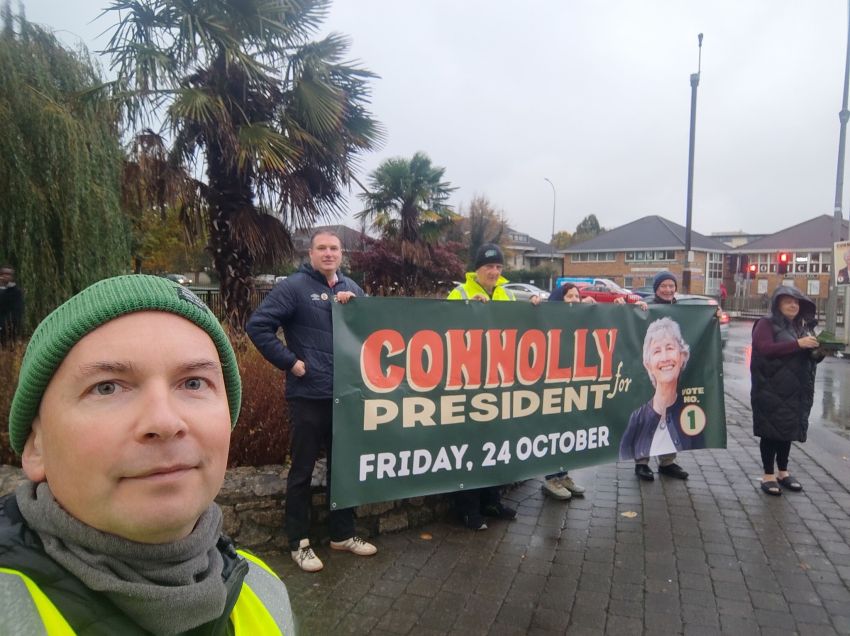
“The main thing we have been saying, which is getting a huge resonance from people, is that this movement does not stop now.
“People have this energy and sense of being able to achieve something.”
Murphy said PBP organised a post-election meeting at a venue of about 300 people, which sold out in an hour. “The thirst of people to discuss what’s next and find a way forward is really profound.”
PBP is advocating for a combined approach of mobilising people around immediate demands such as defensive neutrality, Gaza, the housing crisis and cost of living, while looking ahead to the next general election in four years’ time, because “you really have to do both”.
“We have ideas about united front campaigns on these issues, using the dynamic of unity to try and mobilise people and give them confidence.
“People voted for these values, now we need [them] to mobilise for those values in their local communities and nationally.”
PBP is beginning the process of moving toward establishing a liaison committee of the left parties where future collaboration can be discussed. They are proposing a major assembly of the left, including parties and non-party activists, to discuss things in a non-binding way.
Their sights are set on the bi-election to be held in Connolly’s former seat, which she vacated when she won the presidency. “It would be great to see if we can have a unified challenge in that campaign.”
Looking forward to the next general election, Murphy said a potential “coordinated challenge of the left”, with a pact to transfer preferences, could be based on “a commitment to broad left principles and a commitment not to vote for Fianna Fail and Fine Gael to be Taoiseach [prime minister]”.
If it can be realised, “it would represent a certain turning of the page of politics and put class politics on the agenda in a more definite way”. Connolly’s campaign means the promise of a left government is already “raising people’s hopes [and] getting people into action”.
“We want to be connected to that and then say to people that fundamentally to resolve the housing, ecological and cost-of-living crisis we need to actually challenge the economic system itself.
“We need a government that is willing to mobilise people from below to overcome the opposition of the capitalist class and the state, and have a fundamental ecosocialist transformation of society.”
[Watch the full interview with Paul Murphy on the Green Left Show.]