
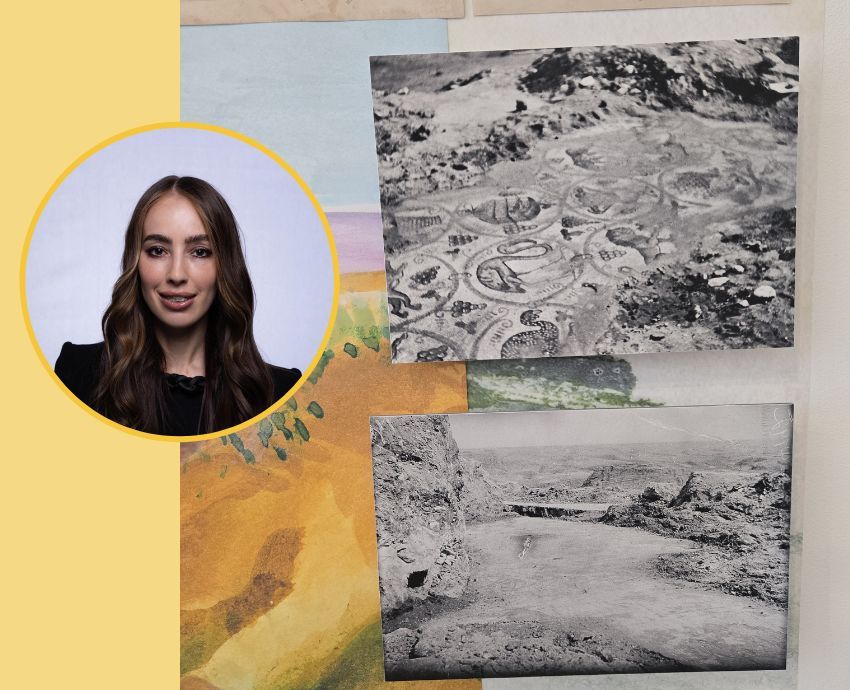
Ayda Issa, from the Tasmanian Palestine Advocacy Network, and a Palestinian-Australian, gave the following speech to the Lutruwita protest on October 11 to mark three years of genocide in Gaza.
***
Having recently returned from Lebanon, I was invited to share my reflections from the trip.
As we observe three years of accelerated genocide in Gaza, these insights feel more urgent than ever, offering a necessary testament to a deeply interconnected region.
In a gallery in Beirut, I found so-called Australia.
I went to Marfa’ Gallery to see As I Weep, an exhibition by Lamia Joreige, a Palestinian-Lebanese artist. There, in the middle of the gallery, was a replica of a mosaic from Gaza.
The Shellal Mosaic is 1500 years old. It was the floor of a church a few kilometres from Gaza City. In 1917, after the Battle of Beersheba, Australian soldiers found it while digging defensive positions near Shellal along the Wadi Ghazzeh. They glued its tiny stones onto linen canvas, lifted it from the ground and shipped it to Australia.
Since 1940, it has been set into a wall at the Australian War Memorial in Canberra. The mosaic that once decorated a holy site is now permanently displayed as a war trophy.
Joreige asks: If the mosaic were returned, who would it go back to? The villages around Shellal were destroyed in 1948 by Zionist militia and the people who lived there were expelled.
How do you return something to a land that has itself been stolen?
I had to travel to Lebanon to learn that a piece of my homeland is sitting in this country’s capital. Gaza’s mosaic is kept safe in Canberra, while Gaza itself is being turned to rubble.
Australia is not a bystander to what is happening in West Asia and it never has been.
The same Australian soldiers who took the mosaic were fighting to help Britain take Palestine. Joreige spent years reading their diaries and the work she built from them was shown at the Biennale of Sydney this year.
That victory handed Britain the power to draw lines across the region; lines that would tear families apart for the next hundred years.
In 1947, Australia helped steer the United Nations plan that carved up Palestine. Today, Australian-made parts go into the fighter jets bombing Gaza and Lebanon, while Australia continues to support Israel with impunity.
Australia will deny its complicity and responsibility, because it was built the same way: on the genocide of Aboriginal people and the theft of Aboriginal land, which this nation still refuses to fully reckon with. Terra nullius, the myth of an empty land waiting to be settled, is the very same colonial narrative used to justify the erasure and colonisation of Palestine.
This always was, and always will be, Aboriginal land. Sovereignty was never ceded.
Joreige’s exhibition is called As I Weep. For over a year, she found herself unable to cry. She watched the genocide in Gaza and the destruction of Southern Lebanon every day, speechless and powerless, yet she could not shed a tear.
Then she went to the archives in London to research the history of this violence, tracking the legacy of the Paris Peace Conference, the Zionist meetings and the Palestinian petitions that were ignored. She eventually unrolled the original Sykes–Picot map, in which Britain and France first carved up this region between them. Without warning, she cried. Her tears fell onto the paper, smudging the lines and blurring the borders that started it all.
What I kept coming back to in Lebanon was this concept of borders. Colonial lines, drawn with arrogant indifference, that divided communities and shaped what came after: both occupation and resistance.
Our friend Hanan lives in a refugee camp in Beirut. She was born in Lebanon, but her family is originally from the Hula Valley.
Before 1923, the Hula Valley and the hills of Southern Lebanon were one world. Farmers grazed their animals across neighbouring valleys. They sold their crops in the next town over. Roads ran from Tyre to Acre, from Bint Jbeil to Safad; these villages functioned as one economic unit.
Then, in 1923, Britain and France drew a line through the middle of it.
The Hula Valley went to Palestine. Nobody asked the people who lived there, who shared a life of farming, trade and community, whether this was okay. Hanan’s family ended up on the Palestinian side. That line made her northern Palestinian.
Then came 1948 — the Nakba.
Hanan’s family was expelled, pushed north across that same line into Southern Lebanon. Their villages were emptied and filled with settlers.
The line didn’t protect the Lebanese side either. In 1948, Israeli soldiers crossed into the Lebanese side of the border into Houla and killed the people they found there. The village later built a monument engraved with the names of almost a hundred people killed.
Hanan does not have Lebanese citizenship because she is from the Palestinian side of Hula. Under Lebanese law, she is barred from working in many professions. She cannot own property. She lives her life as an outsider, 110 kilometres away from her familial village.
One line, drawn by colonial powers, decided what Hanan’s national identity would be, where she could live, what work she could do and whether she could ever return home.
She did nothing to earn that fate, and neither did her children, or the generations that followed.
The Southern Lebanese side of Houla is still being attacked.
Following the so-called ceasefire in November 2024, Israeli soldiers occupied the village, destroying 55 homes in the process. They targeted the living and desecrated the dead, smashing the monument erected to honour the martyrs of the 1948 massacre to pieces. They spray-painted onto it, in Hebrew: “The only good Shia is a dead Shia.”
A retired teacher, Abdul Aziz Chreim, went back to the ruins of Houla. Among the broken marble, he found the names of his grandmother and grandfather.
His house is rubble. His library of more than a thousand books, collected more than 50 years, is gone. His pomegranate trees are gone. Carrying his house key in his pocket, he said: “This is my past that has been wiped out. My present has been wiped out. My future is lost.”
Palestinian families carried their keys out in 1948. Some still have them. And 78 years later, on the other side of the same line, a Lebanese grandfather is doing the same thing.
This is not the past.
Israel continues to attack Lebanon. Every day we spent there, the south was being destroyed. Gaza is still being destroyed.
At the beginning of this month, two women from my family, Maysaa and Mary Abu Daoud, were killed by an Israeli airstrike. They are the third and fourth members of my family we have lost; last year, Najwa Abu Daoud was killed by Israeli shelling and in 2024, Hani Abu Daoud died from a lack of medicine and healthcare, caused by the inhumane siege.
I do not want hollow condolences; I am not sharing my family’s trauma for your pity. You can keep your sympathy. What I want is your rage and I want that rage to disrupt the complicity of this country.
I demand your political accountability. I demand your resistance.
While Palestine remains under occupation, so does the Jolan in Syria, which has been occupied since 1967. And from the ruins of one Southern Lebanese village, you can see both occupied Palestine and the occupied Jolan.
The colonial, expansionist logic that expelled Hanan’s family is the same logic bombing Lebanon today, occupying the Jolan and besieging Gaza. It’s the logic that took this land from its First Peoples. And it’s the logic that decided a mosaic from Gaza belongs on a wall in Canberra.
But lines on maps are not stronger than people.
Hanan still carries the memory of her family’s village. Abdul Aziz Chreim still carries his keys.
Aboriginal people have carried their Country through more than 200 years of ongoing attempts to erase them. Joreige’s tears fell onto the Sykes–Picot map and blurred its borders.
I ask you to remember that behind every border is a person whose life has been broken apart by it. Remember whose land you’re standing on.
Remember that what colonial powers drew onto a map, people have the power to undo.
Free Palestine. Free Lebanon. Free Jolan. Land Back.