
The latest official unemployment rate was released by the Australian Bureau of Statistics on September 24. It was 4.6% in August, seasonally adjusted, up from 4.2% a year ago. By its calculations, the number of unemployed people had grown by 12.4% in that period to 722,900. Another 6.3% were underemployed.
Two days earlier, Reserve Bank of Australia (RBA) Governor Michele Bullock took part in a “Fireside Chat at the Committee for Economic Development of Australia”, where she revealed that this was on the lower end of the RBA’s unemployment target of between 4.5% and 5%.
Higher unemployment, she said, will take the “heat out of the labor market” and “ease pressure on inflation”.
It’s a familiar tune.
Every RBA governor swears blind that everything the RBA does is to “fight inflation”. If some people get hurt in the process, sorry, that is just a necessary sacrifice because inflation hurts everyone.
However, the RBA governor admitted that inflation “really hits the most vulnerable in the community the hardest”.
“They’re the ones that have the least ability and income to move ... They have less flexibility. They have less discretionary expenditure ... So inflation really, really hits the people on the lowest incomes the hardest.”
So is the RBA getting on the side of the poorest?
Yeah, nah.
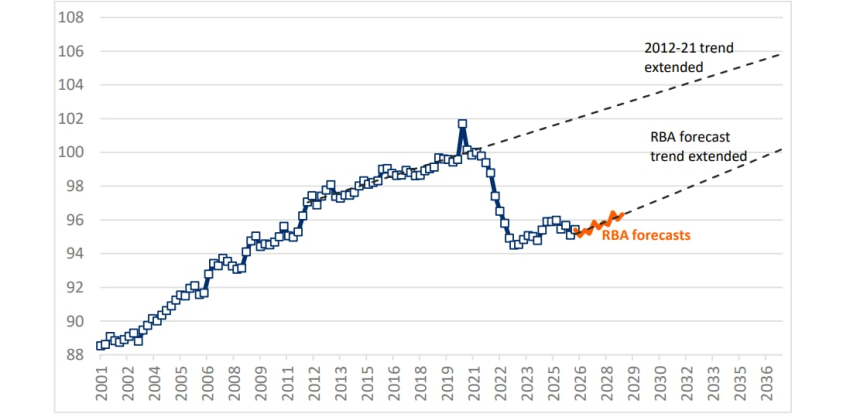
Bullock was just admitting the bloody obvious, when average real wages have been falling sharply since March 2021.
Greg Jericho, The Australia Institute’s chief economist, explained: “The rise of inflation above wage growth in 2022 and 2023 delivered the sharpest decline in the value of real wages since the Reserve Bank began its inflation targeting regime in the early 1990s.”
That has always been the RBA’s real intention — not to stop inflation, but to force the working class to shoulder the burden.
The RBA’s chief weapon against the working class is its ability to crank up interest rates. This forces more people out of jobs, to become part of a reserve army of labour that, in turn, pressures those still with jobs to accept falling real wages.
The official unemployment statistics hide the real pain. More than 1 million people (including children and other dependants) are currently forced to survive on unemployment payments that, according to the Antipoverty Centre, are 40% below the poverty line.
Its October 12 Anti-Poverty Week statement reported that 20% of suicide deaths are people on JobSeeker and 60% of working-age adults who die are on a Centrelink payment.
Jericho warned in his paper, The collapse of real wages and the path to recovery, that the RBA will push back against any attempt to take real wages back to 2021 levels because it is determined to limit both wage growth and wage growth expectations to avoid a “wage-price spiral”.
This argument implies that it is workers’ push for wage rises (to meet rising costs of living) that are the cause of inflation.
But this is not true.
Prices have been rising faster than wages all around the world, first sparked by supply shortages during the COVID-19 crisis and then fed by the surge in oil prices following the illegal United States-Israeli attacks on Iran. They are now being supercharged by the AI arms race.
The RBA is doing nothing to address these drivers of inflation; instead, it is seeking to make those hardest hit carry the pain.
Iain Ross, a member of the Monetary Policy Board of the RBA, gave a detailed speech at the University of Melbourne, showing that a “wage-price spiral” is not a real threat, because the trade union movement had been dramatically weakened, including by laws restricting industrial action and workers’ solidarity.
“There is no evidence of the emergence of a wage-price spiral in the present circumstances, and recent data suggest such an outcome is unlikely,” he said.
Before the 1980s, stronger unions like the Australian Metal Workers Union would win wage rises and these gains would be spread to other industries, according to a principle of “comparative wage justice”.
“The situation today is very different,” Ross said. “Comparative wage justice no longer plays the pervasive role it once did, and quarterly indexation is not a feature of the current system. Importantly, the current system also limits how frequently wage claims can be revisited and how readily outcomes can spread across the economy.”
The major parties’ neoliberalism is responsible for this and the simultaneously terrible social and environmental costs. For decades, the billionaire class has had a free hand to obscenely enrich itself.
This is why Green Left has not only exposed the crimes of the rich and powerful, but has also championed the struggles to build stronger and democratic trade unions and other movements of resistance to capitalist greed.
If you agree with us, become a supporter or donate to our $180,000 Fighting Fund, which is now at $135,527.