
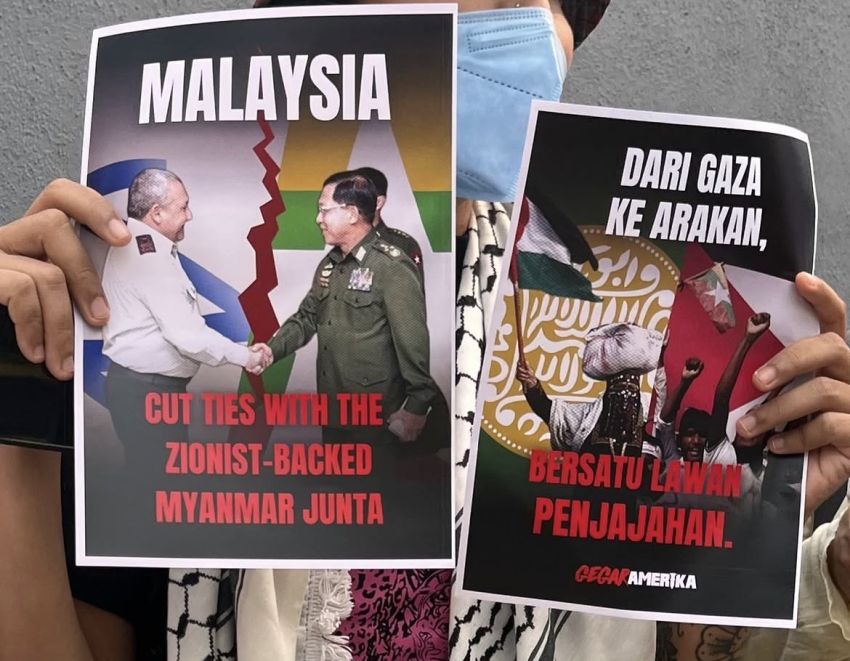
Myanmar President Min Aung Hlaing visited Malaysia on October 7–8 and met with Prime Minister Anwar Ibrahim in Putrajaya. Madhavi Madhu, a member of the Socialist Party of Malaysia (PSM) and a longstanding refugee rights activist, explains why this move has prompted concern and protests from human rights and refugee rights groups.
* * *
Prime Minister Anwar Ibrahim should have maintained a stance toward Myanmar similar to his stance toward Israel, as both leaders fall into the same category: that of war criminals.
A protest was held on October 8 and a joint statement issued unequivocally rejecting and condemning the visit.
The protest was called by the Anti-Imperialist Coalition Movement (Gerakan Gabungan Anti-Imperialis, GEGAR) and the socialist student group AKSI and supported by local human rights NGOs such as Beyond Borders, Suara Rakyat Malaysia (SUARAM), Mandiri, Kuala Lumpur and Selangor Chinese Assembly Hall (KLSCAH) Youth, Malaysian Islamic Youth Movement (ABIM), and the Coalition for Clean and Fair Elections (BERSIH).
They urged the Malaysian government to stand in solidarity with the people of Myanmar and refuse all formal recognition of the junta leader. They also highlighted that this presidential-level reception for the Myanmar President violates the Association of Southeast Asian Nations (ASEAN) Five-Point Consensus.
The joint statement demanded: The immediate cessation of violence in Myanmar and dialogue among all parties concerned; mediation by an ASEAN special envoy; humanitarian assistance through ASEAN mechanisms; and a visit by the ASEAN special envoy to meet with all parties concerned.
The Myanmar president stated again that the regime will only accept the deportation of "genuine citizens" of Myanmar (Rohingyans are not recognised by the regime as genuine citizens).
So while this diplomatic engagement was justified as an attempt to resolve the so-called "Rohingya issue", it has been reported that no Rohingyans have been sent back to Myanmar.
Nevertheless, the recent deportation of 1500 refugees to Myanmar and the planned deportation of another 5000 is a dangerous shortcut and a violation of the principle of non-refoulement — the international law rule that forbids returning people to a country where they face serious threats to their life or freedom.
The Malaysian Bar Association has sought the High Court's permission to challenge the government's repatriation plan.
It is important to be mindful that, apart from Rohingyan refugees seeking protection, there are other refugees from various countries in Malaysia.
A holistic, human rights-based approach is important, and a promised refugee right to work during the previous election is definitely a more dignified and humane solution for refugees and Malaysia.
The government could use readily available United Nations High Commissioner for Refugees expertise and services to manage refugees, while setting up the Dokumen Pendaftaran Pelarian (refugee registration documentation) with more transparency.