
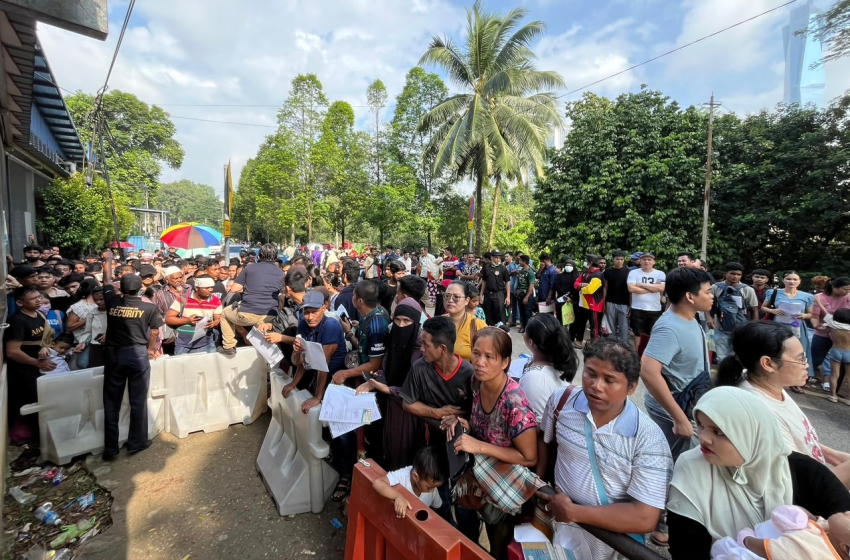
The United Nations High Commission for Refugees (UNHCR) in Malaysia has registered 126,000 Rohingya refugees from Myanmar. An unknown number remain unregistered. They all face official persecution and a rapidly escalating campaign of hate, while desperately struggling to survive without work rights.
More than 100 Rohingya refugees converged outside the UNHCR office in Malaysia’s capital, Kuala Lumpur on July 27, after they were driven out of their settlement in the northern state of Penang.
Two days later, Prime Minister Anwar Ibrahim announced that Myanmar authorities had agreed to “take back” 5000 ethnic Rohingya in immigration detention. As at June 30, 22,166 people were locked up in poor conditions in Malaysian immigration detention centres.
Green Left’s Peter Boyle spoke to Angeline Shannan, an independent observer and refugee rights advocate, and Madhavi Madhu, a member of the Socialist Party of Malaysia (PSM) and a longstanding refugee rights activist, about the escalation in attacks on Rohingya refugees.
* * *
What are the latest developments around the persecution of Rohingya refugees in Malaysia?
Madhavi Madhu: The most recent developments affecting the Rohingya refugee community in Malaysia have been a significant increase in online hate speech and anti-Rohingya sentiment, particularly during May and June this year.
A surge in hostile rhetoric on social media contributed to a more hostile environment on the ground, with numerous reported incidents of Rohingya individuals being harassed by members of the public.
A wave of misinformation appears to have been triggered by false claims circulating online, including allegations that Rohingya refugees were demanding land and special rights through an account falsely claiming to represent the “Rohingya Solidarity Network Malaysia”. This was further amplified by a fabricated poster alleging that a person identifying himself as the “President of Rohingya Malaysia” was demanding that the town of Selayang be designated to serve the Rohingya community.
These false narratives fuelled public hostility and intensified discrimination against the Rohingya refugee community.
Angeline Shannan: The increased harassment of Rohingya started to show about a year or two ago. A crackdown by the Department of Road Transport on unlicensed vehicles was used as the excuse by a vigilante group — headed by one, “Sofian” — to “check” the Rohingya community for persons driving motor vehicles unlicensed. Refugees seen as “illegal immigrants” under Malaysian law are not allowed to be legally licensed to drive cars or ride motor bikes.
Sofian's gang went house to house in Bagan Dalam, Butterworth, not only to harass, beat up and threaten Rohingya families but also “confiscated” any vehicles in their possession, without any legal authority. From Penang, this harassment spread to the national level.
Close monitoring of such occurrences and similar racist attacks on a particular Chinese retail business, revealed a suspected link between Sofian's gang and particular UMNO [the conservative United Malays National Organisation] politicians.
Is the stepping up of the campaign of hate connected to recent state elections and the approaching general election?
MM: There is no clear evidence that the recent surge in anti-Rohingya hate speech is directly linked to the recent state elections or the approaching general election. However, anti-refugee and anti-Rohingya narratives have been used during election periods in the past to appeal to certain segments of the electorate, so this possibility cannot be entirely ruled out.
Just prior to the recent wave of social media attacks targeting refugees, particularly the Rohingya community, several self-described right-wing activists launched a hate campaign against the Hindu community. They alleged that Hindus were responsible for the proliferation of so-called illegal temples across the country.
The timing of these successive campaigns suggests a broader pattern of coordinated identity-based mobilisation. It is conceivable that these right-wing actors are seeking to undermine the Anwar administration by inflaming ethnic and religious tensions, with the aim of shifting public sentiment and electoral support back towards the right-wing BN [Barisan Nasional] coalition.
At the same time, several government agencies and civil society organisations have publicly pushed back against the misinformation and hate speech.
Many of the viral hate-speech-laced social media posts alleged that “Rohingyas are involved in many crimes” and “Rohingyas are a burden on the Malaysian healthcare system and the government is spending tax money for Rohingyas”.
The Inspector-General of Police urged the public to stop spreading harmful speculation about the Rohingya community, noting that only 89 Rohingya individuals (0.02% of the Rohingya population in Malaysia) were involved in criminal offences between 2024 and June 2026.
The Ministry of Health also clarified that refugees, including Rohingya, pay the full foreigner rates for treatment at public healthcare facilities and do not receive subsidised healthcare.
The Human Rights Commission of Malaysia (SUHAKAM) and numerous civil society organisations similarly issued statements condemning hate speech and calling for responsible public discourse.
Despite these public statements, immigration enforcement has intensified significantly over the past six months. More than 30,000 individuals have reportedly been arrested in immigration operations, with refugees also being affected by these large-scale raids, as there is a significant refugee population still undocumented. This represents the most intensive immigration enforcement campaign in recent years.
AS: After the 2022 general election, the Anwar-led Pakatan Harapan (PH) formed a ruling coalition with UMNO and other East Malaysian political parties. Now PH has lost its direction, the promise of reformasi [democratic reforms] remain largely unfulfilled.
Emerging dissatisfaction in middle and low-income electorates with the rising costs of living and the effects of past corruption scandals, is reflected in PH defeats in the recent Johor and Negeri Sembilan state elections.
PH is now in damage control before the next general election, which must be held before February 2028.
The further fracturing of the conservative parties possibly is causing a surge in power struggles and political scapegoating. These are age-old political tactics, made more devious and dangerous by using social media and AI.
What demands have refugee rights advocates put on the government?
AS: Since I became involved in work with refugees and human rights advocacy, nearly 20 years ago, civil society groups, NGOs and human rights advocates have been campaigning for basic human rights and legal status for refugees and asylum seekers.
The main basic human rights are the right to education, to work and free access to medical treatment.
The majority of Rohingya were denied education in their home country. The lack of basic literacy holds a majority of them back from being able to meet many of the challenges in Malaysia where basic education has been accessible to a vast majority of us and possibly to some of the other refugee communities.
Since all refugee and Rohingya children are prohibited access to local public schools, the provision of early and basic education is vital, perhaps moreso than for more literate and more educated refugee communities. There is also an issue of affordability to enter private schools.
Despite the prohibition on formally taking up a job, Rohingya refugees often have to work informally, without any employment rights or safe-guards. They are frequently exploited and at times don't receive any wages after working for months. If found working, they may face arrest and detention.
Now the government has demanded that UNHCR stop all registration of refugees, to initiate its own refugee registration under its new Refugee Registration Document (DPP) scheme. We are very alarmed by this, as asylum seekers who are yet undocumented are in danger of being detained and deported by immigration authorities.
We haven’t heard of any guarantees of safety or granting of legal citizenship by the Myanmar government. We suspect there are none. If this is the case, and repatriation is forced, the Malaysian government will be complicit in supporting genocide of Rohingya people.
Refugee advocates and human rights organisations have voiced their concerns and protests, but there has been no response or assurance from the Federal government. Refugee advocates and other NGOs have pointed out the glaring hypocrisy in apparent support given to the Palestinian issue and absence of any support by the government to the Rohingya issue. Instead, Rohingya refugees and asylum seekers have become targets for racial attacks by far right racist politicians, criminal syndicates and corruption at various levels of officialdom and the general public.
MM: Although the DPP registration system was made for all refugees and asylum seekers, the recent rise in hostility towards the Rohingya community means that many organisations place particular emphasis on: protecting Rohingya refugees from hate speech and harassment; ensuring they continue to have access to asylum procedures and UNHCR or DPP registration; preventing their detention or deportation to Myanmar; and ensuring that the transition to the DPP system does not weaken their protection or expose them to further discrimination.
We are alarmed that the government has announced that 5000 refugees in detention will be deported to Myanmar, which is not safe for them due to the ongoing civil conflicts.
While Malaysia has not ratified the 1951 UN Refugee Convention or its 1967 protocol, it is still obligated to respect the international law principle of non-refoulement, which prohibits countries from returning anyone to a place where they would face a real risk of persecution, torture or other serious ill-treatment, a threat to life, or other comparable serious human rights violations.