
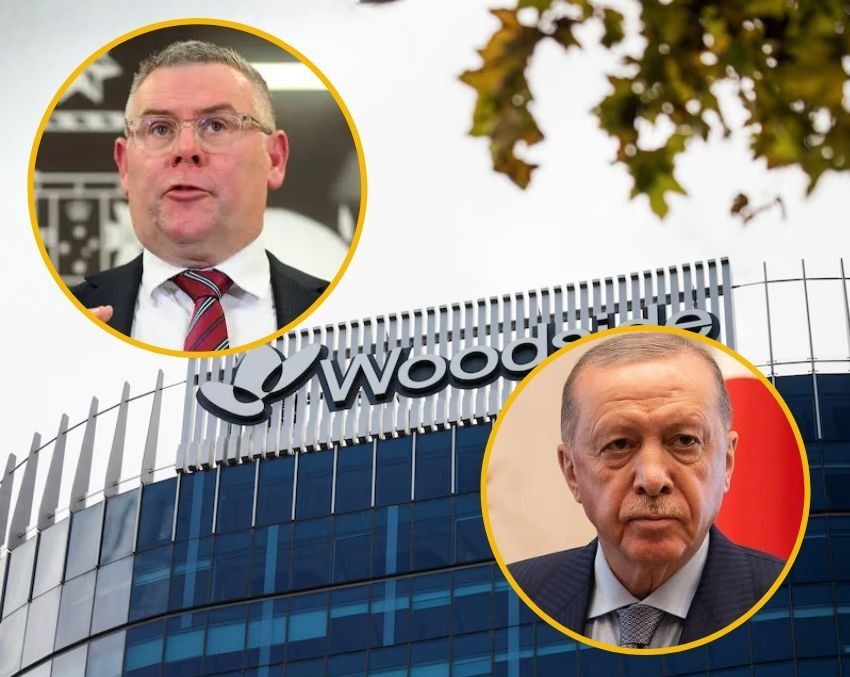
Australia and Türkiye will, unconventionally, share the “presidency” of the world’s biggest climate summit, COP31. While both present themselves as climate leaders, both are seeking to expand dangerous fossil fuels production.
COP31 will be held in Antalya, Turkey, from November 9–20. Türkiye will be the “hosting president” and Australia the “negotiations president”.
Türkiye is promoting a “net-zero by 2053” target, with the date marking the 600th anniversary of the Ottoman conquest of Constantinople. But the symbolism conceals a harder reality — Türkiye’s own projections show emissions continuing to rise until 2038.
Australia has a legislated national target to reach net-zero greenhouse gas emissions by 2050. But climate experts say a 75% cut is needed by 2035 to reach that goal. They also say Australia is dodging its global responsibility to the Paris Agreement by exporting its dangerous fossil fuel emissions, as the agreement does not count those emissions (known as Scope 3).
Since ratifying the 1997 Kyoto Protocol in 2007, Australia has kept its domestic emissions roughly flat — while multiplying its fossil fuel exports.
The Stop Adani campaign, among others, has highlighted the contradiction of governments signing climate agreements and approving new coal and gas mines at the same time.
Australia may burn less coal, but the rest of the world burns what it digs up.
Coal is one Türkiye’s main imports from Australia. Since signing international climate agreements, Türkiye has steadily increased its coal, oil and gas imports.
Australia provides $700 million in climate and disaster finance to Pacific nations — while handing $14.9 billion every year in subsidies to the fossil fuel industry. That is 21 times more for industry than for its most climate-vulnerable neighbours.
These are not parallel stories; they are two sides of the same transaction and one company sits at the centre of both — Woodside Energy.
Australia is among Türkiye’s top three coal suppliers. In 2024 alone, Türkiye imported 2.7 million tonnes of coal. Now, it imports gas, mainly from Woodside.
In September last year, weeks before COP31 was awarded to Antalya, Woodside signed a nine-year liquefied natural gas (LNG) contract, starting in 2030, with Türkiye’s state pipeline company BOTAŞ. The same month, Australian environment minister Murray Watt granted Woodside final approval to extend its North West Shelf LNG project until 2070.
The Climate Council of Australia described the project, Labor’s 27th coal, oil or gas approval since taking office, as “the most polluting fossil fuel project green-lit by the Albanese government”.
The first Australian LNG cargo arrived in Türkiye just after the COP31 host decision. LNG tanker Methane Julia Louise loaded at Gorgon LNG terminal in Western Australia and delivered to Türkiye’s Saros Bay on February 22; it was the first-ever Australian LNG cargo to Türkiye.
Woodside is not just an Australian-owned company selling gas to Türkiye. It is the shared infrastructure of a fossil fuel relationship between two countries that will simultaneously chair the global climate summit.
What the climate debate leaves unnamed
Coverage of Türkiye’s climate policy focuses almost entirely on coal power plants. But the dangerous emissions are driven by three interlocking dependencies — coal, cars and construction — and only one is named.
Türkiye’s automobile fleet grew from 5.8 million in 2005 to 17.4 million last year. Road transport now accounts for 94% of all freight and passenger movement.
High taxes on vehicles and fuel have made fossil-fuel dependency a government revenue stream; the state profits from the fossil fuel system it should be dismantling.
Turkey’s construction boom has transferred wealth upward and carbon downward. New buildings have enriched developers, while ordinary households are left with debt, high energy bills and a built environment designed around fossil fuels.
Asphalt, concrete, roads and buildings are also fossil fuel systems; they are just not named as climate policy. Coal and gas receives the headlines, but the material infrastructure locking in fossil fuel dependency for decades goes unexamined.
The slogans of “net-zero by 2053”, “green growth” and “climate leadership” describe how policies are kept invisible while coal is dug, gas is shipped and roads are paved.
Türkiye has already proved that sloganeering works.
In 2019, a law granting operating permits to thermal power plants without pollution filters passed parliament in near silence — including from the opposition, whose members skipped the vote rather than organise against it.
Activists published the poor attendance record of how many opposition MPs had simply not shown up. Parliament had failed. But the public had had not. Days of public outcry followed and Turkish President Recep Tayyip Erdoğan vetoed the law he had just been given.
Naming the silence worked.
COP31 in Antalya will be a summit of official framings. Two fossil fuel states will market their policies as “climate action”, while a Woodside tanker moves between their ports. The climate movement’s job in Türkiye and Australia is the same as it has always been.
[Önder Algedik is an energy and climate campaigner and founder of the 350 Ankara activist group. He is the author of İklim Meselesi (The Climate Issue), published by İletişim Yayınları, 2025.]