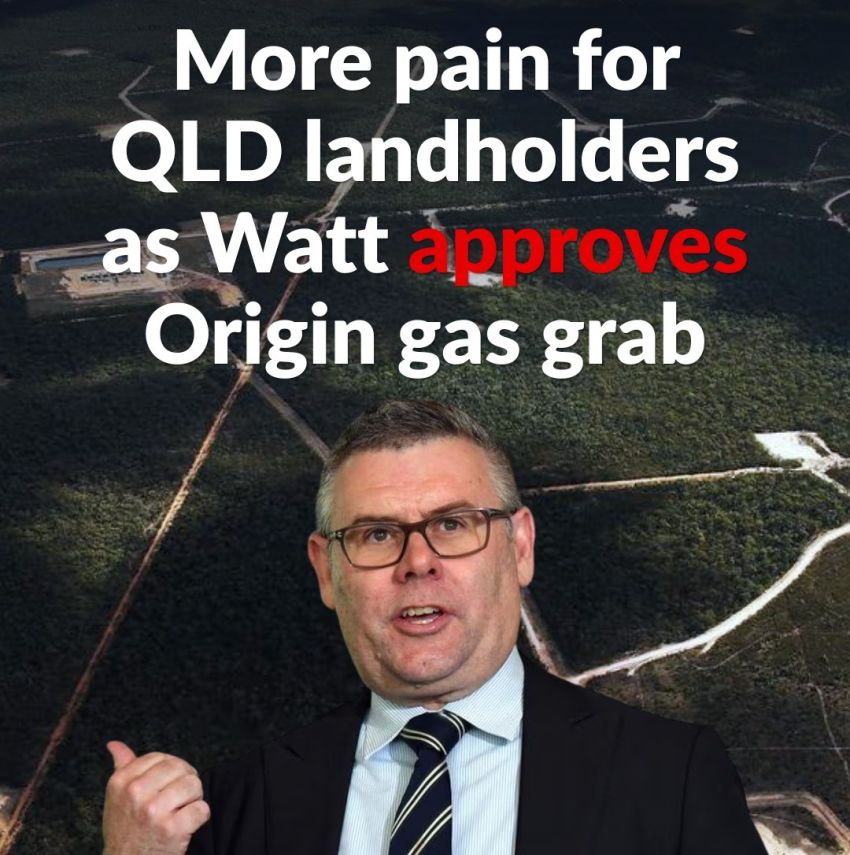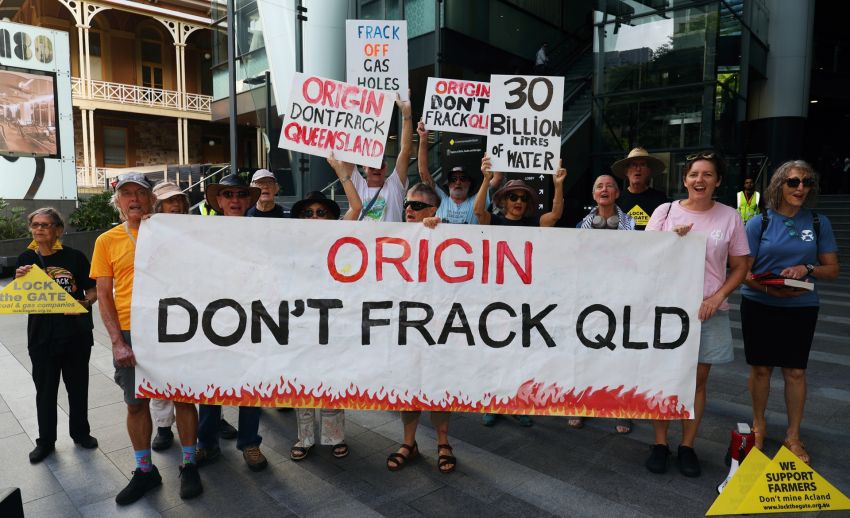
The Lock the Gate Alliance has hit out at federal environment minister Murray Watt’s March 20 approval of almost 1700 new coal seam gas (CSG) wells in Queensland.
Ellen Roberts, from Lock the Gate, told Green Left that, of approximately 10,000 gas wells drilled in Queensland, about 6000 are operational. She said the approval of another 1700 wells — “almost a one third increase” — is a significant expansion.
Further, she said that the industry is at a “crossroads”, since all of the big players signed long-term contracts when gas fracking became a major industry in the state.
The attempt to open new wells now, with a long-term investment, signals that Australia Pacific LNG, a joint venture including Origin Energy that sought the recent approvals, has no plans to transition away from fossil fuel extraction.
The current approvals expire in 2081, three decades after the federal government said it would have achieved “net zero” emissions.
“We think that Origin needs to have a plan for transitioning away from gas exports,” Roberts said. She argued that gas fracking is unsustainable for the government, as “it is inconsistent with its climate targets”.
She pointed to Origin changing its decisions in response to shareholder and customer pressure. Most people know Origin as an electricity retailer, even though it makes more money from gas exports.
Roberts said that “75% of the gas produced by Australia Pacific LNG does go offshore”. She said it “contributes more to the domestic market than any of the other suppliers, so you can see just how export-oriented Queensland’s gas industry is”.
She also highlighted how much Australian consumers pay for gas.
“Obviously, Australia has a huge amount of gas. You would think that would mean that Australian domestic gas would be cheap. But the opposite is the case.”
The Australia Institute (TAI) reported last year that consumers pay more for gas and electricity because of the export gas industry.
According to TAI, “gas exports have led to the tripling of wholesale east coast gas prices and a doubling of electricity prices, since exports began in 2015”.
“Gas price increases due to excessive exports have also caused electricity prices to rise because gas power stations often set electricity prices,” TAI said.
As Roberts explained: “Domestic consumers compete with overseas markets for Australian gas and so we have to pay the same or more than those overseas markets ... That obviously means a lot for Australian households, but it has also meant that we’ve seen Australian manufacturers go offshore.”
Several unions, including the Australian Manufacturing Workers Union (AMWU) and the Australian Workers Union, have called for a gas reservation policy.
The AMWU has gone further and is calling for “accelerating the phase-out of fossil gas use in industrial settings” to provide “energy independence” and “job security for the nation’s 900,000 manufacturing workers”.
Referring to this “live debate”, Roberts said that “the federal government is looking at having a domestic gas reservation, whereas we think it is time for us to move away from export gas completely”.
The big increase in petrol and gas prices in the context of the war against Iran is another reason to do this.
“We’re seeing what it means to have a global fossil fuel market and how vulnerable that makes all of us in terms of reliance [on fossil fuels] for transport and for food and for manufacturing,” Roberts said.
“The real shame is that there are alternatives to gas and coal and oil, and we simply have not taken up those opportunities because of vested interests, including Origin and Shell, who’ve all done a lot of lobbying.”
Roberts believes the war on Iran should be an “opportunity for us to look at how we delink ourselves from global fossil capital, which is not serving our interests. It’s making us vulnerable to the actions of people like [United States President] Donald Trump.”
This is why the federal government is now considering options to tax windfall gas export profits at 25%. The Greens and several trade unions are offering support and TAI estimates it could raise $17 billion in revenue.
Roberts said that companies such as Shell and Australia Pacific LNG are “reaping the benefits of destruction” with windfall profits, but that “we have so many alternatives”. “It is time for us to get off fossil fuels”, she said, not only for environmental reasons, but social and economic ones too.