
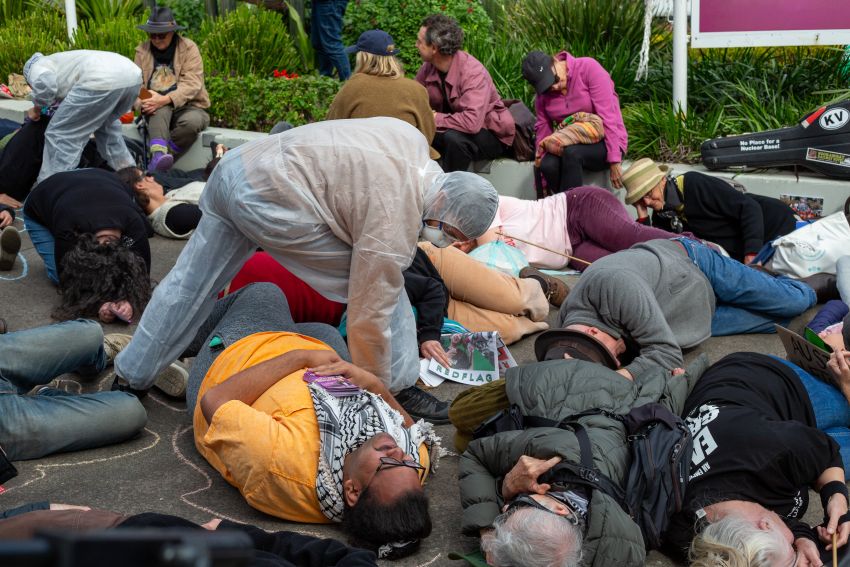
Wollongong Against War and Nukes has joined with many others in this city to show our opposition towards plans to turn Port Kembla into a military town. This included a rally of several thousand people down the main street of Port Kembla in 2023.
More than 40 local organisations, including health and environment bodies, trade unions and church groups, have signed the Port Kembla Declaration demanding the federal government rule out a submarine base in our region.
Port Kembla residents have widely opposed a proposed base, and thousands have come together to declare that this is “No Place for a Nuclear Base”.
We are concerned that the presence of nuclear submarines would make the Illawarra a high-priority target for conventional or nuclear attack. We are concerned that US submarines carrying nuclear weapons could dock in Port Kembla. We are concerned about the risk of nuclear accidents. We are concerned about becoming a site for the storage of nuclear waste. We are concerned about the social, economic and environmental impact of a nuclear submarine base in Port Kembla. We are concerned that, even in a best-case scenario, a nuclear submarine base would have a highly detrimental impact on our community.
We love Port Kembla and the Illawarra region; we don’t want to lose the things we value about this place.
We have been told that the decision on the location of a nuclear submarine base has been deferred. This is no comfort — if anything, it increases our fears that decisions are being made in secret, without community consultation and overriding local dissent.
I take a lot of inspiration from the deep desire for peace that people in our city have shown over many generations. This opposition to war includes the famous “Pig Iron Bob” Dalfram dispute and, in more recent times, protests against the invasions of Vietnam, Afghanistan and Iraq.
We have repeatedly said no to war. For many decades, the local community has also said no to nuclear war.
Wollongong was first declared a nuclear-free city in 1980. In 2019, Wollongong City Council signed up to the International Campaign for the Abolition of Nuclear Weapons Cities Appeal. In 2022 and last year, Wollongong City Council again reaffirmed the city’s nuclear-free status.
Visits or the stationing of nuclear submarines in Port Kembla is highly dangerous.
Nuclear reactors pose major risks for people and the environment. Unlike civilian reactors, most information about military naval reactors is kept classified. Nuclear-powered submarines have a long history of accidents, many of which are again shrouded in secrecy.
Seven-hundred-and-eighty-nine nuclear safety events have been recorded at Scotland’s naval bases since 2006 and the British defence ministry has acknowledged that many incidents had “actual or high potential for radioactive release to the environment”. But it has refused to say what actually happened in any of the incidents, or when they occurred — raising concerns about whether local residents would be informed if similar incidents occurred in Port Kembla.
Even if the probability of an accident is “low”, the level of consequence of a nuclear submarine accident is extremely high, given that the submarine’s nuclear reactors are fuelled by weapons-grade highly enriched uranium.
Secret documents, obtained under Freedom of Information legislation in May, demonstrate that planning is being hidden from the public and the risks are being hidden from the communities affected.
Secret NSW government planning documents have considered what should happen in case of an accident or explosion on one of the submarines. Australia’s nuclear safety agency assessed that an accident at a submarine base here would require evacuating most residential streets in Port Kembla. Port Kembla school — the school my two kids attend — would be in the immediate evacuation zone.
Our community has never been properly informed of or consulted about this risk. It is unclear how large the real evacuation zone would be if an accident or an attack on the base occurred. Or for how long the port, or the city, its land, water and air could be contaminated.
Our community knows all about living with a legacy of toxic waste. I have had my garden soil tested for heavy metals and my attic cleaned because of the accumulation of toxic dust over decades. We are already working hard to heal ourselves and the lands and waters we live on. We will not let this place become a dumping ground again.
Last year, defence officials told the Australian Senate that US submarines carrying nuclear weapons could dock at Australian submarine bases and the Australian government and people would not know.
We believe Australians have a right to know and to reject any presence of nuclear weapons in Australia.
Visits on a continuous or semi-permanent basis of foreign nuclear-armed submarines add a much greater threat to Port Kembla, the Illawarra region and beyond. If these submarines require “deep maintenance”, they could be stuck in port for long periods of time, which could involve long-term stationing of nuclear weapons in Port Kembla.
Port Kembla is a recreational fishing and boating area and home to one of the best beaches in NSW.
The proposed submarine and navy base would be a high-security installation, permanently stationing US military forces and personnel in our city. This would mean restrictions would be placed on access to the port and surrounds, potentially including the sacred Five Islands, Hill 60, Fishermans Beach and popular locations for recreational boating, fishing and surfing.
We would experience significantly more military vehicles on our streets, soldiers moving around the community carrying weapons and we would be surrounded by added military installations to defend the base from attack.
A proposal to host up to 4000 US military personnel year-round in the Illawarra also poses a risk of violence and sexual violence to the local community, as has been experienced in Hawai‘i, Guam, Okinawa, South Korea and Darwin.
Secrecy is what got us into this mess.
The AUKUS agreement was negotiated in secret, without any scrutiny from the public or parliament, and the site selection process for the east coast nuclear subs base has also been kept secret, and continues to be shrouded in secrecy, despite the incredibly high stakes and massive costs.
The question being asked by this inquiry is: Will AUKUS keep us safe?
Our answer is no.
Regardless of whether an east coast base ever gets built here — and I hope it won’t — the more insidious project of AUKUS is the increasing militarisation of our country.
Both major parties have a goal to position Australia as one of the top 10 global weapons producers. Our town is being drawn into the supply chain of the war industry.
Recently, Bisalloy Steel in Wollongong signed a contract to supply steel to the US for its nuclear submarines.
This is what we’re being told is the future of our region. Politicians talk about protecting Australia from an imagined future threat, while the real threat of catastrophic climate change is already here.
AUKUS and nuclear submarine bases will not only fail to protect us from the ongoing climate disasters we are already enduring, but will waste the attention, time, energy, money and resources required to face an increasingly dangerous future.
For a more peaceful and sustainable future, we need to focus on human and environmental security, not military security.
The estimated $368 billion price tag on AUKUS, which will almost certainly increase by a large margin, will waste vast amounts of money that could address rising poverty, the homelessness, housing and cost of living crises and the lack of hospital beds, social services and aged care places. Instead of war industries, war machines and militarisation, I want our town to be a hub for sustainable jobs, clean energy, education and environmental repair.
[Melanie Barnes lives in Port Kembla and is a founding member of Wollongong Against War and Nukes, which formed in 2022 to oppose the nuclear submarine base plan. Read the long-form WAWAN submission to the AUKUS public inquiry here.]