
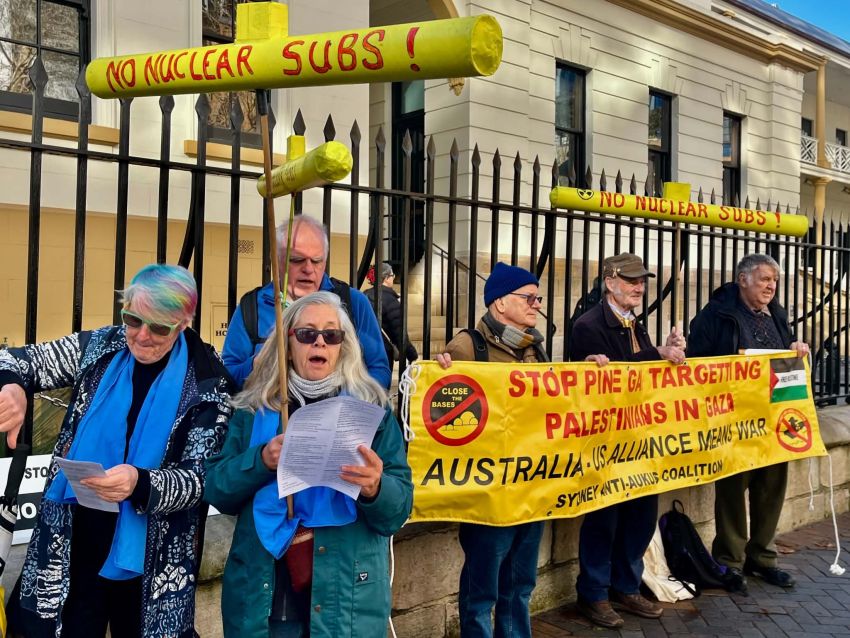
Former politicians and defence personnel, trade unionists and anti-war activists all argued against AUKUS at a day-long public inquiry, organised by the crowd funded Australian Peace and Security Forum, at NSW Parliament on August 10. Not one person argued it should be supported.
Former Coalition Prime Minister Malcolm Turnbull, who spoke first, said AUKUS “sacrifices sovereignty” to the US and it needs to “change course”.
Turnbull said that his predecessor Tony Abbott had wanted a military deal with Japan, upsetting US President Donald Trump, who demanded to know why the US was not Australia’s “preferred partner”. He described the mentality of MPs towards the nuclear-powered Virginia class submarines as a “cargo cult”, even though US Congress had warned several times it may not be able to deliver them, and criticised Labor for its lack of a “Plan B”.
AUKUS is a “good deal” for the US, Turnbull said, because of the sums Australia is sending to its shipyards. Asked about the threat, if any, that China poses, Turnbull said China is not pursuing a “Monroe doctrine” in “this hemisphere”.
The US submarines will likely carry nuclear weapons and HMAS Stirling in Western Australia is “more of a US base” than an Australian one, he added.
The highly enriched weapons-grade uranium in the nuclear warheads, which Australia is obliged to dispose of at the end of the submarines’ life in 20–30 years, presents another massive problem, Turnbull said. By contrast, the French and Chinese navies use low-enriched uranium, presenting a lower risk at disposal.
Bob Carr, former foreign minister and NSW premier, focused his remarks on how federal Labour could have removed Australia from AUKUS “without a rupture” because “Australian diplomacy could have pulled it off”.
He argued that Australia can have “long-range strike capacity with other weapons” and said MPs should adopt the same approach to China as Association of Southeast Asian Nations (ASEAN) countries have. “If they can deal with a powerful China, so can we,” Carr said, quoting approvingly a Singaporean official who said that they want the US “in the region” but “over the horizon”.
Officials from the Maritime Union of Australia (MUA), NSW Teachers’ Federation (NSWTF) and the National Tertiary Education Union (NTEU) spoke next. MUA deputy national secretary Warren Smith drew attention to the likely jobs deficit and the diversion of funds away from social and climate programs, including offshore wind. He said the MUA believes that security is “not advanced by militarism”.
NSWTF deputy president Natasha Watt and TAFE organiser Kelly Marks said the enormous funds being spent on AUKUS kept public schools underfunded and teachers underpaid, as well as living in housing precarity. Asked about the entry of defence programs into schools, they said the union was opposed.
Lachlan Clohesy, NTEU ACT division secretary and incoming NTEU national assistant secretary, said science had a “social responsibility” and the university educators were often fighting vice chancellors who view AUKUS as a funding source after the “historical underfunding” of the university sector.
Peter Murphy and Pip Hinman, from Sydney Anti-AUKUS Coalition (SAAC) spoke next, telling the inquiry that SAAC was endeavouring to unite a range of groups around three themes: No nuclear submarines; No war with China; and No to AUKUS. Murphy said its approach has been to talk about how the huge public funds “could be spent on the important environmental and social priorities”.
Hinman said it is hard to cut through the government and defence disinformation, but that people are increasingly wary of the US — for good reason. “The movement to stop political elites from their wasteful and dangerous allocation of public money to weapons of mass destruction faces huge challenges … but this inquiry is helping to bring people together to make it stronger.”
Professor Toby Walsh, an advocate for banning lethal autonomous weapons, told the inquiry that submarines as weapons are already being superseded by new technologies, and that we are “all less safe” without international guardrails on AI weapons.
Retired librarian Dr Alex Byrne argued that the “lion’s share” of Australian defence is captured by the US. He said Australian defence industry minister Pat Conroy is obfuscating over what to do with the nuclear waste.
Adjunct professor Jocelyn Chey, a former prominent Australian diplomat and academic who specialised in early Australian-Chinese relations, said AUKUS should be “scrapped” and that Australia needed “CBMs [confidence building measures] not ICBMs”. She said one CBM would be to pause military exercises in contested waters. She argued in relation to China that there needed to be “cooperation over containment”, and advocated more effect be spent on teaching more foreign languages, including Chinese, and increasing people-to-people contact.
Ian Dunlop, a former chair of the Australian Coal Association, now a part of the Australian Security Leaders Climate Group, told the inquiry that the rapid acceleration of climate change is the biggest security threat of our time and yet “peanuts” is going to climate science. He warned that emissions from the wars on Ukraine, Gaza, Lebanon and Iran, plus reconstruction costs in those countries, is making the problem worse. He said while the US is trying to undermine steps towards climate mitigation, China is leading the way. He warned against Australia being the “aircraft carrier for US ambitions in the Pacific”, saying Australia would need China’s expertise “to get on top of climate change”.
Others who addressed the inquiry included: Peter Hayes, a former RAAF group captain; Andrew Fowler, a former investigative journalist and now author; anti-nuclear activist John Hallam; Dr Con Costa; Michael Walker; Nick Deane, from Marrickville Peace Group; and Melanie Morrison, from the Sydney Peace Foundation.
[The inquiry started in Walyalup/Fremantle in June and has continued across Australia to the east coast, where it will finish in Magan-djin/Brisbane in next month. About 500 submissions have been sent — you can add yours here.]