
The following is an edited version of a talk given by Renfrey Clarke, a member of Socialist Alliance, at a Power of Activism event on March 8, presented by Adelaide progressives as part of Adelaide Fringe.]
* * *
How would I sum up Australia’s geopolitical situation? We’re in bed with an axe murderer. There’s no kinder way to describe the Donald Trump administration, now that it’s taken to practising “regime decapitation” in countries including Venezuela and Iran.
Meanwhile Australia’s military establishment, backed by our rich and powerful, are actively complicit with the head-choppers in Washington. The US submarine that torpedoed an Iranian warship off Sri Lanka recently had three Australian service personnel in its crew, fully embedded.
Not only that, the order to strike would almost certainly have been transmitted via the Harold E Holt Naval Communications Station at North West Cape in Western Australia.
The collection and processing of intelligence information that led up to the attack would have relied extensively on the Pine Gap Joint Defence Facility, near Alice Springs.
That gives you some idea of the background and purpose of the “AUKUS Trilateral Security Partnership” between Australia, Britain and the US, announced initially in 2021.
AUKUS, of course, is mainly about creating an Australian fleet of nuclear-powered attack submarines, fully interoperable with US and British boats. But, in a general way, the pact also signals a shift to an ever-tighter integration of Australia into US and British war-making.
The Scott Morrison Coalition government, in September 2021, abruptly ditched an agreement with a French consortium to jointly design and build 12 conventional subs for the Australian navy. By one account, the cost of shredding the deal came to $5.5 billion, including $830 million in compensation to the aggrieved French state.
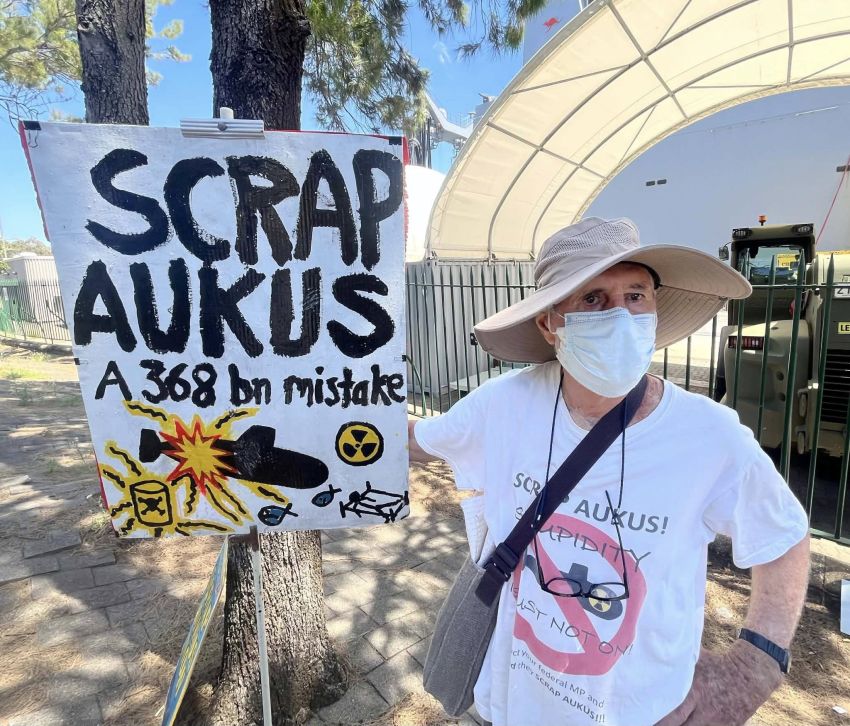
In place of the conventional subs, the Coalition government undertook to build eight nuclear vessels, working with US and British firms. The total cost is $368 billion over 30 years. The price for each submarine looks like being a staggering six times that projected for the deal with the French.
Why this act of financial self-harm, which the Labor government that was elected soon after had the chance to overturn but didn’t?
On the face of it, the conventional submarines being designed with the French were a good match for Australia’s stated defence needs — extremely quiet when running on batteries and difficult to detect even in relatively shallow waters, such as those of the North West Shelf. With the solid-state battery technology that’s now maturing, such vessels will soon be able to patrol for as long as 40 days without surfacing.
By contrast, nuclear subs are problematic in the Australian setting. Their reactors, which are always running, create significant noise and leave a heat “scar” that, in shallow waters, is easily detectable.
Nuclear submarines have virtually unlimited range and can stay submerged for months. But their cost is hair-raising and their highly enriched, bomb-grade fuel is likely incompatible with Australia’s nuclear non-proliferation obligations.
After their service life ends, the submarines have to be cut open and the ultra-dangerous reactor waste extracted and stored — effectively, forever.
Somehow, the need became to “defend” Australia, not in the waters off the Pilbara and Darwin, but in the South China Sea. Supposedly, it became necessary for Australia to join the US in “containing” China.
That required submarines to be able to operate many thousands of kilometres from home, lurking in remote waters until food for the crews ran low. If the designs and equipment matched US and British models, so much the better.
But why should Australia, and Britain for that matter, join the US in preparing to wage war on China?
That proposition rests on multiple layers of absurdity.
For a start, no reputable China scholar would ever agree that the Chinese government plans, or would conceivably plan, to attack Australia. China has direct land borders with 13 countries, to keep its foreign policy strategists preoccupied. Australia is far off in the opposite hemisphere.
Second, it’s just not true that the Chinese state thirsts for expansion. Anyone who suggests this is simply taking the aggressive compulsions of Western imperialism and projecting them onto a very different society and civilisation.
China’s central concern is to maintain a stable world order, which is better to carry on trading.
In Australia, meanwhile, we’re told that we need AUKUS to protect our trade routes — presumably against the Chinese. But China is our largest trading partner, by far. Further, it relies on Australia for most of its vital iron ore imports.
The “logic” of AUKUS is thus that nuclear submarines are needed so that Australia can join the US in menacing China from close offshore — so that China will refrain from starving its industry of ore imports and will be deterred from blocking the exports of cars and other manufactured goods through which it pays for Australian raw materials.
To most of us, that “logic” sounds like a pretty good definition of insanity.
So, what is the real reason for AUKUS?
This can’t be understood without a basic grasp of imperialism. That is the world system under which a small number of highly developed capitalist states — currently about 20, including Australia — siphon off unearned wealth from the countries of the Global South.
New statistics strongly indicate that without that flow of profits and rents, the imperialist countries would be in more or less permanent crisis and recession.
For the wealthy rulers of the imperialist countries, led by the US administration, defending the rip-offs is an existential necessity.
Imperialist countries have plenty of conflicts among themselves. But they’re united in opposing — violently when necessary — any attempts by non-imperialist states such as China, Russia or Iran to challenge their domination.
That’s why the US threatens China and tries to slow its economic growth and why Australia’s ruling class — despite the obvious contradictions — is close by Washington’s side.