
Government officials and bureaucrats are rushing to assure us that Australia stands by the “rules-based” order, even while our supposed closest ally breaks all of them.
Their message is that Australia must hang tight on AUKUS, despite growing misgivings about this secretive military pact with such a lawless and dangerous “ally”.
The British and United States governments have concluded their “reviews”, but we are unlikely to know much more than headline material, as they will not be made public.
While defence officials are sticking to the script, some former colleagues are warning about the military pact’s unreliability.
The latest is Philip Mathias, a former director of nuclear policy with the British defence ministry.
He told the January 12 Sydney Morning Herald that while British politicians do want to expand Britain’s military presence in the Indo-Pacific, “there is a high probability” that it would not be able to deliver because, it does not have enough of its own personnel.
Mathias, who oversaw Britain’s nuclear defence policy from 2005 to 2008, said Australia has shown “a great deal of naivety”. He accused it of not undertaking “due diligence on the parlous state of the UK’s nuclear submarine program before signing up to AUKUS — and parting with billions of dollars”.
He said there had been plenty of “grandstanding” over the past four years, “but very little substantive progress on actually developing the industrial base needed to build and support nuclear-powered submarines”.
“In a democracy, the public should be aware of the gross mismanagement of this hugely expensive and important program.”
US$2 billion handed over
In March 2023, Labor said Britain and Australia would deliver, from the late 2030s, a new class of nuclear-powered attack submarines — the SSN-AUKUS — with at least five to be built in South Australia. In the meantime, the US will fill the gap by selling Australia three second-hand Virginia-class submarines, for an undisclosed sum.
Australia has already handed over US$2 billion of the agreed $3 billion to upgrade US shipbuilding facilities — as part of the secret weapons deal. The US has told Australia the Submarine Rotational Force-West needs to be up and running by early next year to dock and service US nuclear submarines at HMAS Stirling.
They also agreed that, this year, Australia and the US would work on co-producing a hypersonic attack cruise missile — a first for Australia — as well as a short-range air-to-air missile.
Marles, US Secretary of War Pete Hegseth and Secretary of State Marco Rubio signed off on “maximizing” the expansion of “authorised exemptions” to streamline the weapons trade and bolster industrial bases for their manufacture.
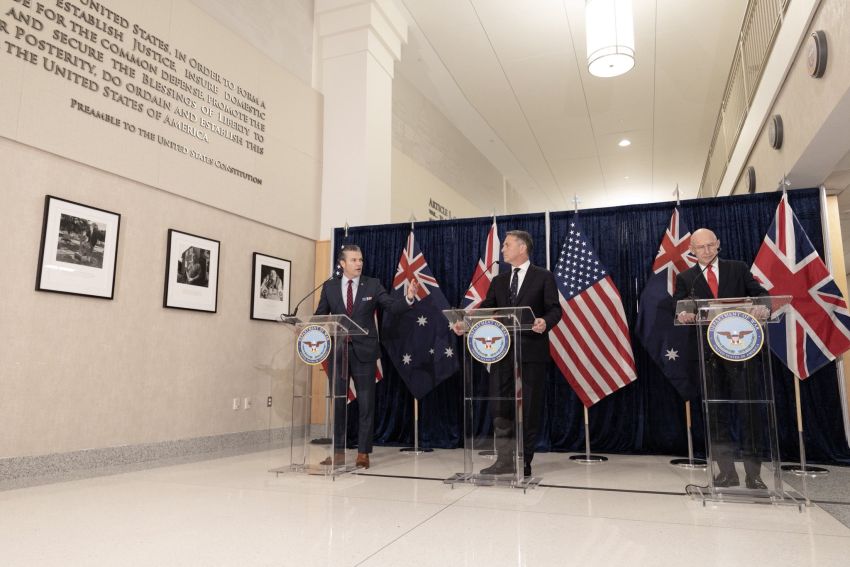
Defence minister Richard Marles remains wildly enthusiastic about the military pact. “Full steam ahead,” he repeated on December 11, standing alongside Hegseth and Rubio in Washington.
The Pentagon review of AUKUS, conducted by Elbridge Colby, called for changes, but those will not be made public. Colby is also on the record as saying the US cannot build submarines for Australia until it finishes building its own fleet.
Even arms industry expansion supporters, such former Coalition Prime Minister Malcolm Turnbull, want the US review to be made public before Australia hands over the next $1 billion. “To a lot of Australians, it looks like we’re paying money to the United States with no certainty at all of getting anything back for it,” he told the Australian Financial Review.
Marles claims that as it is a US review, Australia cannot make it public.
The real reason is that Labor has never consulted the Australian public about the AUKUS deal, nor did it agree to an Australian review when the motion was put forward by Greens foreign affairs spokesperson David Shoebridge.
The major parties know that AUKUS is very unpopular, and not just because Australia has not done its “due diligence”. Many see AUKUS as a vehicle for Trump to step up the US’ military presence in the Indo-Pacific, with its sights set firmly on China.
Containing China
As last November’s National Security Strategy of the United States of America underscored, US strategy in the Indo-Pacific is about “containing” China.
“America retains tremendous assets — the world’s strongest economy and military, world-beating innovation, unrivaled 'soft power' … that enable us to compete successfully," the document said. “Going forward, we will rebalance America’s economic relationship with China, prioritizing reciprocity and fairness to restore American economic independence.”
Trump’s goal is to “re-balance” the US’ trade relationship with China to ensure the US “remains on a growth path”.
He wants to use US military dominance to leverage this economic drive. The White House document lays this out bluntly: “Our ultimate goal is to lay the foundation for long-term economic vitality. Importantly, this must be accompanied by a robust and ongoing focus on deterrence to prevent war in the Indo-Pacific.”
It is also concerned to “focus on pressing” allies and partners to “allow the US military greater access to their ports and other facilities, to spend more on their own defense, and most importantly to invest in capabilities aimed at deterring aggression”.
It insists the US “harden and strengthen” its military presence in the Western Pacific. “In our dealings with Taiwan and Australia we maintain our determined rhetoric on increased defense spending.”
This is welcome news for Marles. But with the self-declared “President of Peace” waging wars, or threatening them, across the globe, it is cause for major concern for those who respect national sovereignty and international law.