
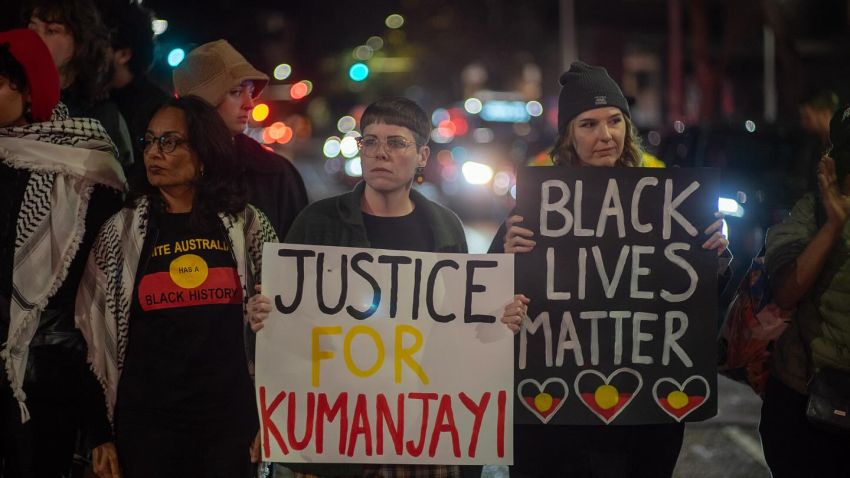
Northern Territory police announced on May 26 that the two police officers who wrestled 24-year-old Warlpiri man Kumanjayi White to the floor of an Mparntwe/Alice Springs supermarket will not be charged.
The police last year held White, a man with disabilities, in the prone position until he stopped breathing. It sparked protests for justice around the country.
The prosecutor flew to the remote community of Lajamanu that day to deliver the news to White’s mother’s family. NT Police Commissioner Martin Dole announced the decision the day before the one-year anniversary of the young man’s death.
Dole said that the NT Director of Public Prosecutions (DPP) had said there are “no reasonable prospects of a successful prosecution”, after an independent expert review, run by the Queensland Police, deemed the police’s use of force appropriate.
The case is closed, with the top cop saying the cause of White’s death is “equivocal”.
The announcement, delivered on National Sorry Day, continues on from a series of unjust decisions regarding the deaths of First Nations people in the NT.
White’s family is dumbfounded that two plainclothes police, who held their son down until he died over a misunderstanding about shoplifting in a Coles, can walk.
The family have been repeatedly denied updates on the case and now it is over with no explanation as to how White died.
‘Our trust is broken’
“Our hearts are breaking. We have no hope. When will we have our justice? How can we keep living like this? After this, how many of us will be crushed? Killed?” asked White’s mother’s family on May 26.
“We’ve been told by the DPP today that they are not charging any of those people who held down our son until he stopped breathing. What does this mean? We don’t know. They did not tell us why. They haven’t given us the insight. Does this mean that this deadly force is ‘reasonable’? That we can expect even more of this from you now?
“He was just in the supermarket. He hadn’t done anything wrong. Because the police aren’t charging these men, how can any of us feel safe in these places where we have to go?”
The family said the police prosecutor and other officers arrived at Lajamanu to deliver the news at short notice. They failed to take White’s father’s side of the family into consideration.
It happened as communities were dealing with sorry business, or grieving, over the recent killing of baby Kumanjayi Little Napanangka.
The family’s statement said the NT authorities’ decision to deliver the message without considering White’s family shows how they view First Peoples as “less than human”.
“Some of us have worked for decades in and with your criminal justice system, trying to work with you to find justice for everyone,” the statement continued. “Our trust is broken. There is no justice in your system. We are sick of being treated unequally. Yapa life has become about enduring your injustice.”
Guaranteed outcomes
It is not uncommon for police to hold people in the prone position, while applying the weight of their bodies until they die. There have been many cases of police officers holding Aboriginal people in this position until they stop breathing. However, this practice and outcome is not just confined to First Peoples.
White died in police custody. Since the Royal Commission into Black Deaths in Custody delivered its final report in April 1991, there have since been 634 more such deaths in police or corrections custody.
No charges have been laid against police involved.
The NT Country Liberal government did not initiate the racist and abusive approach to First Peoples by authorities but it has reinforced the biases by introducing numerous tough-on-crime laws to target First Nations people and especially their children.
NT police constable Zachary Rolfe’s killing of Warlpiri Luritja teen Kumanjayi Walker happened in 2019. Despite Rolfe having fired two shots into Walker’s rib cage while another officer was on top of him, a jury determined it did not constitute murder nor manslaughter. It was not even considered a “violent act causing death”.
Under NT Chief Minister Lia Finocchiaro’s watch, 24-year-old white man Jack Danby ran over two First Nations men in Garramilla/Darwin, killing 39-year-old Kunwinjku man Mr Whitehurst. Danby did not stop, but he only received a 12-month community correction order (CCO).
Police backing police
Aboriginal and Torres Strait Islander Social Justice Commissioner Katie Kiss condemned the decision not to lay charges for the death of White and the process of NT police investigating NT police.
“We support the calls from Aboriginal community leaders and justice advocates for justice sector reform. This case underscores the urgent need for governments to fully implement the recommendations of the Royal Commission,” said the Kaanju and Birri/Widi commissioner.
“Thirty five years on from the Royal Commission [into Aboriginal Deaths in Custody], many of its recommendations remain unimplemented.”
The NT Police Commissioner initially declined to answer questions about the autopsy and the cause of death because of the upcoming inquest into White’s death.
However, on May 27, Dole said the cause of Walker’s death remains unknown and it is a matter for the coroner to determine.
NT coroner Elisabeth Armitage, in mid-2025, said in her findings on the killing of Walker by then acquitted Rolfe that the NT police had “all the hallmarks of institutional racism”.
Gunnai Gunditjmara and Djab Wurrung Independent Senator Lidia Thorpe said she was “shattered” that neither of the NT Police officers who wrestled White to the ground in the confectionary section of a Coles would be charged. She said the struggle must continue, which includes getting the royal commission’s recommendations implemented.
“The police didn’t even have the decency to go through a respectful process to talk to the family,” she said. “No wonder people feel hopelessness. I’m starting to feel that hopelessness. Our people around the country feel this hopelessness, when no one is ever found accountable.
“When police investigate police there is never going to be an outcome. They’re a club. They protect each other.”
[Paul Gregoire writes for Sydney Criminal Lawyers, where this article was first published.]