
Ever since Western Australian-based Lynas Rare Earths set up the world’s largest rare earth refinery outside of China near the Malaysian city of Kuantan, it has faced strong community opposition based on well-founded concerns about the plant’s radioactive waste.
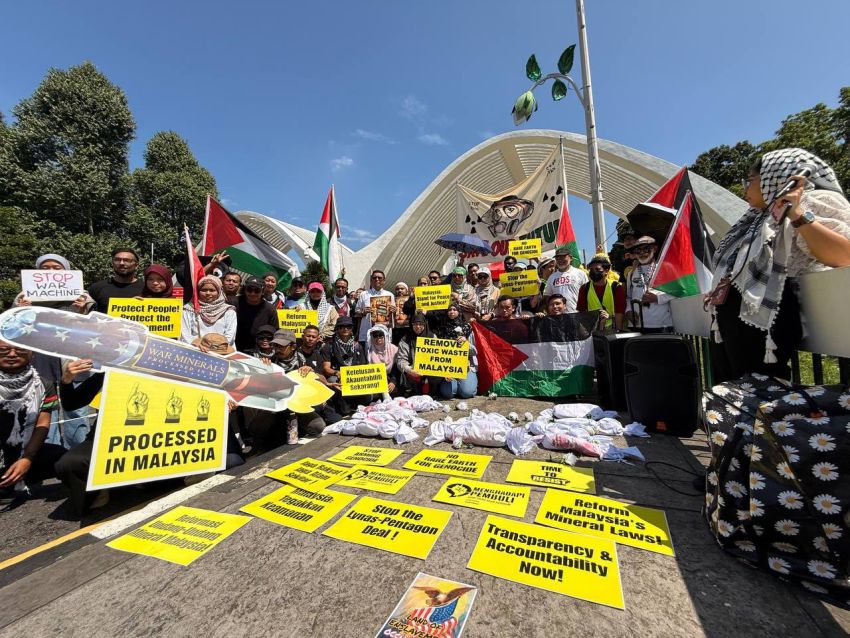
A broader coalition held a protest outside Malaysia’s parliament in Kuala Lumpur, on July 6, focusing on the company’s possible complicity in Israel’s genocide in Gaza.
A parliamentary special select committee began reviewing Lynas’ role in the United States’ defence supply chain, on July 16.
Using a pseudonym, Mikhaal, from the Malaysian Protest 4 Palestine (MP4P) coalition told Green Left: “While there is no direct link between Lynas and the Israeli military, a March 16 binding letter of intent signed between Lynas and the US Department of War puts Lynas squarely in the supply chain of the US military.
“And since the US have been supplying the Israeli military with billions of dollars worth of military aid — more so during the past three years — there is strong reason to suspect that Lynas products may be used to aid the genocide in Gaza.
“[Anti-]Lynas protests for the past decade have mainly been focusing on environmental concerns, that the plant produces radioactive waste that is detrimental both to health and the environment, but now Lynas has also signed a deal with the US military, potentially leading to killing of innocents, wars and genocides.
“The alliance has expanded to include groups that are pro-Palestine, anti-imperialist, anti-war and anti-genocide.”
The protest demanded that Lynas cancel the agreement to sell US$96 million (A$137 million) worth of rare earth oxides to the Pentagon and suspend all rare earth exports to the Pentagon, pending an independent investigation to ensure the deal’s consistency with Malaysian policy and law.
MP4P also called for the full public disclosure of end-use agreements and military supply chain audits for Lynas’ rare earth exports over the past decade. It called on the government to suspend Lynas’ operations and revoke its operating license until the company cancels its Pentagon deal.
Further, MP4P called for legislation “prohibiting any future rare earth exports from Malaysia when there is credible risk that they will be used in violations of international humanitarian law, including genocide, war crimes and crimes against humanity”.
It reiterated an earlier call by environmental groups for Lynas to strictly adhere to its original licensing condition to remove all radioactive water leach purification residue — a byproduct of rare earths processing — from Malaysia.
Protesters said any moves to expand Lynas’ operation in Malaysia should be blocked until the company properly adheres to its original licensing condition to protect public and environmental health.
They called on the government, which has been vociferous in its condemnation of Israel’s genocide in Gaza, to take “proactive diplomatic action through the UN Security Council and International Criminal Court to cut off other nations’ similar resources to Israel”.
“We have laid out the mechanism through which we can get the deal cancelled,” Mikhaal said.
“We have an Act that allows us to impose any condition as is necessary for any plant to be able to get their operating licence. So our suggestion in the parliamentary hearing is to include ‘not supplying rare earth to any foreign military’ as one of the conditions for their operating licence, and revoking their licence if Lynas can’t fulfil it.
“We hope that the government can take this course of action.”
Lynas has lucratively exploited Western military and strategic drives to reduce China’s dominant role in the production of rare earths and critical minerals.
Lee Tan, a policy coordinator and researcher with Aid Watch Australia who has been closely monitoring Lynas, told GL that the Pentagon has financed Lynas with more than US$350 million (A$500 million) in investment.
“In 2020, it awarded initial funding to Lynas and the Texas-based Blue Line Corporation for a heavy rare earths separation plant in Texas.
“Then in 2021, the Pentagon awarded Lynas a further US$30.4 million (A$43 million) to establish a commercial light rare earth separation facility in Hondo, Texas.
“In 2022, a US$120 million (A$171 million) contract was finalised to build a commercial-scale heavy and light rare earth processing facility in the US.
“Then in March 2026, Lynas and the Pentagon entered a US$96 million, four-year supply agreement to establish a guaranteed framework for heavy and light rare earth oxides.”
Tan’s research revealed that the Australian government has also provided a total of $34.8 million to Lynas and the Japanese government has provided close to half a billion in loans and equity for Lynas to date.
The specific rare earth materials that Lynas has agreed to provide the Pentagon for its military applications include:
Samarium (Sm): Recently commenced production. Samarium-cobalt magnets are used in high-precision weaponry, including components for F-35 jet fighters.
Dysprosium (Dy) & Terbium (Tb): Produced commercially since last year. These are critical additives that help high-performance magnets withstand high temperatures.
Neodymium & Praseodymium (NdPr): Supplied under a four-year, US$96 million Pentagon framework agreement. This combination is the standard for high-strength permanent magnets in military systems.
Lynas is also partnering with US-based magnet manufacturer Noveon Magnetics to produce permanent magnets that prioritise serving US military needs.
Lynas has also committed to expanding production of other elements such as gadolinium, yttrium, and lutetium within the next two years.
“These elements are essential for US weapon manufacturing,” Tan explained.
Activists in Malaysia are hoping that the parliamentary review will stop the Lynas-Pentagon supply agreement. However, if the Malaysian government does not match its anti-Israeli genocide rhetoric with its deeds, this campaign will be “a good public awareness campaign to highlight its hypocrisy”, Tan said.
“The new alliance formed between environmental activists and pro-Palestine groups was much needed, and it also helps to break down racial barriers that have long been an undermining factor for social movements in Malaysia”.
[An online petition to stop Lynas from exporting rare earth minerals for the Pentagon can be signed here.]