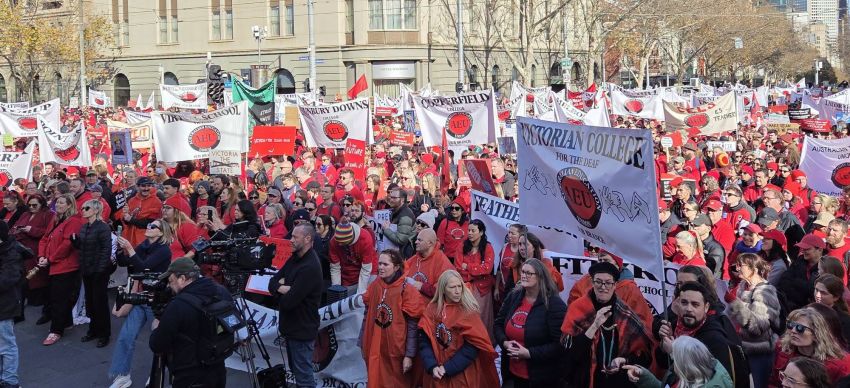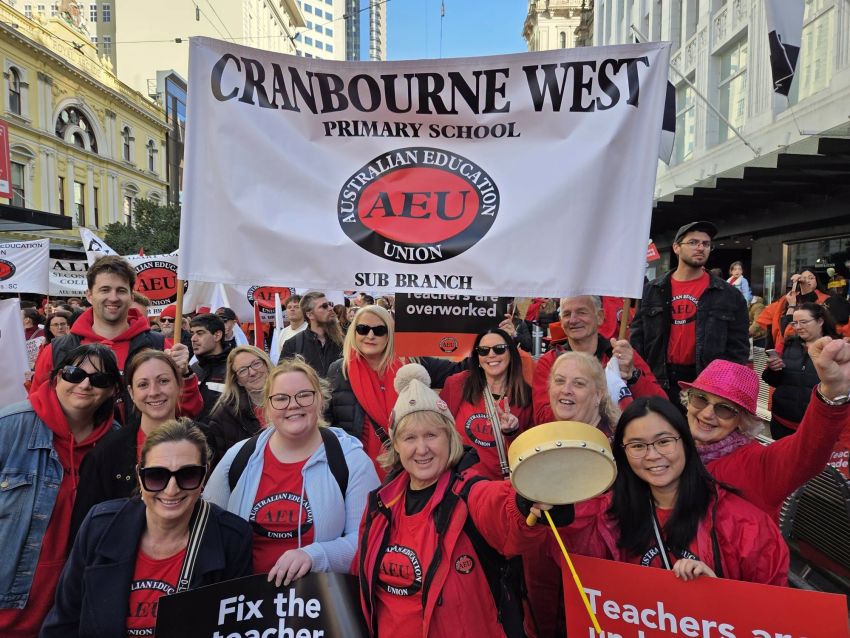
Up to 30,000 Australian Education Union (AEU) teachers and Education Support staff stopped work on July 23 to demand the Victorian Labor government make a better pay and conditions offer.
A sea of red AEU T-Shirts and ponchos jammed Bourke Street, right up to the Victorian Parliament, with banners showing the various schools and education work sites. Union members had come from regional areas, including Bendigo and Geelong, as well as from metropolitan schools. Many public schools were shut down.
Contingents from the Australian Nursing and Midwives Federation, Health and Community Services Union and the Community and Public Sector Union also came to show their solidarity with the AEU, along with a few Construction Forestry Mining Employees Union and Australian Manufacturing Workers Union members. Victorian Trades Hall Council provided marshalls and Luke Hilakari, VTHC secretary, joined the march.
This was the AEU’s second major strike over the government’s pay and conditions offer, after the March action drew at least 35,000 educators.
Unionists do not accept the Jacinta Allan government’s offer of a 28.3% pay rise over four years and less for ES staff, who were only offered temporary, non-compounding bonuses. ES staff, without which schools would not function, are paid as little as $56,580 a year and have no paid lunch break.
The AEU is demanding more allied health and well-being staff in schools, such as speech therapists and psychologists, as well as better working conditions and reversing the state’s chronic under-investment in government schools.
Teachers have long suffered under very heavy workloads, managed only by completing tasks in unpaid overtime. Studies show 90% of teachers report moderate to extreme stress, with depression and anxiety symptoms more than double national averages.
The AEU is also demanding smaller class sizes. While the AEU has long expected classes to be no larger than 25, there are many schools with classes way over this figure.
Smaller classes mean more individual attention for each student and effective class management. With more challenging student behaviour, caused frequently by inadequate support for students with learning difficulties class management for many educators has become very demanding.
Teachers also want less classes each week to have more time to prepare lessons, correct work and collaborate with colleagues. They would also have more time to respond to parents queries and report student progress.
These are the reasons why more than 50,000 AEU members voted, with 51.18% voting against the revised government offer. The AEU leadership was forced to call the second stop-work action, something it was reluctant to do as it had reached an in-principle agreement with the government. It had tried to convince members that the offer was satisfactory.
Justin Mullaly, AEU President, said on July 14 that industrial action was “necessary” as public schools are “the lowest funded in the country and associated workloads drive people out of the profession ... Just three in 10 employees expect to remain working public schools until retirement and report that excessive workloads are one of the reasons why they will leave.”
The confirmation and final call to proceed with the strike only went out to all schools on July 21 — just 48 hours beforehand. This did not give union representatives much time to organise, however the thousands of teachers and ES staff who stopped work to attend reinforced the high levels of dissatisfaction and anger.