
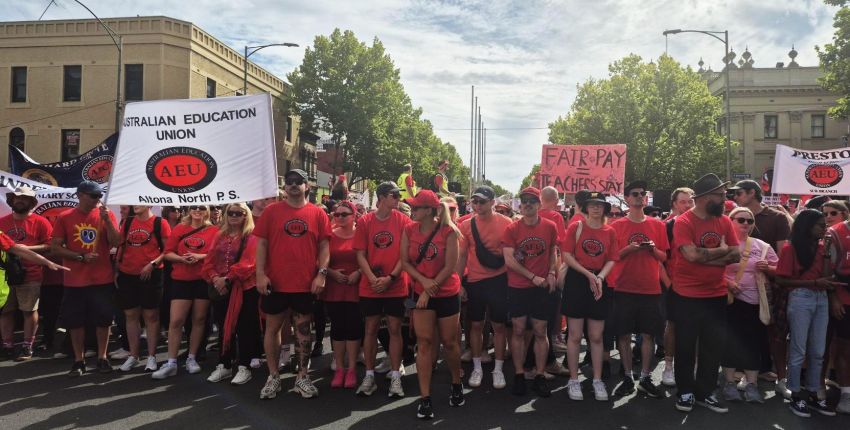
Victorian teachers and education support (ES) staff voted to reject Labor’s enterprise agreement offer on June 19, rejecting the Australian Education Union’s (AEU) advice to accept it.
Close to 58% voted to reject the Victorian government’s Schools In-Principle Agreement 2026.
It is the first time that rank-and-file unionists have rejected an AEU-endorsed agreement in more than 40 years. The result reflects widespread disagreement with the offer and signals that many educators will fight for a better one.
The statewide vote follows the AEU’s 24-hour strike on March 24; tens of thousands joined the union beforehand to participate in the campaign to demand significant improvements to wages and conditions.
In response, Labor increased its wages offer from 17% to 28% over four years. However, the revised proposal still falls well short of what is needed, given rising living costs and the absence of enforceable measures to address excessive workloads. It also restricted the right to take industrial action.
Many are frustrated by the process. MPs were publicly promoting the improved offer even before it had been presented to AEU negotiators. Shortly after, the union leadership suspended rolling half-day stop-work actions, which members had democratically decided on.
Bronwyn Jennings, a long-time teacher and unionist, told Green Left that many felt betrayed and angry by the union leadership’s shift from the original claim.
“The union argued that we needed 35% over three years to make up for the poor outcome of the last agreement and to get ahead of New South Wales. Then, it agreed to 28% over four years.”
ES staff were also unhappy, as the package relied heavily on allowances, rather than direct wage rises. “The ES pay offer is not really a pay rise,” Jennings said, adding many teachers voted against the deal in solidarity with the bad deal for ES staff.
The workload crisis, which is driving educators out of the profession, was another major factor prompting them to reject the agreement.
The proposed agreement contained different outcomes for different workers; only teachers at the top and bottom of the pay scale were going to receive pay rises that put them ahead of NSW.
Jennings said educators need enforceable workload protections and reductions in face-to-face teaching hours.
The decision to reject the agreement came after rank-and-file campaign groups, Fight the Crisis and Socialists in Schools, organised a grassroots “Vote No” campaign across schools and workplaces.
They produced leaflets and social media, and organised workplace discussions on the offer. Mathematics teachers analysed the wage calculations, while education workers spent weeks breaking down the deal’s implications.
AEU Joint Primary and Secondary Sector councillors from Fight the Crisis told a June 19 media conference outside the AEU Victorian branch headquarters that the proposal is “a real pay cut disguised as a pay rise”.
Lucy Honan, a dissenting AEU branch councillor from Fight the Crisis, said members want genuine caps on class sizes and wage rises and are prepared to take more industrial action to achieve this.
The Joint Primary and Secondary Sector Council has since decided to reject the government’s offer, restart negotiations with the Department of Education and survey members on industrial action.
The Victorian AEU Council discussed next steps on June 19. Motions calling for more strike action were defeated in favour of member surveys, including the “risks” of industrial action.
Rank-and-file unionists argue that the AEU leadership is failing to listen to members. Ohad Kozminsky said on June 19 that members want to “make sure we are heard” to “drive the direction of our union”.
Fight the Crisis is campaigning for school sub-branches to discuss a resolution for another statewide strike on August 4. Activists are pushing for as many sub-branch endorsements as possible before the next AEU State Council meeting on July 17.
Educators’ rejection of the Jacinta Allan government’s offer shows that they are sick of being undervalued.
Caitlin Wood, a primary school teacher of 11 years, said that she and her colleagues are “barely hanging in there” because besides being overworked and underpaid, they “just want better conditions for our kids and for us”.
“Everyone is burnt out and we need to make changes to improve our conditions. Parents know that our schools need funding and that we need conditions that let us educate.”
[Chloe DS is an education support worker, pre-service teacher and ES sub-branch representative.]