
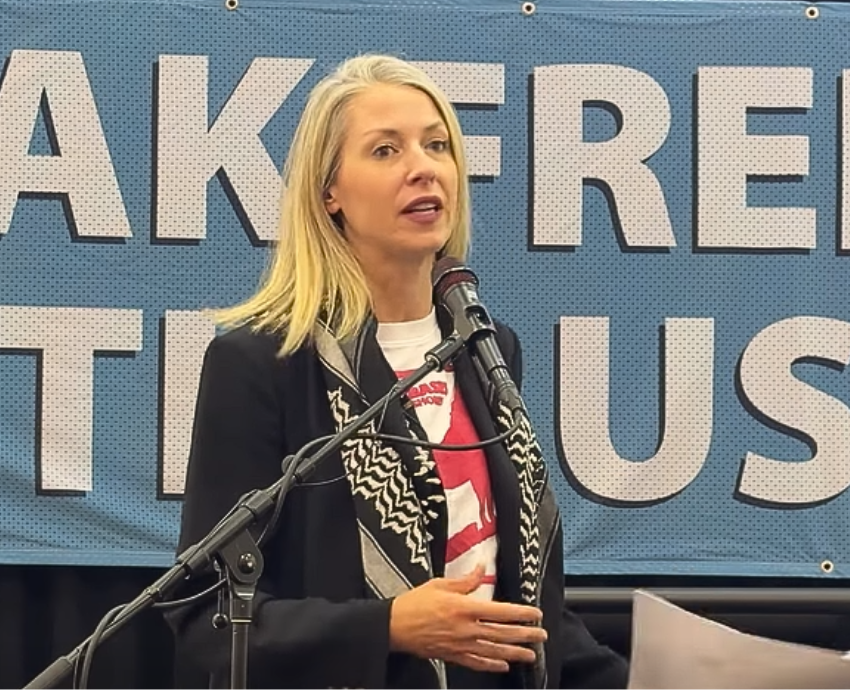
Activist journalist and filmmaker Abby Martin’s recent documentary, Earth’s Greatest Enemy, reveals the role of the United States military as the world’s largest institutional polluter, tracing the link between war, empire and ecological destruction.
Green Left’s Jordan Shukri AK Armaou-Massoud spoke with Martin, who recently visited Australia from the US to promote her film. Her tour coincided with a protest by Traditional Owners and anti-war activists at the joint US-Australian Pine Gap spy base, located on the traditional lands of the Arrernte people.
Under the Australian-British-US war pact, AUKUS, Australia has allocated $400 billion towards US imperialism’s agenda.
More recently, Australia has joined other nations in the rush to build hyperscale artificial intelligence data centres, some of which will have military applications.
Australia is enmeshed with US imperialism through the Pine Gap spy base, where companies such as Raytheon, Northrop Grumman, General Dynamics, IBM and HP have a presence.
Given all this, Martin told GL that Australia plays a crucial role in the US war machine, “even though it’s more invisible”, by “housing the main intelligence hub for US targeting in the Middle East”.
“Pine Gap is a central component in these atrocities,” Martin said.
Its role also extends to the Asia-Pacific region.
“Australia plays such a key staging ground for the US expansion and the Asia-Pacific encroachment, and we’re seeing that buildup today and the consequences of that buildup,” Martin said.
“Every [US] base is a dumping ground. I’ve seen it in Okinawa. I’ve seen it in Guam. I’ve seen it surrounding Australia.
“You guys are the second in line once these islands are destroyed. The US Navy calls those islands an unsinkable aircraft carrier.
“Australia is totally expendable to the US ruling class … and … even though the Australian ruling class probably feels like they have a gun to their head … [they] are basically putting a nuclear target on the back of Australia because you are folded into the crimes and atrocities of my government.”
Despite the role of US imperialism today, Martin told GL that the resistance to Israel’s genocidal war in Palestine and invasion of Lebanon, and the resistance to the US-Israeli war on Iran and blockade of the Strait of Hormuz, has been “incredibly powerful to see” and shows that the US “can only do so much with a military arsenal”, especially when it doesn’t “actually wield control economically like [it] used to”.
“[T]he smarter aspects of the [US] ruling class didn’t want to overextend and possibly impede US hegemony in the long run, but they couldn’t help themselves because Trump is a fucking madman and his is the chaos presidency … [E]very fringe element of the ruling class in the US [is] attaching their agenda and trying to ram it through, including the Iran war hawks.”
Martin said this overextension means the US empire could be brought to its knees “without firing a single shot”, and why the power of organised working people “is so integral to this equation”.
The US capitalist class and its governments have tried to co-opt the union movement for so long, Martin said, “because they know the power of us withholding our labour”.
“I think it shows you that they are losing ground. That’s why they’re so violent and so desperate, and that’s why the propaganda is so violent and so desperate because they know they’ve lost the public conscience.”
This is an age marked by intense crises of capitalism: wars, economic, societal and ecological crises. Yet capitalists rush headlong into destructive resource extraction; there is rising militarisation at home and genocidal wars abroad. All the while, the world’s poor, rural and indigenous peoples pay the heaviest price, especially in exploited countries.
Speaking to the interconnections between these crises of capital, and why internationalists should take up the fight for ecology and against imperialism, Martin said it has been “so frustrating for decades” to see “these struggles being isolated and siloed from each other”.
“[I]t was so obvious all along that the anti-war movement is integral to the environmental justice movement; that this is also a labour issue; that this is a human rights issue; that this is about the militarisation of the police.
“If there’s something to be said about the beautiful nature of the moment that we’re in, it’s how unpredictable it is. Because the unpredictability of this moment means that anything is possible from it.
“There is this burgeoning explosion of international solidarity that I’ve never seen in my life, which drives that undercurrent of the foundational understanding that was lost for so long: that capitalism is driving this, that capitalism is the problem; that all these contradictions that we see are an outgrowth of the capitalist system…
“[T]he military enforces this unsustainable global capitalist dictatorship at the barrel of a nuclear-armed gun, and every country that doesn’t bow to its dictates is threatened, bombed, couped, sanctioned.
“This is the world we live in today, and for the longest time, it’s been hidden right in front of our faces under the pretence of human rights and democracy.
“But now it’s lifted, and people see it for what it is: the naked exposure of neo-colonialism, hearkening back to Christopher Columbus...
“[W]e’ve been gaslit by the corporate media, and now people see the truth for what it is, and that makes anything possible.”
Martin makes a strong argument against “greening” capitalism or the military — both are hostile to the survival of our planet and humanity.
As a journalist, Martin has dealt with threats, doxxing and stalking, but continues to work, not giving in to attacks, which she puts down to meeting other activists around the world “being rooted in movement building and struggles for decades” and recognising that with freedom of speech and relative privilege comes responsibility.
“I am so motivated by all the people that are living in under the receiving end of the brutal violence and subjugation by my government … that continue to fight with every fibre of their being…
“As an American citizen with the First Amendment, with all the privilege in the fucking world, how dare I not?”
While these rights are being targeted in the US and Australia — and are having a “chilling effect” in activist and journalist communities — Martin argues that activists and journalists in the imperialist countries have a duty to do everything in their power to “do what we know is right”.
“Let's not be paralysed and think that we are we too will be targeted … we need to show solidarity with those people that are being oppressed.
“There is so much we can do, and I just encourage everyone to look inside themselves and ask, ‘What can you do? What can you do every single day with your privilege?’”
[Find out where to watch Earth’s Greatest Enemy here.]